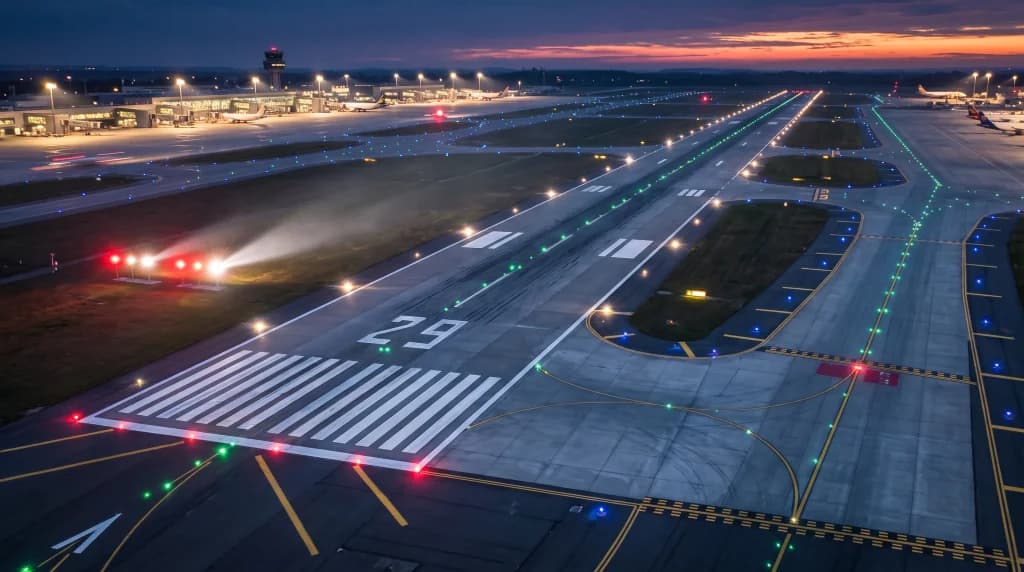
Runway and Taxiway Markings Explained: What Numbers, PAPI Lights, and Lines Mean to Pilots
Introduction: The Skyward Alphabet Painted on Asphalt and Concrete
When you gaze out an aircraft window while taxiing at an airport in Warsaw, Frankfurt, Munich, or Zurich, the pavement of the runway and taxiways looks like a giant chalkboard inscribed with a cryptic code. Oversized white numbers at the runway threshold, longitudinal zebra stripes, dashed yellow lines, strange ladder- and comb-shaped markings, and alongside them rows of dazzling white, red, green, and blue lights. To the untrained eye, it looks like pure abstraction—yet to the flight crew on the flight deck, every single stripe, paint color, and beam angle delivers critical information governing the safety of hundreds of people on board.
In commercial aviation, there is zero room for guesswork. When a 300-ton Boeing 777 or Airbus A350 approaches a runway in dense fog or taxis at night through the intricate labyrinth of a major international hub, pilots must know in a split second where the safe touchdown zone ends, where the boundary of an active runway lies, and whether their glide path is too shallow or too steep. Let's decode the most important pavement markings, airfield signs, and lighting systems across airports worldwide—all standardized under Annex 14 to the ICAO Chicago Convention.
Runway Threshold Numbers: How to Read a Runway's Magnetic Heading
The most recognizable feature of any runway (abbreviated in aviation as RWY) is the pair of giant two-digit numbers painted just past its threshold—such as 11 / 29 at Warsaw Chopin Airport, 07C / 25C in Frankfurt, or 11 / 29 in Gdańsk. What do these digits represent, and why do opposite ends of the exact same slab of concrete display completely different numbers?
These numbers indicate the magnetic heading (magnetic azimuth) toward which an aircraft is pointed during takeoff or landing, rounded to the nearest ten degrees with the final zero dropped:
- How is it calculated? If a runway is aligned along a magnetic heading of 112° (east-southeast), you divide that figure by 10 and round to the nearest whole number—yielding 11. By the same logic, a runway oriented toward 254° becomes 25, while a runway aligned due magnetic north (360°) is designated 36 (aviation never uses 00).
- Why do opposite ends always differ by 18? Because an aircraft can take off or land on the same runway from either direction (always into the wind), the magnetic headings of the two directions differ by exactly 180 degrees. Dropping the last zero yields a constant difference of 18. Consequently, if one end is numbered 11, the opposite threshold is always 29 ($11 + 18 = 29$), and Runway 07 at one end is Runway 25 at the other ($07 + 18 = 25$).
- The Letters L, C, and R Beside the Numbers: At major airports operating two or three parallel runways (such as Frankfurt, Munich, or Amsterdam Schiphol), letters are appended to indicate each runway's position from the approaching pilot's perspective: L (Left), C (Center), and R (Right).
Interestingly, because Earth's magnetic poles gradually drift over time (a phenomenon known as magnetic declination), airports must officially repaint their runway numbers every few decades—as occurred in Warsaw and at numerous airports across North America and Europe.
Anatomy of a Runway: Thresholds, Touchdown Zones, and Mysterious "Chevrons"
Paint color on an airfield conveys instant navigational meaning: all runway markings are white, whereas all taxiway and apron markings are yellow. Let's walk through the key markings a pilot sees through the cockpit windshield during final approach:
- Runway Threshold Markings: A row of longitudinal white stripes resembling a pedestrian crosswalk (zebra crossing) right at the beginning of the landing surface. The number of stripes is far from arbitrary—it tells the pilot the exact width of the runway (for example, 4 stripes denote a 60-foot / 18-meter runway, 8 stripes indicate 100 feet / 30 meters, 12 stripes signify the standard 150 feet / 45 meters, and 16 stripes indicate a massive 200-foot / 60-meter runway built to accommodate giants like the Airbus A380).
- Displaced Threshold: Occasionally, a paved section precedes the actual runway threshold and is marked with white arrows pointing down the runway centerline. This indicates that the pavement may be used for taxiing and for the takeoff roll, but aircraft are prohibited from touching down on it during landing (typically due to approach obstacles, noise-abatement procedures, or lower pavement load-bearing strength).
- Touchdown Zone (TDZ): The first 3,000 feet (900 meters) of runway beyond the threshold, marked by symmetrical pairs of rectangular white bars flanking the centerline every 500 feet (150 meters). The largest pair of wide rectangles positioned 1,000 feet (300 meters) past the threshold are the Aiming Point Markings—the exact target spot where pilots aim the main landing gear wheels while holding their stabilized approach speed ($V_{\text{APP}}$).
- Blast Pad / Stopway and Yellow Chevrons: Before the threshold or past the far end of a runway, you will often spot a paved overrun area painted with large yellow "V" shapes (chevrons). This surface exists solely to protect the ground from jet engine blast and serve as an emergency deceleration zone during a Rejected Take-Off (RTO). Taxiing, taking off, or landing on yellow chevrons during normal operations is strictly prohibited.
PAPI Lights: How Four Projectors Guide an Airliner Down the Ideal Glide Path
During landing—especially at night or in reduced visibility—judging height above the ground visually can be treacherous due to approach visual illusions caused by unusually wide or sloping runways. That is where an ingeniously simple optical system mounted beside the left side of the runway threshold steps in: PAPI (Precision Approach Path Indicator).
A PAPI unit consists of a horizontal row of four high-intensity light projectors aligned perpendicular to the runway edge. Each unit contains a precision optical lens with a red filter across the lower half of its beam, projecting white light above a specific angle and red light below it. Each of the four lights is angled slightly differently around the standard 3-degree glide path, allowing pilots to read their vertical profile in a fraction of a second:
- Four white lights: The aircraft is way too high above the glide path (above 3.5°).
- Three white lights, one red: The aircraft is slightly high (around 3.2°).
- Two white lights, two red: On the ideal 3.0° glide path—known in aviation parlance as being "on glide path."
- One white light, three red: The aircraft is slightly low (around 2.8°).
- Four red lights: The aircraft is dangerously low (below 2.5°)—requiring an immediate pitch-up or a go-around.
Pilots worldwide remember the rule with a classic mnemonic: "Two white and two red, you're dead on; four red, you're dead."
Taxiways and Hold-Short Lines: How Pilots Navigate Massive Airports Without Getting Lost
After vacating the runway, an aircraft enters the network of taxiways (TWY), guided by a continuous yellow centerline that the nose wheel tracks. At night, taxiway edges are outlined by distinctive blue edge lights, while the taxiway centerline is illuminated by flush green in-pavement lights—guiding pilots along the route like a glowing trail of breadcrumbs.
The single most critical safety marking on the ground, however, is the Runway Holding Position. It appears as a transverse yellow pattern consisting of two solid lines (on the taxiway side) and two dashed lines (on the runway side), paired with red mandatory-instruction signs displaying white lettering (such as 29-11) and a row of glowing red lights embedded across the pavement known as a Stop Bar.
Crossing a runway hold-short line or an illuminated red Stop Bar without explicit clearance from Air Traffic Control (TWR) ranks among the most serious violations in aviation, classified as a Runway Incursion—because it places an aircraft directly in the path of traffic actively taking off or landing.
Conclusion: A Precision Visual Language Protecting Every Flight
Every stripe, number, sign, and light fixture across an airport airfield reflects more than a century of refined aviation safety engineering. Because ICAO standards remain uniform whether you land in Gdańsk, New York, Tokyo, or Sydney, any airline crew can read an airfield layout flawlessly even in the most challenging weather.
So the next time you look out your window during final approach and spot four glowing lights beside the runway—two white and two red—alongside the approaching white stripes of the threshold, you can rest assured your aircraft is locked onto the exact glide path for a safe touchdown.