Airport Falconers: How Raptors and Patrol Dogs Protect Runways from Wildlife Strikes
Introduction: The Most Unexpected Crew at the Airport
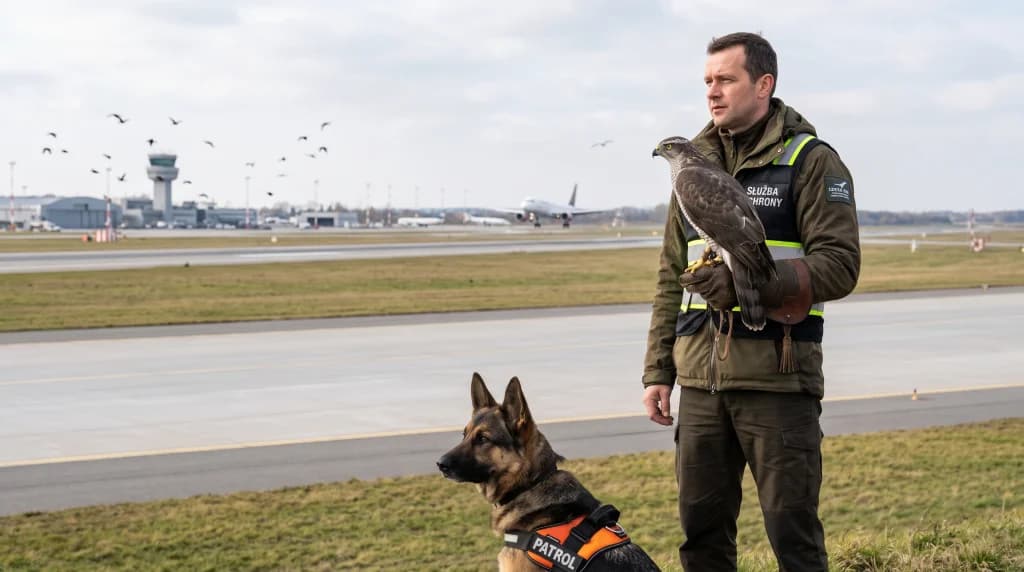
When we think of airport safety, images of advanced ground radars, Instrument Landing Systems (ILS), thousand-horsepower crash fire tenders, and seasoned air traffic controllers immediately come to mind. Few passengers gazing out a terminal window realize, however, that one of the most vital guardians protecting departing and arriving airliners is a handler wearing a heavy leather gauntlet with a peregrine falcon perched on their forearm and a patrol dog standing at their side.
In an era of artificial intelligence, deterrent lasers, and autonomous drones, airport falconry remains one of the single most effective defenses against one of commercial aviation's most persistent hazards: collisions between aircraft and wildlife, known across the industry as Bird Strikes and Wildlife Strikes. Why does modern electronics routinely lose out to the predatory instinct of a Harris's hawk, how are patrol dogs trained to work on an active airfield, and what does the daily battle to keep runways clear of wildlife actually look like?
The Physics of Impact: Why a Seagull or Hare on the Runway Is a Deadly Threat
To the casual observer, a collision between a 300-ton Boeing 777 or Airbus A350 and a three-pound seagull or mallard duck might sound like a minor nuisance. From a physics standpoint, however, it is a violent kinetic impact. Kinetic energy scales with the square of velocity ($E_{\text{k}} = \frac{1}{2}mv^{2}$). That means when an airliner accelerates down the runway toward its rotation speed ($V_{\text{R}}$) of roughly 160 to 185 mph (over 75 m/s), striking a 4.5-pound bird unleashes an impact force comparable to hitting a several-hundred-pound boulder.
The consequences of such an encounter can be severe:
- Bird Ingestion into a Turbofan Engine: Modern fan blades forged from titanium or carbon-fiber composites spin at thousands of revolutions per minute. Ingesting a large bird—or an entire flock of starlings—can shatter fan blades in a fraction of a second, trigger a compressor stall, spark an engine fire, and cause an immediate loss of thrust. That exact scenario unfolded in 2009 during the famous "Miracle on the Hudson" (US Airways Flight 1549), when a flock of Canada geese disabled both engines of an Airbus A320 moments after takeoff from New York's LaGuardia Airport.
- Damage to Airframe Skin, Radomes, and Cockpit Windshields: A strike during climb or final approach ($V_{\text{APP}}$) can dent a wing's leading edge, crush the weather radar nose cone (radome), or shear off Pitot tubes, depriving pilots of reliable airspeed readings.
- Ground Hazards from Mammals: Hares, foxes, roe deer, and even wild boars straying onto a runway pose a grave threat to landing gear during takeoff rolls and landing rollouts. Hitting a deer at 125 mph can collapse a main landing gear strut and send an airliner veering off the pavement.
According to statistics from the International Civil Aviation Organization (ICAO) and the U.S. Federal Aviation Administration (FAA), more than 20,000 wildlife strikes are reported worldwide each year, generating global repair bills and flight-delay losses exceeding $1.2 billion annually.
Why Technology Loses to Nature: The Problem of Habituation
Over the decades, airports have tested virtually every conceivable technological deterrent to disperse birds: propane gas cannons, loudspeakers blasting predator calls and avian distress cries, green-beam deterrent lasers, scarecrows, predator-eye balloons, and even radio-controlled model aircraft.
Every one of these devices suffers from the same fundamental flaw: habituation. Birds are remarkably intelligent and adaptable creatures. Within days or weeks, gulls, rooks, and lapwings figure out that a propane cannon fires every 15 minutes without ever harming anything, and that a recorded hawk screech from a loudspeaker is never followed by an actual predator in the sky. Birds have even been spotted calmly perching directly atop propane cannons and loudspeaker masts.
This is precisely where the airport falconer steps in. A live apex predator cannot be ignored or tuned out. To a flock of gulls or pigeons, the silhouette of a real falcon circling above the airfield triggers an unmistakable, life-or-death alarm hardwired by millions of years of evolution. Crucially, the goal of airport falconry is not to kill birds—in fact, hunting and feeding on prey near a runway is actively discouraged, since a distracted raptor eating on the asphalt could itself be struck by an aircraft. Instead, the falcon's mission is a deterrent presence patrol that drives flocks off the airfield in immediate panic and conditions local bird populations to recognize the airport as lethal hunting territory.
Winged Guardians of the Runway: Which Species Work at Airports?
Falconry units operating at major hubs—such as Warsaw Chopin Airport, Gdańsk Airport, Frankfurt, London Heathrow, Amsterdam Schiphol, and Madrid-Barajas—never rely on random birds of prey. Each species is selected for a specific tactical role matched to local weather, terrain, and problem wildlife:
- Peregrine Falcon (Falco peregrinus) and Saker Falcon (Falco cherrug): These are the airfield's high-altitude interceptors. Released by the handler, they climb steeply, circle high above the runway, and execute blistering mock stoops at speeds exceeding 150 to 185 mph. Their presence strikes terror into gulls, terns, pigeons, and ducks, clearing entire flocks from the airspace within a radius of several miles.
- Harris's Hawk (Parabuteo unicinctus): Native to the Americas, this hawk is a low-altitude special-operations specialist. As the only raptor species that hunts cooperatively in packs in the wild (much like wolves), it bonds effortlessly with both human handlers and patrol dogs. Harris's hawks operate close to the ground—between terminal buildings, beside hangars, and along drainage ditches—flushing starlings, jackdaws, rooks, rabbits, and hares.
- Northern Goshawk (Accipiter gentilis): An explosively agile short-range sprinter, indispensable in dense brush and wooded perimeters surrounding airport boundary fences.
Every working raptor wears a miniature telemetry transmitter (radio or GPS) clipped to a tail feather or leg. This allows the falconer to track their bird's exact position and altitude second by second, while the Air Traffic Control tower (TWR) maintains constant radio contact with the ground patrol—pausing raptor flights several minutes before any scheduled takeoff or landing.
Four-Legged Partners: The Role of Patrol Dogs on the Airfield
Complementing aerial falcon patrols are specialized airfield patrol dogs—most commonly Border Collies, Belgian Malinois, or pointers. Their job has nothing to do with sniffing for explosives or contraband inside the terminal; they are trained herders and trackers working strictly airside.
Drawing on its natural herding instinct, a Border Collie can silently and swiftly herd flocks of geese, gulls, lapwings, or plovers feeding on the grassy strips beside the runway, forcing them to take flight at the exact moment a falcon appears overhead. This coordinated dog-and-falcon team creates an inescapable pincer effect: birds feel unsafe both on the grass (where the dog pursues them) and in the sky (where the falcon waits). Patrol dogs also inspect perimeter fences for fox, badger, and hare burrows, detecting mammals hidden in tall grass long before human eyes could spot them.
Habitat Management: Why Airport Grass Must Be Kept at a Specific Height
The work of falconers and their animals forms one pillar of a broader Wildlife Hazard Management Plan (WHMP) mandated by EASA and ICAO regulations for every international airport. Airfield wildlife biologists work daily to make the airport environment as uninviting to animals as possible:
- The Long Grass Policy: Contrary to what passengers might assume, the grassy medians between runways and taxiways are not manicured like a golf course. Instead, grass is maintained at a strict height of roughly 6 to 10 inches (15 to 25 centimeters). Tall, dense grass prevents gulls, rooks, and starlings from spotting earthworms and insects while blocking their line of sight—birds avoid landing in tall grass because they cannot see an approaching fox or patrol dog on the ground.
- Eliminating Standing Water and Nesting Sites: Drainage ditches across the airfield are covered with netting or piped underground so they do not attract ducks and herons, while hangar roofs and approach light masts are fitted with anti-perching spikes and netting.
Conclusion: Nature and Technology Working Together for Flight Safety
Airport falconry is compelling proof that even in the world's most technologically advanced industry, the smartest solutions sometimes come straight from nature. The seamless coordination between an air traffic controller surrounded by digital radar screens, a falconer in a high-visibility vest, a peregrine falcon, and a Border Collie forms a multi-layered safety shield that keeps passengers taking off and landing safely around the clock.
The next time you look out your cabin window before takeoff across the grassy strips flanking the runway and spot an airfield SUV with an amber beacon alongside a raptor circling overhead, you are watching commercial aviation's most elite preventive unit in action.