No More Removing Laptops or 100 ml Liquid Limits? Why Airport CT Scanners Face Delays
Introduction: The Ritual That Has Frustrated Travelers for Two Decades
Anyone who has boarded a flight since 2006 knows the airport security checkpoint choreography by heart. While still inching forward in line, you unzip your backpack, pull out a clear one-liter zip-top bag filled with miniature 100 ml bottles of shampoo and toothpaste, remove your laptop, tablet, e-reader, and a tangle of charging cables and power banks, and spread everything across three or four plastic trays. Forget a small water bottle at the bottom of your tote or leave a camera tucked inside, and your bag gets shunted onto the secondary screening belt for a manual search—adding stress and bottlenecking the entire queue.
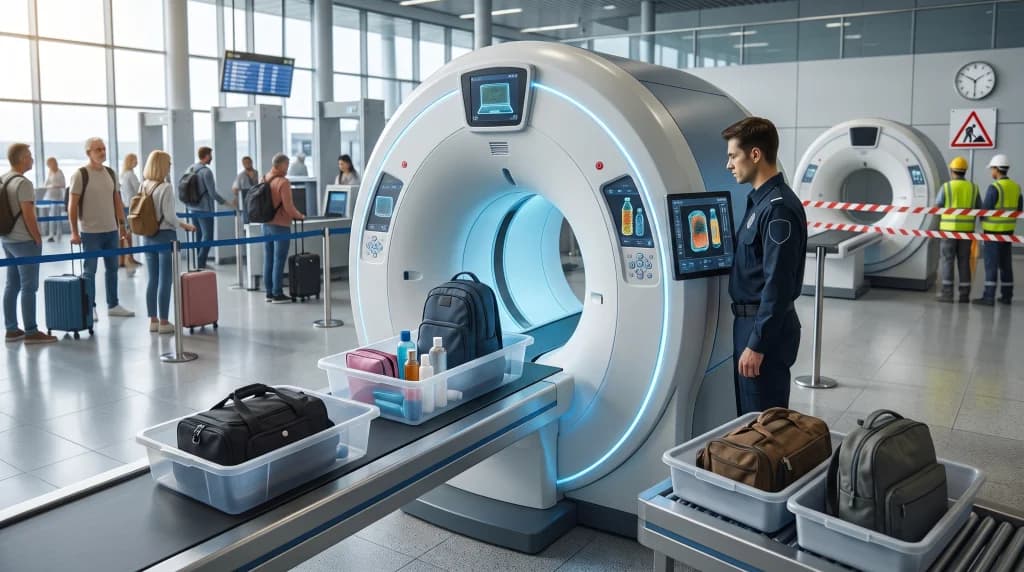
Next-generation Computed Tomography (CT) security scanners—derived from hospital diagnostic imaging and high-speed checked-baggage screening systems—promised to end that era for good. Major hubs and regional airports alike, including London City, Amsterdam Schiphol, Rome Fiumicino, Milan Malpensa, and Polish airports in Kraków, Lublin, Poznań, and Warsaw, began installing sleek, rounded machines resembling compact medical CT scanners, heralding the return of full-sized water bottles and the end of unpacking electronics. Yet in mid-2024, the European Commission unexpectedly hit the emergency brake, temporarily reinstating the 100 ml liquid limit even at airports equipped with the latest CT hardware. Why has rolling out CT scanners proven so complex technologically, regulatorily, and financially?
How Conventional X-Ray Scanners Work—and What Makes CT Scanners Different
To understand why passengers spent nearly twenty years pulling out laptops and rationing toiletries into 100 ml containers, it helps to examine the physics of legacy 2D X-ray checkpoint machines still operating at most airports worldwide.
The Limitations of Traditional 2D X-Ray Screening
A conventional X-ray tunnel projects a beam from one or two fixed angles (known as Dual View systems). On the monitor, the security officer sees a flat, two-dimensional shadow image of the bag's contents in which overlapping items obscure one another. A dense lithium-ion laptop battery or a large bottle of liquid creates a dark, opaque mass on screen—making it easier to conceal a detonator or thin sheet explosive underneath. Moreover, older 2D scanners measure only basic effective atomic density ($Z_{\text{eff}}$), meaning they cannot reliably distinguish everyday drinking water, perfume, or olive oil from liquid explosives such as hydrogen peroxide or nitroglycerin.
The 3D Revolution Inside CT Scanners
An airport CT scanner (manufactured by companies such as Smiths Detection, Rapiscan Systems, and Analogic) operates on the exact same principle as a hospital CT unit. Inside the tunnel housing sits a rotating gantry equipped with an X-ray source and an array of detectors that spins rapidly around the bag as it moves along the conveyor belt, capturing hundreds of cross-sectional slices in fractions of a second.
Sophisticated digital reconstruction algorithms assemble those slices into a complete, high-resolution 3D volumetric model of the bag's interior. Sitting at the workstation, an officer can use a mouse or touchscreen to rotate the virtual bag a full 360 degrees, zoom in on individual components inside a laptop, or virtually "strip away" outer layers of clothing to inspect beneath a smartphone battery or inside a flask. Crucially, CT systems perform real-time density and atomic-number analysis on every drop of liquid, automatically flagging a bag only when software detects the chemical signature of a prohibited explosive substance.
Why Did the European Union Reinstate the 100 ml Limit in 2024 Despite CT Scanners?
Many travelers were caught off guard when, starting September 1, 2024, airports such as Rome Fiumicino, Milan Linate, Amsterdam Schiphol, and Frankfurt—despite boasting brand-new CT lanes—put back signs enforcing a strict 100 ml cap per liquid container (known in aviation security terminology as the LAGs rule: Liquids, Aerosols, and Gels).
The decision was not triggered by any flaw in CT imaging physics itself, but rather by a software issue affecting explosive detection algorithms (EDSCB) in a specific C3-standard CT scanner configuration. Technical evaluations commissioned by the European Civil Aviation Conference (ECAC) and testing laboratories in the United States found that for very large liquid containers (exceeding 330 ml) and certain bottle geometries, the detection software exhibited higher-than-acceptable false-alarm rates or lacked full chemical classification certainty without time-consuming secondary checks.
The European Commission therefore enacted a precautionary measure: until updated detection algorithms were developed, tested, and recertified by ECAC across all C3 scanner manufacturers, the 100 ml limit had to be temporarily reinstated as an added security layer. Importantly, even while the temporary 100 ml cap remained in place, CT scanners still allowed travelers to keep all liquids, laptops, tablets, and cameras inside their carry-on bags—dramatically speeding up checkpoint throughput.
What Does the Upgrade Cost? Financial and Architectural Hurdles at Airports
Even once regulatory hurdles and software recertifications are fully resolved, replacing legacy equipment across every airport in Europe and around the globe will take years due to three major engineering and financial constraints:
- Massive Capital Costs: A single CT security lane paired with an Automated Tray Return System (ATRS) costs between $380,000 and $650,000 (€350,000 to €600,000)—several times more than a traditional 2D X-ray unit. For a major hub operating 20 or 30 screening lanes, that represents a capital investment running into tens of millions of euros.
- Weight, Footprint, and Floor-Load Limits: CT scanners are substantially larger, wider, and heavier than older machines. A single CT unit weighs between 1.8 and over 2.5 metric tons due to heavy lead radiation shielding and the spinning X-ray gantry. In many older passenger terminals (such as London Heathrow or Frankfurt), installing CT scanners on upper concourse levels requires costly structural reinforcement of reinforced-concrete floor slabs, expanded checkpoint halls, and upgraded electrical and HVAC infrastructure.
- Belt Throughput and Operator Training: During the initial months after deploying CT lanes, several airports experienced unexpected dips in hourly passenger throughput. While 3D imagery provides vastly superior threat detection, analyzing volumetric scans requires specialized training and takes several seconds longer per bag until officers master the new interface.
The Situation in Poland: Which Airports Lead CT Scanner Adoption?
Polish airports rank among Europe's early adopters in modernizing passenger security checkpoints. Lublin Airport became the first in Poland to deploy CT scanners, closely followed by Kraków Airport (Balice), which outfitted an entire bank of next-generation tomographic lanes and significantly reduced departure wait times. Additional deployments have been completed or are underway at Poznań (Ławica), Warsaw Chopin Airport, and Gdańsk.
During the transition period—until every lane at a given airport is equipped with a certified C3 CT scanner running updated software—screening procedures can still vary even within the same terminal depending on which queue airport staff direct you into.
Practical Traveler's Guide: How to Breeze Through Airport Security
To avoid unnecessary delays and secondary bag checks at the security belt, keep a few practical habits in mind whether you are departing from a major international hub or a smaller regional airport:
- Watch Signage and Staff Instructions Before Entering the Lane: At airports operating mixed infrastructure (some 2D X-ray lanes, some CT lanes), staff positioned ahead of the belt direct passengers and clearly announce whether laptops and liquids must come out or stay packed inside your bag.
- Be Mindful of Double-Walled Metal Flasks: Even inside CT scanners, thick vacuum-insulated stainless-steel bottles (such as Hydro Flasks) strongly attenuate X-rays, frequently prompting officers to pull the bag aside for a quick visual check.
- Keep Power Banks and Spare Lithium Batteries in Carry-On Only: Regardless of what scanner technology an airport uses, all power banks, spare camera batteries, and e-cigarettes must travel exclusively in carry-on luggage (never in checked suitcases), with individual capacities capped at 100 Wh (or up to 160 Wh with prior airline approval).
Conclusion: The Inevitable Future of Unpack-Free Air Travel
Although temporary regulatory setbacks in recent years cooled traveler excitement, the long-term trajectory of airport security is unmistakable. Computed Tomography CT scanners reconcile two goals that once seemed at odds: dramatically raising threat detection accuracy—protecting passengers far more effectively than aging 2D machines—while restoring comfort and speed to the airport checkpoint experience.
As manufacturers roll out recertified detection software and airports complete multimillion-dollar terminal upgrades, pulling out laptops and stuffing miniature toiletries into plastic baggies will soon become nothing more than a memory from an earlier era of flight.