Fiber-Speed Airplane Wi-Fi: How Starlink Is Transforming Internet Over the Oceans
Introduction: The End of the "Dead Zone" at 36,000 Feet
For the past two decades, internet access aboard commercial airliners was synonymous with technological frustration. Passengers paying dozens of dollars or euros for a Wi-Fi pass on a transatlantic route received a connection that, in practice, barely supported sending a plain-text WhatsApp message or slowly downloading emails without attachments. Streaming 4K video, joining a live video conference, or downloading large files from the cloud over the middle of the Atlantic or Pacific Ocean remained out of reach. Worse still, across polar regions and deep over open oceans, the signal frequently dropped out altogether for hours at a time.
That years-long stagnation in the in-flight connectivity (IFC) sector has been shattered by SpaceX's Starlink Aviation constellation. Deploying internet powered by thousands of satellites in Low Earth Orbit (LEO) has enabled passengers aboard carriers such as Qatar Airways, Hawaiian Airlines, United Airlines, Air France, and airBaltic to experience cruising-altitude speeds of 200–350 Mbps with latency under 40 milliseconds. It is a genuine breakthrough that transforms an aluminum-and-composite aircraft fuselage into a flying fiber-optic office.
Why Did Traditional Airplane Wi-Fi Work So Slowly?
To fully appreciate the revolution ushered in by Starlink, it helps to examine how legacy aviation connectivity systems operated. For years, the industry relied on two foundational architectures, each constrained by severe physical and geographic limitations.
1. Air-to-Ground (ATG) Systems – Coverage Strictly Over Land
Air-to-Ground technology (used by providers such as Gogo in North America and the European Aviation Network in Europe) functions much like cellular mobile networks. Antennas mounted on the belly of the aircraft communicate with upward-pointing ground cell towers. While this design offers relatively low latency, its flaw is fundamental: it works exclusively over land. The moment an airliner leaves the coast of Ireland or Newfoundland and heads out over the ocean, ATG connectivity cuts out instantly.
2. Geostationary Satellites (GEO) – The 22,236-Mile Distance Trap
On intercontinental and transoceanic routes, airlines historically relied on massive geostationary satellites operated by companies like Inmarsat, Viasat, and Intelsat. These satellites orbit directly above the equator at an altitude of 22,236 miles (35,786 kilometers) above Earth's surface. While this orbit keeps the satellite fixed above a single point on the globe, it creates two formidable physical bottlenecks:
- High Signal Latency: A radio signal traveling at the speed of light must journey from the aircraft up to GEO orbit, down to a ground gateway station (teleport), and then back along the exact same path—covering nearly 90,000 miles (over 140,000 kilometers) round-trip. The resulting physical data travel time (ping) sits at a minimum of 600–800 milliseconds, rendering smooth video calls, online gaming, and responsive remote desktop work practically impossible.
- Bandwidth Bottlenecks and Polar Dead Zones: A single GEO satellite must serve dozens of aircraft simultaneously, dividing finite bandwidth among thousands of passengers. Moreover, because GEO satellites sit above the equator, their beams cannot reliably reach latitudes above 75–80 degrees—resulting in total internet blackouts on polar routes (such as flights between Europe and Japan or the U.S. West Coast).
The LEO Revolution: How Starlink Aviation Works at 36,000 Feet
Starlink abandoned the paradigm of isolated, distant satellites in favor of a dense constellation of more than 6,000 (and ultimately tens of thousands of) compact satellites operating in Low Earth Orbit (LEO) at an altitude of just 340 miles (550 kilometers)—roughly 65 times closer to Earth than geostationary satellites.
Optical Space Lasers (Inter-Satellite Links)
The defining innovation enabling Starlink to blanket the middle of the Pacific, the Atlantic, and the North Pole with high-speed coverage is its optical laser mesh network in space. Conventional LEO satellites require both an aircraft and a fiber-connected ground gateway station to sit simultaneously within the satellite's footprint. Out over the mid-ocean, however, no ground stations exist.
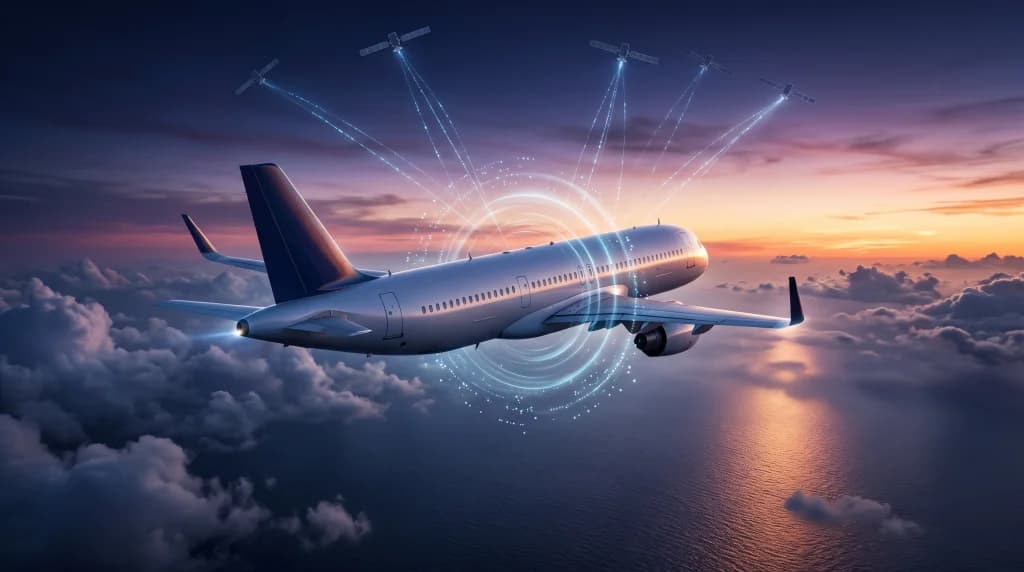
Next-generation Starlink satellites carry optical space lasers that transmit data directly from satellite to satellite through the vacuum of space at the speed of light—even faster than terrestrial fiber-optic cables, where light slows by roughly 30% inside glass. When an airliner cruises over the middle of the Atlantic, its fuselage antenna beams a Ku/Ka-band radio signal up to a satellite passing 340 miles overhead. That satellite relays the data packets via laser links across a chain of neighboring satellites until reaching one positioned over the European or North American coastline, which then downlinks the traffic into terrestrial internet infrastructure. The entire round-trip takes just 20–40 milliseconds.
Electronically Steered Phased Array Antennas
Mounted atop the aircraft fuselage is a low-profile, flat Starlink Aero Terminal. Unlike older mechanical dish antennas housed beneath bulky, drag-inducing radomes, the Starlink terminal uses phased array technology. Featuring zero moving mechanical parts, the antenna steers its radio beam electronically in fractions of a microsecond—seamlessly handing off connections from one satellite to the next every few seconds as both aircraft and orbital constellation hurtle past each other at tremendous speeds. Its sleek, aerodynamic profile also minimizes air resistance, translating into tangible fuel savings for airlines.
A New Business Model: Free High-Speed Wi-Fi for Every Passenger
Starlink's arrival has triggered a domino effect across commercial aviation not only technologically, but commercially as well. SpaceX introduced an airline pricing structure designed to make high-speed internet completely free for every passenger on board—from economy class to first class, with no data caps and no intrusive advertisements.
Hawaiian Airlines and regional carrier JSX pioneered the rollout, swiftly followed by global industry heavyweights. Qatar Airways began equipping its widebody Boeing 777 and Airbus A350 fleets with Starlink, letting travelers stream 4K content and play online games mid-ocean. United Airlines announced an unprecedented commitment to install SpaceX terminals across its entire fleet of more than 1,000 regional and mainline aircraft, offering complimentary access to MileagePlus loyalty members. Air France, airBaltic, and Air New Zealand have charted similar fleetwide rollouts.
What Ultra-Fast Connectivity Means for Flight Safety and Operations
While passengers celebrate seamless Netflix streaming and lag-free Zoom calls, high-bandwidth LEO connectivity carries major operational benefits for flight crews and airline safety:
- Real-Time Weather Data: Pilots using Electronic Flight Bag (EFB) tablets can download continuously updated high-resolution radar imagery, jet stream maps, and live Clear Air Turbulence (CAT) reports transmitted by aircraft flying ahead—even over the center of the Pacific.
- Engine Telemetry and Predictive Maintenance: Modern turbofan engines (such as the GE9X or Rolls-Royce Trent XWB) generate gigabytes of diagnostic telemetry on every flight. Continuous broadband connectivity streams engine health parameters to ground engineering centers in real time, allowing mechanics to meet the aircraft at the gate with a replacement part ready before touchdown.
- In-Flight Telemedicine: Should a passenger suffer a sudden medical emergency over the ocean, cabin crew can establish a high-definition video link with on-call ground physicians, transmitting live onboard electrocardiogram data and often avoiding costly, unscheduled emergency diversions.
Challenges and Limitations: Does the System Have Weak Spots?
Despite its remarkable capabilities, Starlink Aviation still faces regulatory and certification hurdles. Aviation regulators—such as the FAA in the United States and EASA in Europe—require a separate Supplemental Type Certificate (STC) for each specific aircraft model and fuselage variant (individually for the Boeing 737-800, 737 MAX, Airbus A321neo, or Boeing 777-300ER), as antenna installation modifies airframe skin structures and aircraft electrical wiring.
National telecommunications regulations present a second constraint. Several countries require local regulatory licenses (Landing Rights) before satellite terminals may transmit within their sovereign airspace. Consequently, onboard terminal software must automatically toggle transmitters on or off using real-time GPS coordinates whenever an airliner crosses into the airspace of nations that have not yet granted regulatory approval.
Conclusion: A New Standard in Air Travel
Starlink Aviation has accomplished for in-flight connectivity what fiber-optic broadband achieved for home internet years ago—transforming an expensive, temperamental, sluggish service into a reliable, high-speed everyday utility. For modern travelers, the final digital barrier separating ground and sky has vanished: a long-haul flight from Warsaw to New York or Doha to Sydney no longer means disconnecting from the world.
Over the next few years, complimentary, ultra-fast Wi-Fi powered by Low Earth Orbit satellites will become as standard in commercial aviation as seatback entertainment screens and pressurized cabins. The era of "No Internet Connection" alerts over the middle of the ocean is rapidly becoming aviation history.