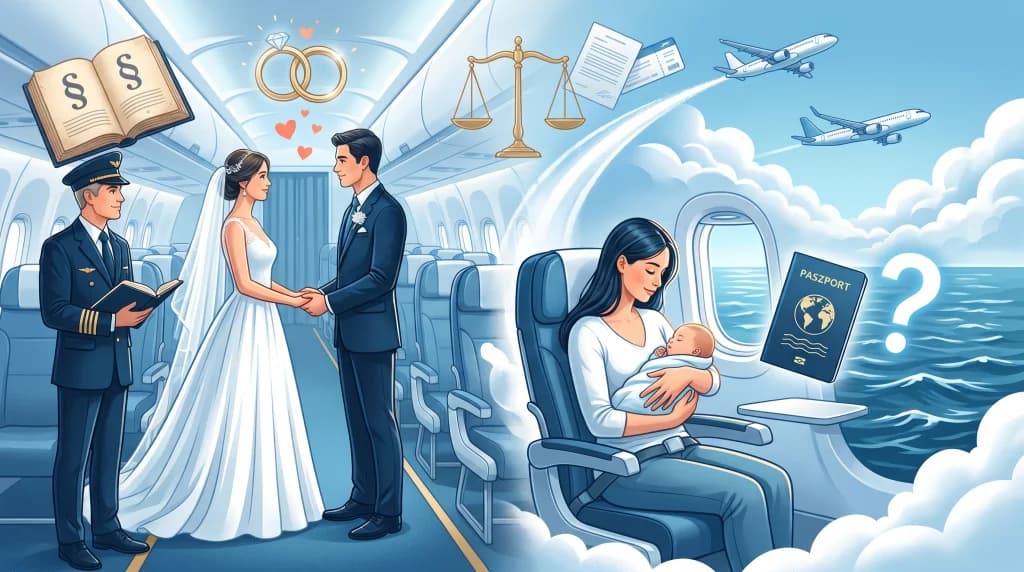
Weddings and Births on Airplanes: What Law Applies at 36,000 Feet?
Introduction: A Mid-Air No-Man's-Land and a Fascinating Clash of Laws
When a commercial airliner reaches its cruising altitude of 36,000 feet over the middle of the Pacific or Atlantic Ocean, it leaves behind national administrative borders and enters airspace above international waters (the High Seas). Inside this sealed, pressurized metal cylinder hurtling forward at over 560 miles per hour, an entire human drama can unfold within a matter of hours. Passengers fall in love, take part in romantic ceremonies, give birth mid-flight, get into disputes, and occasionally—tragically—pass away. Every one of these events triggers immediate, complex legal questions: whose law applies inside the cabin?
Popular culture has woven countless myths around this subject. Many travelers believe that an aircraft captain—much like sea captains of the age of sail—wields virtually unlimited authority in the clouds: able to officiate weddings, perform baptisms, arrest passengers, and issue binding civil records, while a baby born over the ocean automatically receives the citizenship of the airline's home country or a lifetime of free flights. The legal reality in civil aviation, however, is far more intricate. The fate of a newborn or the validity of a mid-air marriage is governed by international treaties such as the 1944 Chicago Convention, the 1963 Tokyo Convention, and the complex conflict-of-laws rules of individual nations.
Can an Airline Captain Officiate a Wedding? Myths vs. Reality
The widespread belief that an aircraft commander can legally join a couple in matrimony stems directly from romantic maritime tradition. Centuries ago, during multi-month ocean voyages, ship captains indeed held extraordinary legal powers born out of prolonged isolation from land (though even today, aboard most commercial vessels, that authority is heavily restricted or abolished outright). When passenger aviation emerged, travelers naturally projected those maritime notions onto airline captains.
Under modern aviation law, the answer is unequivocal: an airline captain does not hold the authority of a civil registrar and cannot perform a legally binding marriage. Neither the Chicago Convention nor national aviation statutes grant an aircraft commander the legal power to solemnize marriages. If a captain were to pronounce marriage vows over the cabin Public Address (PA) system, the ceremony would be purely symbolic and social, carrying zero legal weight once the aircraft touches down.
How a Legal Wedding Aboard an Aircraft Actually Works
Despite the captain's lack of legal authority, fully valid weddings do take place in the skies—provided specific legal conditions are met:
- An Authorized Officiant or Clergy Member on Board: The most straightforward way to contract a valid marriage mid-flight is to bring aboard a licensed civil registrar, judge, or ordained clergy member who holds legal jurisdiction over the territory directly beneath the aircraft at the moment vows are exchanged. Airlines such as EasyJet, Virgin Atlantic, and Air New Zealand have hosted such ceremonies by precisely calculating the moment the flight crosses the airspace boundary of the authorizing state or county.
- Flying Through a Marriage-Friendly Jurisdiction: In certain U.S. states (such as Nevada or Colorado), laws governing marriage officiants are notably flexible, making it easier to conduct a legally valid ceremony while flying through that state's airspace—provided the couple has obtained a valid ground-issued marriage license beforehand.
- Law of the State of Registration (Flag Law): Theoretically, if the domestic law of the country where the aircraft is registered permitted a captain to officiate a marriage under extraordinary circumstances (such as an imminent threat to life—a marriage in extremis), the union could be recognized. In modern commercial aviation, where flights last at most a dozen or so hours, such scenarios simply do not arise.
Born at 36,000 Feet: Which Passport Does a "Skyborn" Baby Receive?
Whereas an in-flight wedding is always a carefully planned event, an onboard childbirth is almost invariably a dramatic race against time. Although airlines enforce strict travel rules for expectant mothers (typically requiring a medical clearance certificate, MEDIF, after 36 weeks for a single pregnancy or 32 weeks for multiples, and prohibiting travel altogether past 38 weeks), several dozen babies are born aboard commercial flights around the world each year.
Determining the nationality of a mid-air newborn (referred to in legal circles as a Skyborn) is a fascinating legal puzzle governed by two foundational principles of international law: right of blood (Jus Sanguinis) and right of soil (Jus Soli).
1. Right of Blood (Jus Sanguinis) – The Primary Foundation
The vast majority of countries worldwide—including Poland and nearly all of Europe and Asia—follow the principle of Jus Sanguinis. Under this rule, a child inherits the citizenship of their parents regardless of where on Earth (or at what altitude above sea level) they are born. If a Polish citizen gives birth aboard a LOT Polish Airlines flight over the mid-Atlantic, the newborn acquires Polish citizenship by operation of law. On the birth certificate, the place of birth is typically recorded as the city where the aircraft subsequently lands or the geographic coordinates accompanied by a notation indicating birth aboard an aircraft.
2. Right of Soil (Jus Soli) – When the Territory Below Matters
The legal picture becomes far more intriguing when an aircraft is flying through the airspace of a country that practices unconditional birthright citizenship (Jus Soli), such as the United States or Canada. According to the U.S. Department of State's Foreign Affairs Manual, the airspace above U.S. land territory and its territorial waters (extending 12 nautical miles offshore) forms an integral part of the United States. Consequently, a baby born aboard any airliner flying over U.S. territory at the moment of delivery automatically becomes a U.S. citizen, even if both parents are foreign nationals merely transiting between Europe and South America.
By contrast, if the birth occurs over international waters (such as the middle of the Atlantic Ocean) while en route to the United States, the outcome is entirely different. U.S. law explicitly clarifies that a U.S.-registered aircraft flying over the high seas is not considered U.S. territory within the meaning of the 14th Amendment to the Constitution. In that scenario, the child does not acquire U.S. citizenship by virtue of birthplace alone.
3. Aircraft Registration Law and the Convention on the Reduction of Statelessness
What happens in the rare edge case where a baby is born over the open ocean and the laws of the parents' home country do not automatically confer citizenship (for example, due to strict residency rules governing children born abroad)? Here, a legal safety net under the 1961 UN Convention on the Reduction of Statelessness comes into play. Under Article 3 of the Convention, birth aboard an aircraft is deemed to have occurred in the territory of the state where the aircraft is registered. If the airliner bears the registration marks of a contracting state, that nation is obligated to grant the newborn citizenship so the child does not become stateless.
The Myth of Lifetime Free Airline Tickets
Contrary to persistent urban legends, airlines do not automatically award lifetime free tickets across their global network to babies born on board. Across aviation history, only a handful of isolated publicity gestures—such as those by Thai Airways, Asia Pacific Airlines, or Polar Airlines—have granted a child complimentary travel until adulthood or a commemorative gift. From an airline's operational standpoint, an in-flight birth is not a marketing opportunity, but a high-stakes medical emergency that frequently forces the captain into a costly unscheduled diversion and the dumping of tens of tons of fuel.
Jurisdiction in the Clouds: Who Rules the Cabin Under the Tokyo Convention?
What if, rather than welcoming a new life, a flight is disrupted by a physical altercation, theft, or severe panic attack threatening flight safety? That is where the 1963 Tokyo Convention (on Offences and Certain Other Acts Committed on Board Aircraft), ratified by nearly every nation on Earth, governs the response.
Under its provisions, primary criminal jurisdiction over acts committed aboard an aircraft rests with the state of aircraft registration. If you fly aboard a Lufthansa jet registered in Germany (tail registration beginning with D-A...) from France to Spain, German criminal law applies inside the cabin. At the same time, the Tokyo Convention grants the aircraft commander special law-enforcement powers:
- From the moment all external doors are closed following embarkation until any door is opened for disembarkation, the captain has the legal authority to impose reasonable physical restraint (including onboard plastic flex-cuffs from the aircraft's Restraint Kit) upon any unruly passenger whom the commander reasonably believes is jeopardizing flight safety, good order, or fellow travelers;
- The captain is empowered to disembark that passenger at any airport along the route and hand them over to the local law-enforcement authorities of the landing state—even if that nation is neither the state of aircraft registration nor the offender's country of citizenship.
When a Passenger Passes Away Mid-Flight: Procedures and Legal Realities
The final, most solemn aspect of aviation law is the death of a passenger in flight. Because only a licensed physician can legally pronounce a person dead (and a doctor is not always among the passengers), an individual whose vital signs cease mid-flight is often treated from a formal legal standpoint as alive until the aircraft lands and an airport medical examiner or coroner steps aboard.
In such situations, cabin crew follow strict, compassionate protocols: the deceased passenger is discreetly moved to an empty row of seats away from other travelers, a crew rest area, or near a galley (never inside a lavatory, as the body cannot be properly secured there for landing), covered respectfully with a blanket, and fastened with a seatbelt. The official death certificate is subsequently issued by the civil authorities of the country where the aircraft lands, recording the place of death based on the geographic coordinates logged in the captain's flight journal.
Conclusion: A Floating Island of International Law
A modern commercial airliner is far more than a mode of transport—it is a floating island of international law gliding through the stratosphere, where the jurisdictions of the state of registration, the overflown country, the state of landing, and the nationalities of everyone on board intersect. While a captain cannot legally marry you over the Atlantic, and being born above the ocean will not hand a newborn a stack of passports from every country along the route, the framework of international aviation treaties operates with remarkable precision. Thanks to these rules, even seven miles above the Earth and far from any shoreline, no one ever travels in a legal vacuum.