Thefts at 33,000 Feet: How Organized Pickpocket Gangs Operate on Airplanes
Introduction: A False Sense of Security Beyond the Checkpoint
Most airline passengers regard an aircraft cabin as one of the safest places on Earth. This belief has a solid psychological foundation: to step aboard, every traveler must pass multi-layered identity checks, document verification, and thorough baggage screening by airport security personnel. Inside a sealed, pressurized fuselage cruising at 33,000 feet, there are no crowds of random passersby, and a would-be offender has nowhere to run—police and border control await at the arrival gate. Consequently, travelers lower their guard: they stow backpacks containing cash, luxury watches, and jewelry in overhead bins, close their eyes, put on noise-canceling headphones, and drift into a deep sleep for hours.
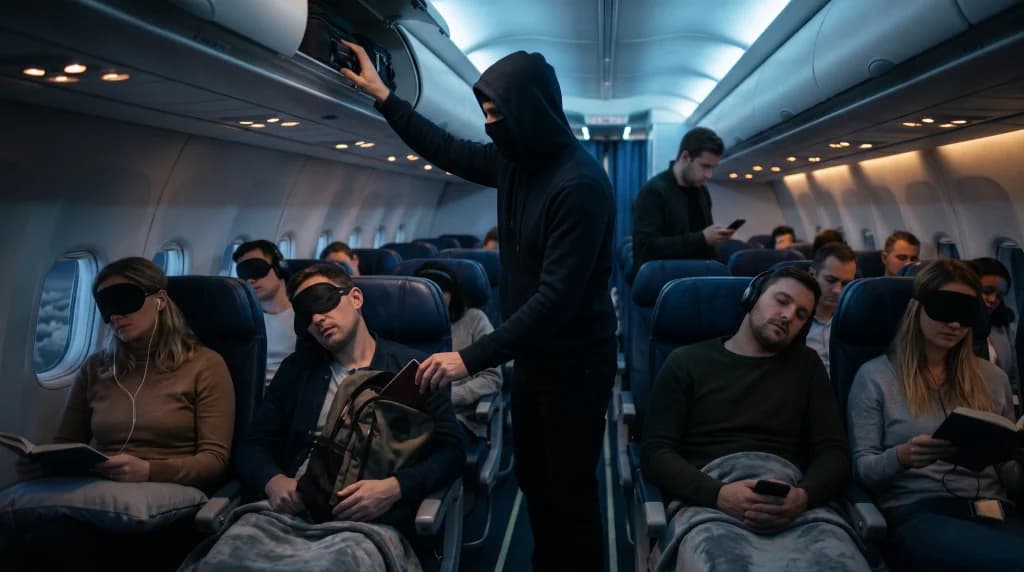
Yet for highly specialized international criminal syndicates, a commercial airliner is an ideal operating environment. In-flight theft has escalated to an industrial scale in recent years. Along routes connecting major transit hubs across Asia, Europe, and the Middle East, organized gangs of airborne pickpockets purchase regular airline tickets solely to systematically rifle through fellow passengers' carry-on luggage during overnight flights. They operate silently in the dim glow of a darkened cabin, relying on sharp behavioral psychology, transit logistics, and an intimate understanding of cabin crew routines.
Anatomy of an Airborne Gang: Who Targets Passengers and Where?
In-flight thefts are rarely the work of isolated, opportunistic individuals. Reports from international law enforcement agencies—including Interpol and specialized airport police units in Hong Kong, Singapore, Dubai, Paris, and Zurich—consistently indicate that organized crime rings orchestrate the majority of these thefts. For their members, flying is treated like structured shift work.
Preferred Routes and Flight Profiles
Criminals do not choose flights at random. Their primary targets are overnight medium- and long-haul sectors where passengers fall asleep shortly after takeoff and cabin crew dim the main cabin lighting following the initial meal service. Routes linking affluent financial and tourist centers in Southeast Asia (Singapore, Hong Kong, Bangkok, Kuala Lumpur) with Europe and the Middle East are particularly vulnerable, as are busy intra-Asian trunk routes operated by widebody aircraft such as the Boeing 777, Boeing 787, and Airbus A350. High passenger density in both economy and business cabins ensures that movement in the aisles appears routine and attracts little suspicion.
Why Business Class Is a Prime Target
Contrary to popular assumption, a premium ticket does not insulate passengers from theft—in fact, it often increases exposure. Business class offers substantially greater privacy: high partitions surrounding modern enclosed suites (such as Qsuite or Apex Suite configurations) shield the seat area from the view of neighboring passengers and passing flight attendants. Premium travelers frequently carry large sums of foreign currency, remove expensive mechanical watches before sleeping, and pack high-end electronics. Thieves readily invest in business class tickets knowing that a single successful haul from two or three overhead compartments can yield many times the cost of their airfare.
Modus Operandi: How a Heist Unfolds in a Darkened Cabin
Airborne pickpockets almost never work alone. A typical operational cell consists of two to four operatives who deliberately book seats in separate sections of the same cabin, giving no indication to the crew that they know one another. Their operation follows a tightly choreographed sequence:
- Phase 1: Surveillance During Boarding. While standing in the boarding gate queue and taking their seats, "spotters" scan for promising targets. They watch for travelers wearing designer attire or luxury timepieces, paying with thick wads of cash at duty-free shops, or anxiously checking a specific carry-on bag as they place it into an overhead bin.
- Phase 2: Strategic Seating and Bag Placement. An operative intentionally places their own small, nearly empty backpack or cabin trolley inside the exact same overhead bin as the targeted victim—ideally two or three rows ahead of or behind the victim's seat. This prevents the target from directly seeing the bin door open right above their head.
- Phase 3: Striking During the Quiet Window. The theft typically occurs in the middle of the night, roughly two to three hours after departure, when most passengers are asleep and flight attendants are stationed in the galleys or taking scheduled breaks in the Crew Rest Compartment (CRC). The thief stands up, opens the bin, and pulls down their own bag alongside the victim's backpack—or screens the open compartment with their body and an unfolded jacket or blanket.
- Phase 4: Searching and Staging the Loot. In many cases, the perpetrator carries the victim's bag into an aircraft lavatory, locks the door, and within seconds removes cash from the wallet (often leaving a few bills behind so the victim does not immediately notice the missing money upon landing), takes jewelry or payment cards, and then returns the bag to its exact spot in the bin. Meanwhile, an accomplice seated several rows away monitors the aisle and gives a prearranged signal—such as a cough or switching on a reading light—if a crew member approaches.
- Phase 5: Dispersing the Stolen Goods. Stolen cash and valuables are swiftly passed among syndicate members seated in different rows. Even if a victim wakes up early, discovers the theft, and alerts the crew, searching the primary suspect's carry-on will turn up nothing—the stolen items are already tucked inside an accomplice's pocket ten rows away.
Why Airborne Thieves Are So Difficult to Catch
From a law enforcement standpoint, in-flight thefts present severe jurisdictional and evidentiary hurdles. Criminal syndicates understand the gray areas of international aviation law and exploit them systematically:
- No CCTV Cameras in Passenger Cabins: Despite widespread assumptions, commercial airliners do not have surveillance cameras monitoring passenger seating areas or overhead bins due to strict passenger privacy regulations and aviation certification standards. Cameras are typically restricted to the area outside the flight deck door and occasionally galley zones.
- Delayed Discovery of the Theft: Time is a thief's greatest ally. Passengers rarely inspect the contents of a wallet stowed overhead just before touchdown. Most travelers realize they have been robbed only in the arrivals hall, at a currency exchange counter, or inside a taxi on the way to their hotel—an hour or more after deplaning. By then, the perpetrators have already cleared immigration or boarded an onward connecting flight.
- Jurisdictional Complications (The Tokyo Convention): When a theft is reported mid-flight, the captain can request police to meet the aircraft upon arrival. Under international aviation law, however, legal jurisdiction over offenses committed aboard an aircraft falls to the state of aircraft registration or the state of landing. When a citizen of Country A steals from a citizen of Country B aboard an airliner registered in Country C while flying to Country D, initiating criminal prosecution and detaining suspects without catching them red-handed can prove procedurally complex.
How Airlines and Police Fight Back Against In-Flight Pickpockets
In response to rising incident reports, airlines and airport security authorities have rolled out targeted preventive and investigative measures. At major transit hubs—including Singapore Changi, Hong Kong, Dubai, and London—dedicated aviation police units analyze Passenger Name Record (PNR) data for suspicious booking patterns, such as last-minute one-way tickets purchased in cash or individuals flying back and forth multiple times a week with no checked luggage.
Many carriers now train cabin crew in behavioral detection techniques. Flight attendants are briefed to watch for passengers who repeatedly get up at night to open multiple overhead bins, scan the cabin nervously, or relocate bags mid-flight. If an in-flight theft is reported before landing, the captain can coordinate with ground authorities to conduct customs and police screenings of all disembarking passengers directly inside the jet bridge before anyone can disperse into the terminal.
Golden Rules of Protection: How to Secure Your Belongings Aloft
While airlines continue refining onboard security protocols, ultimate responsibility for valuables carried into the cabin rests with the passenger. Adopting a few straightforward habits reduces the risk of falling victim to airborne pickpockets to near zero:
- Keep High-Value Items on Your Person: Cash, credit cards, passports, jewelry, watches, and compact electronics (smartphones, storage drives) should never be placed in an overhead bin. Keep them in a slim waist pouch worn beneath your sweater or inside a small personal item tucked directly under the seat in front of you—positioned so no one can slide it out without waking you.
- Use the Opposite Overhead Bin: If you must store a laptop backpack in an overhead locker, place it in the bin across the aisle (facing your row) rather than directly above your own seat. That way, the compartment door remains directly within your line of sight every time you glance up.
- Secure Your Zippers: A small TSA-approved combination padlock or even a simple carabiner clipping two zipper pulls together serves as an effective deterrent. A thief operating in a darkened cabin has only seconds to open a bag discreetly—having to wrestle with a locked zipper forces them to abandon the attempt immediately in search of an easier target.
- Take Precautions Before Sleeping: If you plan to take sleep medication or wear an eye mask during a long overnight sector, loop the strap of your personal bag securely around a seat leg or your own wrist before drifting off.
Conclusion: Staying Vigilant Above the Clouds
Air travel is a time for rest, excitement ahead of a vacation, or quiet focus before important business meetings. Unfortunately, for organized criminal networks, those same hours inside a closed cabin represent an opportunity for rapid, silent profit at the expense of unwary fellow travelers. Recognizing that airport security checkpoints screen solely for prohibited items—not the criminal records or intentions of fellow passengers—is the essential first step toward safer flying.
Treat an aircraft cabin with the exact same caution you would exercise at a crowded railway station or aboard an overnight express train. Taking thirty seconds before takeoff to move your passport and cash into a small pouch beneath your seat ensures that even if the most seasoned airborne pickpocket boards your flight, they will walk off empty-handed while you arrive at your destination without an unwelcome detour to the airport police station.