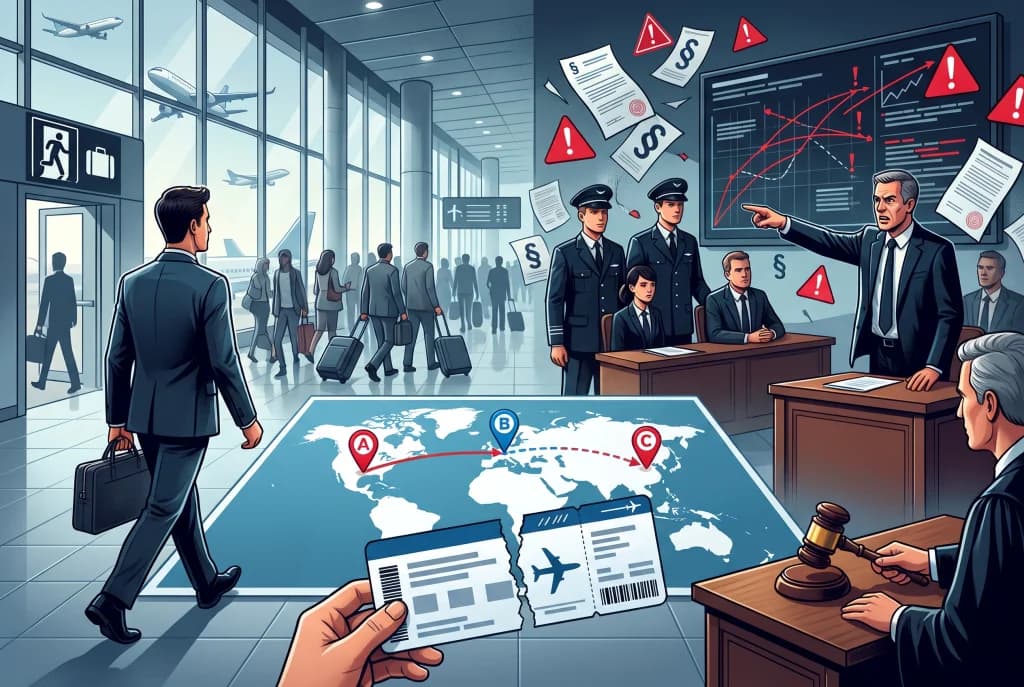
Hidden City Ticketing (Skiplagging): How It Works and Why Airlines Sue Over It
Introduction: The Most Disliked Trick in Commercial Aviation
In the realm of sophisticated revenue management algorithms utilized by modern airlines, the price of a ticket rarely correlates with the physical distance flown or the cost of jet fuel consumed. Travelers have long observed baffling pricing anomalies: a direct economy ticket from Warsaw to Frankfurt might retail for $450, whereas a flight on the exact same route—aboard the same aircraft on the very same day, but with an onward connection from Frankfurt to New York or Madrid—is priced at a mere $240. To the average flyer, this appears to be an illogical quirk. To savvy fare hunters, it is a systemic loophole ripe for exploitation.
This practice is known as Hidden City Ticketing, widely referred to in travel parlance as skiplagging. It involves purchasing a multi-segment ticket solely to disembark at the connecting airport (which is the passenger's true intended destination) and intentionally abandoning the final leg of the itinerary. While common sense suggests a consumer has every right to forfeit a portion of a service they have fully paid for, airlines view skiplagging as a direct threat to their pricing architecture. So much so that major carriers—from U.S. giants like United Airlines and American Airlines to Europe's Lufthansa—have waged an aggressive legal battle against the practice, filing multimillion-dollar lawsuits against both booking platforms and individual passengers.
Anatomy of a Pricing Paradox: Why Connecting Flights Cost Less Than Direct Ones
To understand why airline reservation systems generate fares that incentivize skiplagging, one must examine the Hub-and-Spoke network model that underpins legacy carriers.
Major airlines funnel passenger traffic through massive connecting hubs such as Frankfurt, Munich, London Heathrow, Atlanta, or Chicago O'Hare. On nonstop routes feeding directly into their primary hub, a carrier often holds a dominant or near-monopolistic market position. Corporate travelers flying from Warsaw to Frankfurt or Krakow to Munich prioritize convenience, schedule frequency, and direct access over price. Pricing algorithms recognize this low price elasticity and set point-to-point nonstop fares at steep premiums.
The competitive landscape shifts dramatically on connecting itineraries, such as flying from Warsaw via Frankfurt to Lisbon. On this city pair, Lufthansa competes not only against direct flights from rival carriers, but also against Air France (connecting in Paris), KLM (connecting in Amsterdam), and low-cost operators. To attract travelers willing to endure an inconvenient layover, fare algorithms aggressively discount the bundled Warsaw–Frankfurt–Lisbon itinerary. Consequently, the Warsaw–Frankfurt segment priced as part of a longer journey costs a fraction of the identical seat on the exact same flight booked as a standalone ticket. Skiplagging simply leverages this pricing asymmetry: Frankfurt becomes the "hidden city" where the passenger terminates their trip.
The Golden Rules of Skiplagging: How It Works in Practice
Executing a Hidden City Ticketing strategy requires strict adherence to several non-negotiable operational rules. A single procedural misstep at the airport can unravel the itinerary and expose the traveler to steep fare recalculations or lost luggage.
- Carry-On Luggage Only: This is the foundational rule. Checked baggage tendered at the origin airport is tagged through to the final ticketed destination. If a passenger exits at the layover airport, their suitcase will either continue onward without them or trigger an emergency offload from the cargo hold for security compliance (Positive Passenger Bag Match), delaying the flight and drawing immediate scrutiny from airline security personnel.
- One-Way Bookings Exclusively: Airline reservation systems enforce strict sequential coupon usage. The moment a passenger fails to board the final segment of a one-way itinerary, the system automatically flags them as a No-Show and cancels all remaining segments on that Passenger Name Record (PNR)—including the entire return journey—without refund.
- Omit Frequent Flyer Numbers: Attaching a Miles & More, Flying Blue, or AAdvantage account number to a skiplagged reservation provides the airline with an instant audit trail. Carriers routinely cross-reference traveler histories and may forfeit accrued miles or terminate loyalty accounts for repeated violations.
- Avoid Transit Countries with Strict Visa Controls: If booking an itinerary connecting through a country that requires transit or destination entry visas, check-in agents at the origin airport will verify travel documents against the ticketed final destination rather than the intermediate city where the traveler intends to walk out of the terminal.
Carriers vs. Flyers: High-Profile Legal Battles
For years, skiplagging remained an insider tactic discussed primarily on niche aviation forums. That changed in 2014 when 22-year-old software developer Aktarer Zaman launched Skiplagged.com—the first consumer-facing search engine engineered to automatically uncover Hidden City fare gaps. The airline industry's response was swift and uncompromising.
United Airlines and Orbitz vs. Skiplagged
In late 2014, United Airlines and online travel agency Orbitz filed a joint lawsuit against Zaman, seeking damages for unfair competition and the promotion of contract breaches. Notably, a federal court in Chicago dismissed the suit on jurisdictional grounds, while a crowdfunding campaign supporting Zaman's legal defense generated widespread publicity and drove tens of thousands of new users to the platform.
Lufthansa Sues Its Own Passenger
Europe's most prominent legal showdown occurred in 2019. Lufthansa sued a passenger who booked a business class ticket from Oslo via Frankfurt to Seattle, and on the return leg disembarked in Frankfurt, skipping the final flight to Norway. The airline demanded over 2,112 euros in fare adjustments—representing the exact price difference between the connecting itinerary and a nonstop flight between Germany and the United States. While a lower court in Berlin initially dismissed the claim due to ambiguous wording in the carrier's fare calculation clauses, the case sparked intense debate across the European Union regarding contract law and consumer rights.
American Airlines and Multimillion-Dollar Judgments
In 2023, American Airlines escalated enforcement efforts on two fronts. The carrier pursued aggressive litigation against Skiplagged over unauthorized trademark usage and deceptive ticketing practices—resulting in a Texas federal court awarding the airline over $9 million in damages—while simultaneously imposing strict penalties on individual flyers, including lifetime travel bans for repeat offenders.
The Contract of Carriage: Why Airlines Claim You Are Breaking the Rules
From a criminal law standpoint, skiplagging is not illegal—no traveler faces arrest for walking out of a connecting airport terminal. Under civil contract law, however, the matter is far more complex. Purchasing a ticket binds the passenger to the airline's Contract of Carriage, an extensive legal agreement governing mutual obligations.
Nearly all legacy airlines include explicit clauses prohibiting Hidden City Ticketing, Throwaway Ticketing (purchasing a cheaper round-trip fare and discarding the return leg), and Back-to-Back Ticketing (nesting two round-trip tickets to bypass minimum-stay requirements). Carriers maintain that a passenger does not purchase "transportation on any chosen segment," but rather a specific point-to-point service from Origin A to Destination C. By obscuring their true destination to bypass fare rules, the traveler commits a breach of contract according to airline legal teams.
How Airlines Track Down "Skiplaggers"
Modern airline Revenue Integrity departments deploy sophisticated analytical tools that continuously audit booking patterns across Global Distribution Systems (GDS). Automated algorithms flag recurring behavioral signatures:
- PNR History Auditing: If the same traveler—matched via full name, date of birth, and passport details—fails to board the final segment terminating at the same hub two or three times within a calendar year, their passenger profile is flagged in the airline's internal database.
- Gate-Level Verification: When skiplagging is suspected, gate agents or ground staff may intercept the passenger for document verification, deny boarding, or issue an Agency Debit Memo (ADM) billing the issuing travel agency for the fare differential.
- Irregular Operations (IRROPS) Rerouting Risk: This represents the most significant operational trap for skiplaggers. When severe weather or mechanical issues disrupt flights, the airline is legally obligated to transport the passenger to the final ticketed destination. If a passenger books Warsaw–Frankfurt–Lisbon intending to exit in Frankfurt, and the Frankfurt leg is canceled, the carrier will readily rebook them on a nonstop flight from Warsaw to Lisbon or via Zurich. In that scenario, the traveler has zero contractual grounds to demand routing through Frankfurt.
Conclusion: A High-Stakes Cat-and-Mouse Game
Hidden City Ticketing exposes a fundamental contradiction at the heart of modern airline pricing. On one hand, carriers demand strict passenger compliance with complex fare rules, threatening lawsuits and account terminations when a traveler skips the final leg of a paid ticket. On the other hand, those same airlines rely on dynamic pricing engines capable of shifting fares by hundreds of percent within minutes and routinely overbook flights—bumping confirmed passengers off aircraft to maximize load factors and yield.
For informed travelers, skiplagging remains a compelling fare-hacking tactic capable of saving substantial sums on expensive business hubs. Yet it remains a strategy fraught with operational and contractual risks. In an era where major carriers defend their profit margins with dedicated revenue-protection teams and AI-driven analytics, outsmarting the fare system is a delicate balancing act—effective only as long as schedules run smoothly and airline algorithms look the other way.