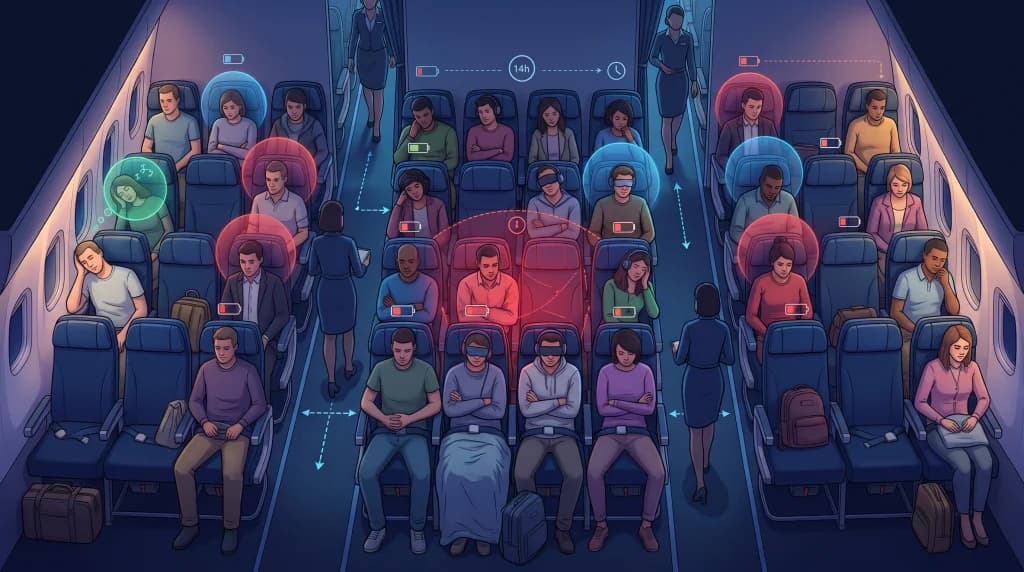
Widebody Cabin Psychology: How 3-4-3 Seating Shapes Passenger Behavior on 14-Hour Flights
Introduction: The Pressurized Tube and Spatial Compression
When Boeing introduced the 777 in the mid-1990s, engineers in Everett designed the fuselage cross-section around a nine-abreast layout in a 3-3-3 or 2-5-2 configuration. Economy class seats back then offered a comfortable width of roughly 18.5 inches (about 47 centimeters), allowing passengers enough breathing room to maintain personal dignity on transoceanic crossings. Yet modern aviation economics, driven by fractional reductions in Cost per Available Seat Kilometer (CASK), catalyzed a quiet cabin revolution. Across modern Boeing 777 fleets, as well as high-density configurations on other widebody platforms, the industry standard has shifted to squeezing ten seats across each row: the 3-4-3 layout.
For an airline, adding an extra seat to every row yields 20 to 30 additional passengers per airframe, generating millions of dollars in annual revenue. For the traveler, this economic calculation shrinks seat cushion width to a mere 17 inches (43.2 cm) while paring aisle widths down to barely 17 inches. Packing over three hundred strangers into a pressurized aluminum cylinder for fourteen hours—such as flights from Doha to Auckland or Paris to Santiago de Chile—under severe spatial constraints is more than a test of physical endurance. It is an unintended mass psychological experiment that alters passenger behavior, triggering primal territorial instincts, emotional detachment, and, in severe cases, acute air rage.
Proxemics at 36,000 Feet: The Violation of Intimate Space
To understand the psychological strain of being seated within a 3-4-3 cross-section, one must turn to the proxemic theory established by anthropologist Edward T. Hall. Hall classified interpersonal space into four distinct concentric boundaries:
- Public Space: Beyond 12 feet (3.6 meters)—no personal or emotional connection required;
- Social Space: 4 to 12 feet (1.2 to 3.6 meters)—the natural distance for formal interactions with strangers;
- Personal Space: 1.5 to 4 feet (45 to 120 centimeters)—the perimeter reserved for friends and casual conversations;
- Intimate Space: Under 18 inches (45 centimeters)—a zone strictly reserved for partners, children, and close physical care.
In a 17-inch seat within a 3-4-3 configuration, the passenger's intimate space is continuously breached by an unrelated stranger. Hips press together, shoulders rub against one another with every fork motion during meal service, and a neighbor's breath is felt across one's forearm. Human neurobiology did not evolve to endure unbroken physical contact with an unfamiliar person for fourteen hours without the possibility of flight. The subconscious mind registers this persistent physical encroachment as a low-grade threat, triggering a sustained, silent release of cortisol and adrenaline into the bloodstream.
The Battle of Centimeters: Armrest Conflicts and Micro-Territorialism
In environments of severe resource scarcity, human behavior readily regresses to territorial defense mechanisms. Within a 3-4-3 cabin, the primary flashpoint is the armrest—a narrow strip of molded plastic barely two inches wide, physically incapable of supporting two forearms simultaneously.
The Middle Seat Protocol
Frequent flyers have long recognized an unwritten code of cabin etiquette: the window seat gains a view and a cabin wall to lean against; the aisle seat gains ease of movement and room to stretch a leg; the middle seat passenger—the primary victim of airline density—is entitled to both interior armrests. In practice, fourteen hours aloft often erodes this courtesy. Passengers instead deploy tactical maneuvers of micro-territorialism:
- The Elbow Wedge: Pinning an elbow firmly into the rear corner of the armrest before the aircraft pushes back from the gate, denying the adjacent seatmate any leverage;
- Shoulder Shifting: Applying gradual, sustained muscular pressure while a neighbor dozes, systematically pushing their center of gravity off the shared boundary;
- Fabric Palisades: Rolling blankets, travel pillows, and jackets into defensive berms arranged along the edge of the seat cushion to form a tactile barrier against inadvertent contact.
The Middle-Four Trap: Seats E and F
The operational core of the 3-4-3 layout is the middle block of four seats (typically designated D, E, F, and G). Seats E and F represent the most challenging locations on the aircraft: passengers assigned here are flanked on both sides by strangers, separated from the nearest aisle by two intervening bodies. From an environmental psychology standpoint, these seats produce pronounced spatial helplessness. Occupants often refrain from drinking water for hours to avoid the social friction of waking two sleeping seatmates to access the lavatory, resulting in severe dehydration and tension headaches.
The 14-Hour Flight Arc: Anatomy of Behavioral Breakdown
A fourteen-hour flight through an ultra-dense cabin does not follow a uniform emotional trajectory. Experienced cabin crew recognize that passenger behavior shifts through predictable psychological phases across the flight profile.
Hours 0–2: Optimism and Nest Building
Upon boarding, passengers direct their energy toward immediate logistical routines: stowing carry-on baggage overhead, connecting charging cables, and browsing the in-flight entertainment (IFE) catalog. Politeness predominates. Seatmates exchange brief smiles, manage brief pleasantries, and arrange their under-seat legroom. The initial meal service provides a structured distraction from the confined dimensions of the seat.
Hours 3–6: The Recline Conflict
Once cabin lighting dims for the cruise phase, a common friction point emerges: seat recline. With seat pitch in a 3-4-3 layout frequently restricted to 30 to 31 inches (76 to 78 cm), a fully reclined forward seat reduces the occupant's frontal clearance by more than 30 percent. The seatback screen drops within inches of the passenger's face, rendering laptop work or comfortable dining impossible. This phase accounts for frequent verbal disputes, seatback jostling, and knee-bracing against forward seat shells.
Hours 7–10: Sensory Deprivation, Fatigue, and Microsleep
By the midpoint of the journey, the cumulative physiological effects of altitude hypoxia (a cabin pressure altitude around 6,000 to 7,000 feet) and dehydration set in. The constant 75 to 80 dB drone of engine and airflow noise induces cognitive fatigue. Passengers settle into static, contorted postures, searching for brief periods of restorative slow-wave sleep. Lacking lateral head support, passengers inadvertently nod off onto their neighbors' shoulders, leading to startled awakenings and embarrassed retreats back to their seat centers.
Hours 11–13: Peak Cabin Irritability
This interval marks the lowest point of crew and passenger patience. Executive function and impulse control within the prefrontal cortex decline under sustained exhaustion. Minor sensory stimuli—a loud headphone leak, a neighbor removing their shoes, a bright smartphone screen, or an overhead light left on across the aisle—trigger disproportionate annoyance. In-flight call bells chime frequently as minor grievances escalate to cabin crew interventions.
Hour 14: Catharsis and Social Re-engagement
When cabin mood lighting simulates sunrise, galley ovens begin morning breakfast service, and the flight deck announces top-of-descent, the collective tension breaks. Irritation recedes as the end of confinement nears. Passengers return their seats upright, stow personal items, and resume standard social pleasantries, united by the shared relief that the journey is concluding.
Biological Amplifiers: Physiology Shaping Behavior
Passenger psychology inside a 3-4-3 cabin cannot be separated from aerospace physiology. Confined human behavior aloft is directly shaped by how the body operates under cabin atmospheric parameters:
- Hypobaric Hypoxia: Reduced ambient oxygen partial pressure keeps blood oxygen saturation around 90% to 92% (compared to 98% to 99% at sea level). Mild cognitive hypoxia lowers frustration thresholds, impairs complex reasoning, and magnifies emotional sensitivity;
- Extreme Aridity: Cabin relative humidity hovering below 12% dries out nasal passages and ocular surfaces, sending persistent low-level discomfort signals to the central nervous system;
- High-Altitude Gas Expansion: Trapped intestinal gases expand by 20% to 25% under reduced cabin ambient pressure. In a narrow 17-inch seat that restricts posture adjustment, this causes physical abdominal discomfort that correlates with social irritability;
- Continuous Broadband Acoustic Noise: Sustained exposure to 80 decibels of ventilation and turbofan hum taxes the autonomic nervous system, keeping the sympathetic fight-or-flight response subtly engaged.
Coping Mechanisms: Strategies for Dense Seating Layouts
Faced with physical confinement, long-haul travelers often adopt specific behavioral strategies to manage spatial constraints across fourteen hours:
1. The Sensory Digital Cocoon
Active noise-canceling (ANC) over-ear headphones have evolved into an indispensable psychological shield. Paired with a sleep mask and an oversized hooded sweatshirt, travelers broadcast an unambiguous non-verbal boundary: "Do not disturb. Do not initiate conversation." By disconnecting sight and hearing, the passenger constructs an internal perceptual boundary that offsets external proximity.
2. Pharmacological Disconnection
A common approach on long-haul routes is relying on sedative hypnotics (such as zolpidem), over-the-counter sleep aids, and alcohol to accelerate the passage of time. Aviation medical authorities caution that combining sedatives with cabin hypoxia risks grogginess, transient global amnesia, and sleepwalking in the aisles, even as passengers seek an escape from the physical realities of the middle seat.
3. Kinetic Minimization
Many travelers adopt deliberate physical stillness: crossing arms tightly over the chest, tucking feet squarely below the seat frame, fixing their gaze on the seatback display, and remaining motionless for hours. This unconscious behavioral compensation seeks to occupy as little volume as possible, minimizing physical contact with neighboring passengers.
Practical Strategies: Surviving the 3-4-3 Layout
While passengers rarely influence the seat configurations selected by airlines, structured preparation can significantly reduce the strain of high-density travel:
- Invest in Sensory Protection: High-grade active noise-canceling headphones and a supportive travel pillow provide reliable defense against sensory overstimulation and posture fatigue;
- Relinquish Space Frustrations: Accepting that personal boundaries will be constrained for the flight's duration reduces counterproductive tension and lowers baseline stress responses;
- Maintain Systematic Hydration: Drinking roughly 250 milliliters of water per hour while avoiding alcohol eases the physiological impact of low cabin humidity and altitude fatigue;
- Apply Shared Empathy: Recognizing that immediate seatmates face identical physical and environmental constraints turns potential conflict into mutual consideration.
Conclusion: The Modern Test of Travel Endurance
Commercial aviation has evolved from mid-century luxury into global mass transit, and the ten-abreast 3-4-3 widebody cabin stands as its clearest operational expression. It illustrates the calculated balance airlines strike between transport economics and human spatial tolerance.
Navigating fourteen hours in such a cabin requires conscious discipline and patience. When the landing gear touches down and reverse thrust spools up after an ocean-crossing journey, passengers have completed more than an international transit. They have managed an intensive fourteen-hour endurance test against close quarters, high-altitude physiology, and modern airline economics.