MCC and CRM Training: How Cockpit Communication Reduced Accidents by 90%
Introduction: When the Human Ego Becomes the Deadliest Component
During the early decades of the jet age, aerospace engineers operated under the assumption that eliminating accidents was primarily a matter of mechanical perfection. Airframe structures were reinforced, triple-redundant hydraulic systems were engineered, multi-channel flight controls were adopted, and increasingly sophisticated flight management computers were integrated into cockpits. Yet safety statistics throughout the 1960s and 1970s revealed a troubling trend: while catastrophic mechanical failures plummeted, fatal accident rates did not decline at a commensurate pace. Hundreds of passengers perished aboard mechanically airworthy aircraft. Accident investigators uncovered a consistent pattern: flights were not crashing into terrain due to engine failure, but because two highly qualified aviators failed to communicate effectively, challenge questionable decisions, or jointly manage operational emergencies.
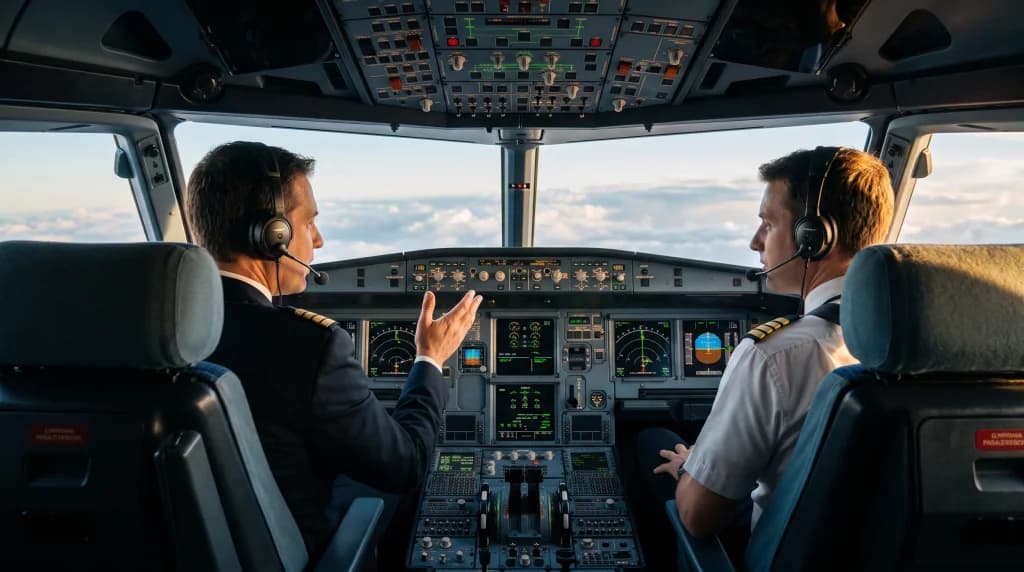
In that era, the flight deck of a commercial airliner functioned much like a rigid hierarchy. The captain—often a military veteran with thousands of flight hours in fighters or heavy bombers—commanded absolute authority. Junior first officers rarely felt empowered to question commands, even when approaching disaster. Overturning that dynamic required an organizational shift in civil aviation. The development of Crew Resource Management (CRM) and integrated Multi-Crew Cooperation (MCC) training marks a major turning point in aviation safety: a combined psychological and procedural evolution that contributed to reducing human-factor-related air carrier accidents by nearly 90%.
Tragic Catalysts: Accidents That Dismantled the Myth of the Infallible Captain
Modern aviation safety regulations are built upon the rigorous investigation of past failures. Crew Resource Management did not emerge from abstract theory; it developed as an operational response to a series of high-profile disasters where advanced aircraft were lost to communication breakdowns and authoritarian command structures.
Tenerife, 1977: The Deadliest Disaster in Aviation History
On March 27, 1977, amid heavy fog on the single runway at Los Rodeos Airport on Tenerife, two Boeing 747s operated by KLM and Pan Am collided, claiming 583 lives. In command of the KLM aircraft was Jacob Veldhuyzen van Zanten—the airline's chief flight instructor, a prominent figure in promotional campaigns, and one of its most respected captains. When van Zanten initiated takeoff thrust without an explicit takeoff clearance from air traffic control, the flight engineer tentatively questioned whether the Pan Am jumbo jet had cleared the runway. Van Zanten dismissed the concern with a brief, authoritative "Yes!" Constrained by authority gradients, neither the first officer nor the flight engineer intervened further or pulled back the thrust levers. Seconds later, the KLM 747 collided with the Pan Am aircraft taxiing in the fog.
United Airlines Flight 173, Portland 1978: A Burned-Out Indicator Lamp
In December 1978, a United Airlines Douglas DC-8 entered a holding pattern near Portland, Oregon, following an abnormal landing gear transit indication. The captain fell victim to tunnel vision—focusing entirely on diagnosing a burned-out gear indicator bulb while losing track of time and fuel burn. Both the first officer and the flight engineer recognized their dwindling fuel state. Yet, rather than delivering an unambiguous, assertive demand to divert and land, they offered only indirect hints. The aircraft exhausted its fuel reserves and crashed in a suburban area, killing ten occupants. The National Transportation Safety Board (NTSB) investigation formally recommended that the airline industry establish mandatory flight-crew training focused on communication, assertion, and shared decision-making.
Defining CRM: From NASA Research to Global Standard
In 1979, NASA convened an industry conference focused on what was initially termed Cockpit Resource Management. Empirical data showed that more than 70% of aviation hull-loss accidents stemmed not from technical flying deficiencies (stick-and-rudder skills), but from breakdowns in communications, task delegation, and interpersonal dynamics. Over time, the discipline expanded into Crew Resource Management, incorporating coordination among flight crews, cabin crew, flight dispatchers, and air traffic controllers (ATC).
Modern CRM integrates standard operating procedures with applied behavioral science. It is neither about creating an informal cockpit nor establishing a democratic vote at the controls. The captain retains sole, ultimate legal responsibility for the aircraft as Pilot-in-Command (PIC). However, CRM provides structured communication channels to leverage the co-pilot's situational awareness, while granting first officers clear procedural pathways to arrest an error chain before it leads to disaster.
Core Pillars of Crew Resource Management:
- Situational Awareness: Maintaining an accurate mental model of the aircraft's energy state, configuration, spatial position, and flight environment, while anticipating operational threats 5, 10, and 30 minutes ahead. Losing situational awareness is often the first step toward an accident.
- Workload Management: Prioritizing operational tasks effectively during periods of acute stress or multiple system failures. Aviators adhere to the strict operational hierarchy: Aviate, Navigate, Communicate—in that order.
- Aeronautical Decision-Making (ADM): Utilizing structured decision-making frameworks such as FOR-DEC (Facts, Options, Risks, Decision, Execution, Check) or DODAR (Diagnose, Options, Decide, Assign, Review) to counter emotional reactions with structured risk assessment.
- Advocacy and Assertion: The ability to clearly, professionally, and non-defensively voice operational concerns, setting aside hesitations stemming from rank or seniority.
MCC Training: Transitioning from Single-Pilot to Multi-Crew Operations
A pilot begins flight training as a solo operator in single-engine aircraft like a Cessna 172 or Piper Archer. Through hundreds of flight hours, student pilots are trained to handle every task independently: scanning instruments, managing navigation logs, working radios, and making unilateral command decisions. Upon earning a Commercial Pilot License with an Instrument Rating (CPL/IR), the candidate still operates with a single-pilot mindset.
The bridge to the airline flight deck is the Multi-Crew Cooperation (MCC) course, frequently expanded into the Airline Pilot Standard Multi-Crew Cooperation (APS MCC) framework. Conducted in multi-pilot flight simulators (such as an FNPT II MCC or Level-D Full Flight Simulator) replicating commercial platforms like the Airbus A320 or Boeing 737, students spend dozen-hour curricula learning structured task allocation, standard callouts, and mutual flight path monitoring.
Operational Roles: Pilot Flying (PF) vs. Pilot Monitoring (PM)
In modern multi-pilot operations, crew responsibilities are divided into two distinct roles, irrespective of who wears four stripes as captain or three as first officer:
- Pilot Flying (PF): Controls the trajectory of the aircraft, managing airspeed, heading, and altitude either manually or via automated flight control systems. The PF remains focused on primary flight parameters during high-workload phases, avoiding distractions such as looking up manuals or handling administrative radio calls.
- Pilot Monitoring (PM): Serves as an active monitor and cross-check. The PM handles radio communications with ATC, sets systems and switches as requested by the PF, reads checklists, inputs route modifications, and monitors primary flight displays to challenge any deviation from target parameters.
Modern MCC curricula emphasize that the Pilot Monitoring role requires just as much vigilance as flying the controls. An attentive PM provides an essential barrier against cognitive lapses from the PF before deviations become unsafe flight conditions.
Escalating Concerns: The PACE Assertiveness Framework
One of the primary tools introduced by modern CRM programs is the PACE escalation model. Historically, a first officer noticing a captain's deviation might hesitate to speak up to avoid reprimand. PACE provides a standardized four-step ladder for escalating safety concerns:
- Probe: Make an initial inquiry to confirm the other pilot's situational awareness. Example: "Captain, we're descending at 2,500 feet per minute; is that your intention?"
- Alert: Point out the specific operational parameter or flight-path deviation. Example: "We are drifting below the glideslope, and our rate of descent exceeds stabilized approach criteria below 1,000 feet."
- Challenge: Direct an immediate course correction clearly and professionally. Example: "Our approach profile is unstable. We must level off immediately and correct this descent rate."
- Emergency (Intervention): If the captain does not respond and the aircraft is approaching an unsafe condition, the first officer is procedurally required to intervene directly, state the formal takeover command—"I have control!"—and execute a missed approach by advancing thrust levers to TOGA (Takeoff/Go-Around).
Progressing through the PACE sequence is a trained procedure practiced in simulator evaluations. Training scenarios intentionally place instructors in simulated states of high fixation or subtle incapacitation, requiring junior pilots to apply the protocol and take control of the aircraft when safety limits are breached. This training helps eliminate hesitation rooted in rank deference.
Learning from Human Fallibility: Just Culture and Threat and Error Management (TEM)
CRM and MCC training could not succeed within an adversarial corporate culture. For decades, traditional operations were governed by punitive management structures: pilots who committed procedural lapses were reprimanded, demoted, or terminated. This led crews to conceal errors, keeping critical safety data from being reviewed.
To resolve this, modern aviation adopted the principles of a Just Culture. Airlines provide immunity from disciplinary action for inadvertent human errors that are proactively reported, provided there was no willful misconduct, substance abuse, or gross negligence. Through confidential reporting frameworks (such as NASA's ASRS in the United States and SMS reporting channels worldwide), operators analyze thousands of crew reports annually. If several crews note that an ambiguous chart layout on a complex instrument arrival leads to repeated altitude busts, airlines and aviation authorities can redesign the procedure before an incident occurs.
Threat and Error Management (TEM)
Contemporary CRM has developed around the Threat and Error Management (TEM) model. Rather than aiming for an unrealistic goal of zero human error, TEM accepts that operational mistakes are inevitable. The focus centers on identifying environmental threats early (e.g., severe weather, ATC disruptions, time pressure) and detecting errors before they progress into an Undesired Aircraft State (UAS).
Conclusion: The Architecture of Aviation Safety
When travelers take their seats on a modern commercial flight, their safety relies on more than advanced avionics and structural engineering. An equally vital protection is the professional culture inside the flight deck: a workplace designed to remove unhealthy ego, encourage clear communication, and leverage structured procedures that mitigate human fallibility.
MCC and CRM training reshaped traditional flight deck dynamics, replacing authoritarian command with structured, collaborative communication. In doing so, commercial aviation achieved an extraordinary safety record. In an industry governed by complex machines, one of its greatest advancements remains understanding and supporting the human mind.