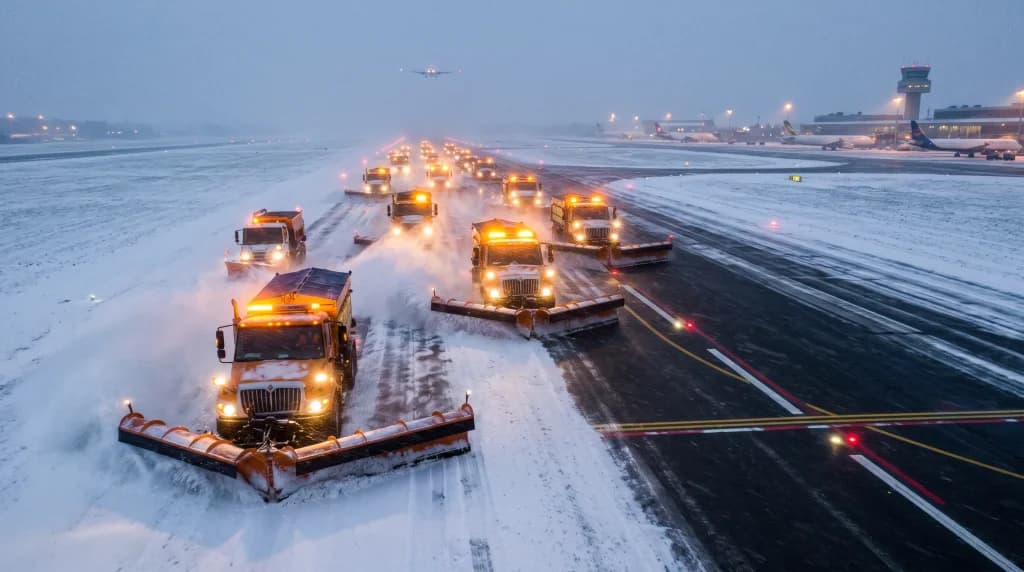
Airport Snow Operations: How 3-Kilometer Runways Are Cleared in 10 Minutes
Introduction: Ten Minutes That Determine Airspace Paralysis
A winter morning at a major international hub often looks tranquil from inside a passenger concourse: heavy snowflakes drifting lazily against terminal glass, runway approach lights softened by low fog, and the deliberate movement of airliners taxiing along aprons. Yet for airport duty operations managers and airfield maintenance supervisors, that same winter landscape signals an immediate operational threat. A layer of wet, compacted snow barely an inch deep across an active runway does not simply degrade braking performance; it introduces acute risks of directional instability, high-speed dynamic aquaplaning, and cascading flight delays that can paralyze airline networks across entire continents.
The operational imperative during a sustained snowfall is not simply to clear the pavement, but to do so with surgical speed: in under ten minutes, inside a tightly orchestrated gap between an arriving Airbus A321 on final approach and an outbound Boeing 787 lining up for takeoff. How do airport ground teams mobilize a synchronized armada of high-speed plow trucks, high-rpm rotary broom units, industrial blowers, and chemical anti-icing spreaders across 3,000 meters of runway measuring 45 to 60 meters wide? It is a demanding logistical maneuver of fleet telemetry, civil engineering, and surface chemistry—where a coordination lapse of just thirty seconds can force a widebody aircraft with 300 passengers into an unplanned diversion.
The Geometry of Clearing: The Echelon Formation
Many travelers assume airfield snow clearing mirrors municipal road maintenance—with individual plows pushing slush to the roadway shoulder. On an active commercial runway, that approach would prove hazardous. If plows push snow directly to the pavement edges without specialized displacement, they build a compacted vertical ridge (a snow bank). During a crosswind landing, an aircraft crabbing onto the centerline risks striking that frozen mound with an engine nacelle or wingtip.
The standard method for high-tempo runway snow removal is the Echelon Formation, frequently referred to by airport ground crews as the wedge or staggered diagonal sweep. The clearing convoy typically deploys between 6 and 14 integrated multi-function clearing units (Sweep-Sweeper-Blower units) entering the runway threshold simultaneously:
- Lead Vehicle: Stations itself immediately adjacent to the painted runway centerline (or outer pavement edge), angling its heavy plow blade at roughly 30 to 35 degrees.
- Wing Vehicles: Successive clearing rigs trail staggered several dozen meters behind and stepped outward by one blade width, preserving a working overlap of roughly two meters. Each vehicle collects the windrow cast off by the unit ahead and pushes it further toward the pavement perimeter.
- Formation Speed: These specialized rigs do not crawl like city dump trucks. The convoy drives down the runway at sustained speeds between 45 and 60 km/h (28 to 37 mph). At this velocity, polyurethane-cutting-edge blades throw snow clear off the moldboard surface.
Through this staggered formation, the snow layer is swept diagonally across the runway surface until it meets the intake of an industrial Rotary Snow Blower working the runway edge. Powered by dedicated 800- to 1,000-horsepower auxiliary diesel engines, the blower casts the discharge 40 to 50 meters clear of the paved safety strip (Runway Strip), leaving an even surface free of hazardous vertical berms.
Specialized Equipment: Multi-Function Airfield Rigs
The vehicles that maintain airport surfaces during winter operations are bespoke, high-performance machines engineered by manufacturers like Vammas, Øveraasen, and Schmidt. A single compact multi-function tractor-trailer unit coordinates three distinct clearing actions in a single sweep:
1. High-Speed Front Plow
Spanning widths between 6 and 8 meters, the front plow features segmented cutting edges engineered from composite formulations of polyurethane, corundum ceramics, and spring-loaded steel. The blade must shear away hard-packed snow while deflecting elastically over inset runway centerline and touchdown zone lighting fixtures (In-pavement Runway Centerline Lights), avoiding damage to flush-mounted CAT III lighting assemblies.
2. Center-Mounted Rotary Broom
Suspended between the prime mover axles or mounted on an articulated trailing chassis, this cylindrical broom measures roughly one meter in diameter. Bristled with high-density steel and polypropylene wire coils spinning at up to 1,000 rpm, the broom handles bare-pavement contact. It strips residual moisture, compacted tire slush, and frozen debris from pavement microtextures that escape the leading blade.
3. High-Velocity Air Blower
Completing the sweep train, an auxiliary diesel engine powers a centrifugal turbine producing an air blast exceeding 400 to 500 km/h (250 to 310 mph). Directed through ground-hugging nozzles situated behind the broom assembly, this exhaust stream clears fine ice crystals, snow dust, and standing water, leaving behind clean, dry pavement.
Chemical De-icing: Why Road Salt Is Strictly Prohibited
Standard rock salt (sodium chloride – NaCl), common on public roadways, is strictly prohibited across civil and military airfields. If salt aerosols enter high-bypass turbine engines running at operational temperatures or settle into structural airframe recesses, the chloride ions induce aggressive pitting and galvanic corrosion across aluminum-lithium alloys, structural titanium, and primary avionics wiring looms. A commercial fleet operating through a winter season at a salt-treated airfield would face structural airworthiness compromises.
Instead of chlorides, certified airfields use biodegradable, non-corrosive chemical solutions formulated from formate and acetate organic salts:
- Liquid Agents: Primarily potassium formate solution. Discharged through heavy sprayer booms extending 36 to 45 meters across the runway, this liquid lowers the freezing point of surface water to as low as -30°C (-22°F), preventing surface glazing and black ice.
- Solid Granular Agents: Primarily sodium formate or calcium magnesium acetate (CMA). Granules are applied when frost or packed snow has already bonded to the pavement. The solid pellets burn vertically through the ice sheet down to the pavement interface, then spread horizontally to break the chemical bond, allowing brooms to clear the loosened sheet on a subsequent pass.
Precision Timing: Clearing a Runway in 600 Seconds
Operating airfield snow sweeps effectively depends on seamless coordination with air traffic control. Halting runway operations for thirty minutes at hubs like London Heathrow, Frankfurt, or Amsterdam creates widespread arrival holding, rapidly exhausting reserve fuel across inbound flights. To avoid extended closures, airport operators use Rolling Sweeps to maintain active throughput.
Operational Timeline: Second by Second
The clearing evolution relies on tight communication between the control tower (TWR) and the airfield maintenance convoy leader (callsign, e.g., "Snow-1"):
- T minus 5 minutes: The sweep convoy idles on a designated perimeter taxiway adjacent to the runway holding point, brooms engaged. Approach radar controllers sequence inbound arrivals to create a coordinated 12-minute separation gap.
- T zero: The preceding arrival touches down, decelerates, and vacates via a rapid-exit taxiway (RET). As the aircraft clears the runway safety line, the tower controller issues the clearance: "Snow-1, enter Runway 29, you have a 10-minute working window."
- T + 30 seconds: The convoy enters the runway threshold at speed, deploying into the staggered echelon layout. Drivers track precise lane offsets using in-cab RTK-GPS guidance systems.
- T + 5 minutes: The convoy crosses the mid-point marker (1,500 meters downfield). The trailing chemical spreader blankets the full runway width with high-pressure potassium formate mist.
- T + 8 minutes: The lead plows reach the opposite runway end. The convoy peels off smoothly onto an exit taxiway, immediately opening the landing surface.
- T + 9 minutes: A continuous friction measuring vehicle (Friction Tester) sweeps the active surface at speed, logging automated surface grip numbers.
- T + 10 minutes: Airport duty operations reports the updated runway state to the tower: surface clear, friction values verified. The tower clears the trailing arrival to land, currently on four-mile final approach.
The Physics of Braking: From Mu-Meters to GRF and SNOWTAM
Clearing snow down to bare asphalt does not tell the full operational story. Pilots flying a 70-ton narrowbody transport on approach need to understand exactly how their anti-skid brakes, ground spoilers, and thrust reversers will perform. For decades, the industry relied on direct friction coefficients ($\mu$ – Mu), calculated using specialized test vehicles (such as modified Saab or Volvo cars fitted with a retractable fifth wheel logging continuous deceleration friction).
To improve international consistency, the International Civil Aviation Organization (ICAO) instituted the Global Reporting Format (GRF). This standard restructured how runway surface assessments are communicated directly to cockpits:
- The active runway is evaluated across three equal sections: the Touchdown Zone, Mid-point, and Roll-out End.
- Airfield inspectors evaluate surface contaminants and assign a standardized Runway Condition Code (RWYCC) ranging from 0 to 6 for each third:
- Code 6: Dry, bare pavement – baseline normal braking.
- Code 5: Wet surface or damp snow – good braking deceleration.
- Code 3: Compacted snow or wet snow – medium braking action with extended stopping distance.
- Code 1 or 0: Wet ice or freezing rain – poor or negligible braking action (triggers immediate runway closure).
These surface observations are broadcast directly through real-time SNOWTAM telemetry advisories. Pilots enter these condition codes into their onboard flight management systems (FMS) and electronic flight bags. The onboard performance software processes the current RWYCC to calculate field-length limits, autobrake settings, and maximum allowable landing weights.
Conclusion: Ballet in the Shadow of Airliners
Keeping an active runway open during a major winter storm remains an impressive feat of airport operations. It demands precise coordination among ground operations, specialized industrial equipment, and air traffic control. The process leaves no room for error: an equipment stall within the formation, a miscalculated chemical application, or a sixty-second delay in clearing the safety zone can disrupt a carefully balanced daily flight schedule.
The next time your flight touches down smoothly on clear black asphalt bordered by deep snowbanks, look out the window across the parallel taxiways. Parked near the holding points, emergency beacons flashing, sits the sweep convoy. Inside warm cabs, operators wait for the next ten-minute gap in arrivals to keep the runway clear.