Gravel Kits and Ice Runways: Arctic Passenger Aviation in Northern Canada
Introduction: The True Edge of the Roadless World
When most travelers envision boarding a commercial passenger jet, their minds conjure images of endless ribbons of smooth tarmac, climate-controlled jet bridges, and precision Instrument Landing Systems guiding aircraft through dense fog. Yet north of the 60th parallel—across the vast expanses of Nunavut, the Northwest Territories, and the Yukon—the concept of commercial aviation takes on a radically demanding definition. Across a territory spanning nearly four million square kilometers, there is no interconnected highway network. More than thirty remote settlements and Inuit fly-in hamlets remain isolated from the outside overland world 365 days a year. The surrounding sea remains frozen for over six months, leaving the delivery of fresh food, blood products for medical transfusions, generator parts, and passenger transport squarely on the shoulders of Arctic aviators.
In these high latitudes, a jetliner is not an instrument of leisure travel, but an essential lifeline. Landings are conducted on runways carved from loose, frozen gravel or directly onto the natural blue ice of frozen lakes and Arctic fjords, in ambient surface temperatures plunging to -50°C and crosswinds exceeding 40 knots. The aircraft operating across these northern networks require structural adaptations that would seem extraordinary in conventional air transport. Chief among these engineering achievements is the legendary Gravel Kit—a specialized conversion package that transforms a commercial airliner into a reinforced workhorse built for rugged, unpaved runways.
Engineering Anatomy: What Is the Gravel Kit?
Modern high-bypass turbofan engines—such as the CFM LEAP or Pratt Whitney GTF series—feature large nacelles positioned merely inches above the tarmac. Touching down with such powerplants on an unpaved gravel runway would prove disastrous: the massive air intake vortex would ingest hundreds of sharp stones directly into the spinning titanium fan blades (a catastrophic Foreign Object Damage, or FOD event), destroying high-value machinery within seconds and triggering serious safety hazards.
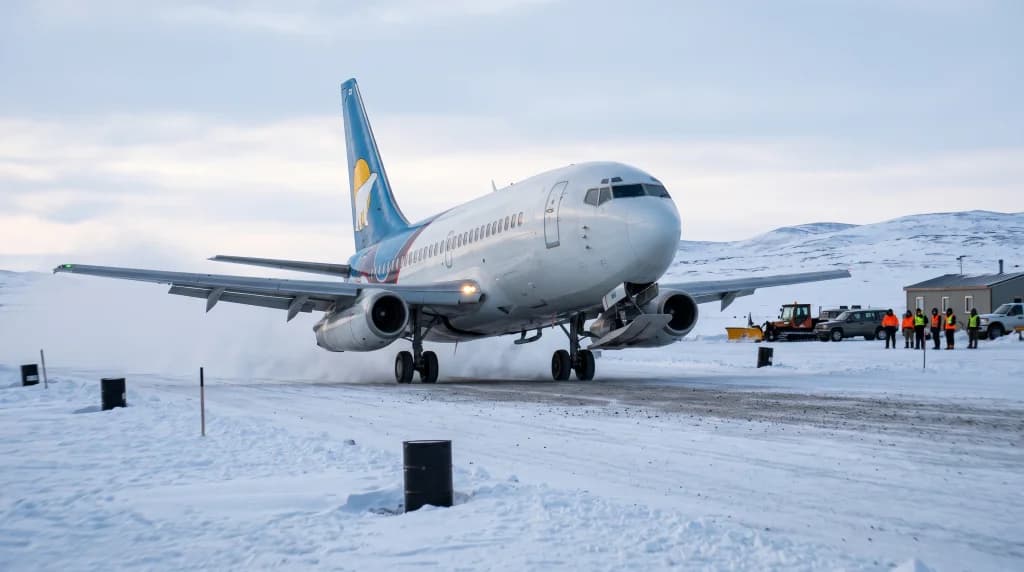
During the 1960s, Boeing engineers designing the Boeing 737-200 confronted a challenge posed by carriers operating throughout Alaska and northern Canada: how to enable a jet transport to operate into permafrost tundra where laying concrete or asphalt runways is either geotechnically impossible or prohibitively expensive. The factory solution was the certified Unpaved Strip Kit, universally known across the industry as the Gravel Kit. It comprised several key engineering modifications:
1. Nose Gear Gravel Deflector
Mounted directly beneath the nosewheel assembly was an oversized, ski-like deflector fabricated from reinforced laminate and steel. Its primary aerodynamic function was to intercept the rooster tail of gravel, sand, and slush thrown up by the dual nose tires during 140-knot touchdowns, deflecting stone scatter outward and downward away from the fuselage underbelly and powerplant intakes.
2. Bleed-Air Vortex Dissipators
The most visually distinct element of the installation consisted of two horizontal stainless steel tubes projecting forward beneath each Pratt & Whitney JT8D engine nacelle, terminating in downward-canted pressure nozzles. During ground taxi, takeoff roll, and landing rollout, engine bleed air was ducted forward through these tubes and discharged toward the surface. This high-velocity air blast disrupted the ground-effect vortex—the miniature cyclonic tornado that naturally forms between a low-slung intake and the runway—preventing stones from being vacuumed off the surface into the compressor stage.
3. Armored Underside and Wing Protection
Loose stone gravel thrown by the high-speed main gear wheels struck the airframe with ballistic velocity. The modification package treated the entire belly with resilient, high-build polyurethane and Teflon elastomeric coatings. In addition, all exposed hydraulic brake lines and electrical harness bundles routed along the landing gear struts were shielded inside stainless steel armor wraps. The flap leading edges received heavy-gauge protective metal wraps, and sacrificial shielding was installed across the underside of the wings to safeguard structural composite panels and fuel tank access plates.
The Last Redoubt: Why Canadian North and Nolinor Flew the "Jurassics"
For decades, northern Canadian operators—including Canadian North, First Air, and Nolinor Aviation—kept active fleets of the classic Boeing 737-200 in frontline scheduled service. While mainline carriers retired and scrapped these noisy, fuel-thirsty jets during the late 1990s, in the Arctic they remained irreplaceable. The key lay in the physical architecture of the JT8D-17 engine: a long, slender, low-bypass powerplant nestled tight against the wing with high surface ground clearance.
As successor generations arrived (737 Classic, NG, and MAX), high-bypass turbofan diameters increased substantially. The engines grew so wide that their nacelles had to be flattened along the lower rim, leaving barely 45 centimeters of clearance from the pavement. Fitting functional vortex dissipators to modern CFM56 or LEAP-1B engines proved aerodynamically and physically unworkable given the enormous volume of the inlet air stream. For years, no modern replacement could match the 737-200's proven rough-field capability at remote gravel runways like Cambridge Bay or Rankin Inlet.
Only the gradual rollout of treated gravel sealants, selective runway paving at key Arctic hubs, and the deployment of modern regional turboprops—such as gravel-deflector-equipped ATR 42-500 and Dash 8-Q400 airframes—finally enabled the retirement of the beloved "Jurassic 737s." Yet for generations of northern travelers, the thunder of JT8D thrust reversers kicking up clouds of Arctic gravel remains the enduring memory of arriving home safely.
Runways on Ice: Landing on Frozen Lakes and Oceans
Operating from gravel runways represents only one aspect of northern operations. An even more demanding challenge is flying into seasonal Ice Runways, prepared each winter across frozen sub-arctic lakes near Yellowknife or atop thick Arctic Ocean sea ice to supply remote diamond mines (such as Diavik and Ekati) and polar research stations.
An ice runway is far more than an ordinary frozen water surface; it is an engineered, floating flexible plate governed by the laws of fluid mechanics and ice viscoelasticity:
- Critical Ice Thickness: To support a 60-ton commercial jetliner or a heavy Lockheed L-100 Hercules freighter, the ice must consist of dense, contiguous crystalline structure (known as Blue Ice) measuring at least 100 to 120 centimeters in thickness. Snowmobile-mounted ground-penetrating radar (GPR) surveys scan the entire alignment to detect subsurface voids or thermal fractures before flight operations begin.
- Hydrodynamic Wave Resonance: When a heavy transport taxies or touches down on floating ice, its mass produces a localized depression in the ice sheet. As the aircraft moves, it pushes an underwater hydrodynamic pressure wave ahead of it beneath the sheet. If ground speed matches the propagation velocity of this underwater wave, hydrodynamic resonance can rupture the ice from below, creating catastrophic structural failure. Consequently, ice runways enforce strict taxi speed limits (typically held under 15 to 20 km/h).
- Surface Friction Conditioning: Touching down on wind-polished glare ice would present virtually zero braking coefficient. Ice strips are mechanically conditioned using heavy grader blades fitted with serrated scarifier teeth to carve micro-grooves along the surface, or spread with an even layer of fine, chilled sand that freezes into the upper crust, providing surface friction comparable to damp concrete.
Extreme Cold-Weather Logistics: When Fuel Turns to Gel
Sustaining flight operations between -40°C and -50°C requires ongoing adaptation to changing physical properties. Under extreme cold, structural steel alloys turn brittle, elastomeric hydraulic O-rings lose elasticity and fail upon initial actuator displacement, and standard Jet A-1 fuel risks precipitating paraffin wax crystals, clogging line filters.
Arctic Kerosene: Jet B and Specialized Additives
Across high Arctic operations, aviation kerosene often transitions to Jet B—a wide-cut naphtha-kerosene blend engineered with a freezing threshold depressed to -60°C. Fuel uplifts routinely include specialized Fuel System Icing Inhibitors (FSII), which chemically scavenge suspended moisture molecules, preventing ice crystal nucleation throughout the fuel delivery system during long transits at cruise altitude where static air temperatures frequently drop toward -70°C.
The Cold-Soak Factor and Herman Nelson Pre-Heaters
When an aircraft touches down at Resolute Bay (YRB)—one of the world's most northerly civil airfields—engines are frequently kept idling during routine ground stops for passenger turns and cargo offloading. Shutting down in sub-zero winds induces rapid cold soaking, after which restarting requires hours of ducted heating applied to engine cores and gearboxes via portable Herman Nelson heaters pumping hot air through flexible canvas ducts directly into nacelle cowlings.
Cabin interior systems require equally vigilant management: lavatory water tanks and potable lines are drained immediately upon arrival and treated with non-toxic glycol solutions to avoid burst water lines or fractured hull pressure dump valves.
The Arctic Passenger: Survival Equipment as Standard Wardrobe
The experience of boarding an aircraft at Edmonton or Yellowknife bound for the High Arctic contrasts sharply with flying typical domestic routes. In the North, practical clothing replaces casual attire: passengers board wearing heavy sub-zero parkas with genuine ruffs, heavy insulated snow pants, and commercial-grade cold-weather boots rated to -70°C.
This is not due to a lack of cabin climate control—the aircraft's pneumatic packs maintain a steady interior temperature of +21°C. Rather, it represents a mandatory Transport Canada aviation safety standard. In the event of an emergency diversion onto an unpopulated tundra plateau or the remote coast of Baffin Island, search and rescue (SAR) teams operating from CFB Trenton may face transit delays of 12 to 36 hours during blizzard conditions. With engines stopped, interior cabin temperatures plummet from comfortable warmth to -30°C within minutes. Standard passenger attire would offer little protection in that environment.
Beneath the floorboards in the cargo hold, every certified airliner carries specialized emergency Arctic survival gear: commercial polar expedition tents, extreme-cold military sleeping bags, high-calorie ration packs, portable stoves, ice melting gear, and 12-gauge shotguns with heavy rifled slug ammunition to protect occupants against curious or predatory polar bears investigating an off-field landing site.
The Combi Configuration: Passengers Beside Cargo Pallets
The unit economics of flying into remote northern settlements led to the widespread development of the Combi aircraft layout. In major hubs, passenger and dedicated freighter fleets operate independently. In Nunavut, flying separate passenger and dedicated cargo airframes into an isolated community of 800 residents would be economically unsustainable.
The Boeing 737 Combi solves this challenge by dividing the main cabin using a certified, heavy-duty movable bulkhead:
- Forward Main Deck: Configured as an active freight deck. Through an oversized main-deck cargo door installed on the forward port side, ground crews use forklifts to load cargo pallets carrying mail, essential fresh produce, cartons of milk (which often command steep prices in northern hamlets), and occasional snowmobiles or marine outboard motors.
- Aft Main Deck: Features standard airline passenger seating for 30 to 60 passengers, complete with flight attendants serving hot coffee and a full rear lavatory.
For families traveling between Iqaluit and Igloolik, sitting a few rows behind a bulkhead separating them from thousands of pounds of fresh freight is a familiar part of travel. It exemplifies the practical logistics required to keep Arctic communities supplied.
Conclusion: Operating on the Northern Frontier
Commercial aviation throughout the Canadian Arctic represents a dynamic balance between aerodynamic precision and rugged operational necessity. The flight crews and maintenance technicians operating these corridors possess exceptional skill. Managing flight plans without ground-based radar surveillance, operating in zones of magnetic unreliability near the Magnetic North Pole, and touching down in strong crosswinds on snow-swept gravel require disciplined airmanship.
Even as satellite-based GPS navigation and low-earth-orbit Starlink connectivity streamline communication at northern stations, the underlying operating environment remains demanding. Every takeoff and landing across Yellowknife, Rankin Inlet, and Resolute Bay reflects the ingenuity of northern flight operations—a reliable bridge connecting remote Arctic communities across thousands of miles of frozen terrain.