Aviation Capitals in the Middle of Nowhere: How Remote Pacific Islands Stay Connected
Introduction: The Desert of Blue and Runways of Crushed Coral
When you observe the globe centered over the Pacific Ocean, landmasses virtually disappear. You are met by an immense, hypnotic expanse of water covering one-third of the planet's surface. Across thousands of miles of open sea lie isolated coral atolls, volcanic ridges, and island chains whose total terrestrial landmass is smaller than a modest European province. For the communities residing across Kiribati, Tuvalu, the Marshall Islands, and the Federated States of Micronesia, this ocean is not merely picturesque scenery. It is a formidable physical barrier: isolating, demanding, and logistically unyielding. Here, scheduled air service is neither a leisure option nor a travel luxury—it is fundamental state infrastructure, the circulatory system of the local economy, and the vital link connecting remote populations to the outside world.
Operating a scheduled air network across the open Pacific presents significant operational challenges. Taking off and landing on crushed-coral runways, threading through equatorial convective thunderstorms, and flying without overland diversion airfields within a thousand nautical miles requires meticulous airmanship and rigorous dispatch planning. How do remote Pacific communities maintain these critical air routes? What is the operational reality for passengers where a jetliner functions much like a rural bus line, and where a technical error or fuel miscalculation leaves no alternative but an open-ocean ditching?
The Geography of Remoteness: When Alternate Runways Are Four Hours Away
In standard continental commercial aviation across North America or Europe, Instrument Flight Rules (IFR) dispatch planning relies on an extensive network of diversion fields (Alternate Airports). If an unexpected fog bank drops surface visibility below operating minimums at Frankfurt, dispatchers can divert the aircraft to Cologne, Leipzig, or Munich with a fuel reserve covering roughly 30 to 45 minutes of flight. Across the Pacific, this operational framework changes completely. Here, the regulatory reality of the Isolated Aerodrome dictates flight planning.
Consider a scheduled flight inbound to Bonriki International Airport (TRW) on the atoll of Tarawa in the Republic of Kiribati. The nearest paved runway capable of handling a commercial jet transport is Nadi, Fiji (NAN) or Majuro in the Marshall Islands (MAJ)—transits spanning 1,200 to 1,400 nautical miles over open ocean. If the runway becomes obstructed by a blown tire from a preceding arrival, suffers a sudden loss of airfield lighting, or is hit by a tropical squall reducing ceiling and visibility to zero, the flight crew has nowhere nearby to divert.
Consequently, oceanic fuel calculations follow strict ETOPS (Extended-range Twin-engine Operational Performance Standards) and Point of Safe Return (PSR) protocols. Prior to crossing the PSR—the geographic threshold beyond which returning to the departure or en-route alternate is no longer physically possible based on onboard fuel reserves—dispatchers and flight crews must obtain reliable, up-to-date weather observations for the destination atoll. Flights dispatched along these routes carry substantial mandatory reserves—known as Island Holding Fuel—allowing the aircraft to loiter overhead for up to two hours awaiting conditions to clear. This reserve fuel carries significant weight, directly reducing commercial payload capacity: it is common for a 180-seat airliner to be capped at roughly 100 passengers to keep the aircraft within Maximum Takeoff Weight (MTOW) limits.
The Island Hopper: United Airlines' Lifeline Across the Pacific
Few commercial routes in international aviation carry the historical and operational significance of the Island Hopper (United Airlines flights UA154 / UA155). Inaugurated in the late 1960s by Continental Micronesia (affectionately known across the archipelago as Air Mike), this multi-stop service remains the primary arterial corridor connecting the islands of Micronesia to regional hubs in Guam and Hawaii.
Operated by specially configured Boeing 737-800 airframes, the flight transits a string of isolated airfields across the central Pacific:
- Honolulu (HNL): The eastern transpacific gateway in the Hawaiian Islands,
- Majuro (MAJ): The capital of the Marshall Islands, featuring a runway built atop a narrow strip between the open sea and the lagoon,
- Kwajalein (KWA): A restricted US military missile testing range where deplaning and photography are strictly prohibited for civilian transit passengers,
- Kosrae (KSA): A volcanic high island fringed by dense tropical rainforest,
- Pohnpei (PNI): The capital of the Federated States of Micronesia, situated near the ancient stone city of Nan Madol,
- Chuuk (TKK): Famous for its expansive, sheltered lagoon containing preserved wartime shipwrecks,
- Guam (GUM): The primary western hub and transit crossroads of the Mariana Islands.
Flying the complete route takes more than 14 hours. During intermediate turnarounds, engines are often kept running to preserve cooling and electrical systems in the tropical heat while passengers board and disembark. Ground crews transfer mailbags, fresh produce, critical medications, and electrical generator parts. Every flight carries a dedicated flight technician traveling with an onboard tool kit and certified fly-away spares; isolated stops like Kosrae and Chuuk possess minimal third-party maintenance support, meaning an unaddressed mechanical issue could otherwise ground the airframe for weeks.
Airfield Realities: Strips Positioned on the Tide Line
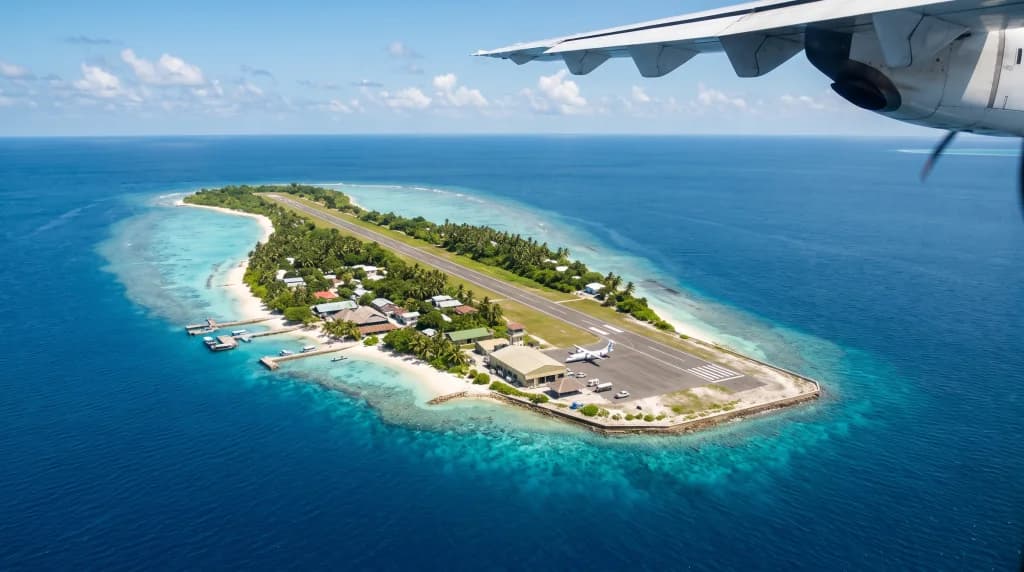
Constructing and maintaining an operational airfield on a coral atoll presents distinct civil engineering challenges. A typical atoll consists of a narrow ring of reef often only a few hundred yards wide, rising barely five to seven feet above mean sea level. In this environment, carving out a 6,500-foot runway to accommodate commercial twinjets requires allocating nearly all usable contiguous land area.
Funafuti (Tuvalu): The Runway as a Community Common
The operational profile of Funafuti International Airport (FUN) in Tuvalu illustrates this balance between aviation infrastructure and local community space. On this narrow atoll, the paved airstrip occupies a substantial proportion of the nation's total land area. When no flight operations are scheduled, the runway serves as an open civic plaza. In the late afternoon as temperatures cool, residents gather on the tarmac to play soccer, volleyball, ride motor scooters, and socialize. Twenty minutes prior to the arrival of an ATR 72 turboprop operated by Fiji Airways, an audible siren sounds across the atoll. Local police and emergency personnel clear the runway of pedestrians, pets, and vehicles, transferring the surface to international ICAO air traffic protocols. Once the flight departs and clears local airspace, the siren sounds again, returning the asphalt to community use.
Salt Spray, Coral Aggregates, and Marine Corrosion
The maritime environment of low-lying atolls places severe demands on airframes and avionics systems:
- Atmospheric Salt Ingestion: Continuous maritime trade winds carry fine, salt-laden sea spray across the field. Aircraft stationed overnight require systematic freshwater engine washes (Compressor Washes) to prevent corrosive salt deposits from degrading turbine blades and electrical harness connectors.
- Coral Dust Surface Wear: Airfield pavements constructed from crushed coral aggregates bound with thin asphalt layers experience accelerated wear under the impact of heavy transport gear and tropical downpours. Fine, abrasive coral dust also accelerates mechanical wear on wing leading edges and engine nacelles.
- King Tide Inundation: During seasonal perihelion spring tides (King Tides), ocean swells can breach coastal margins and push seawater across parking aprons. Water percolates upward through the porous coral bedrock, requiring ground crews to take active precautions to shield ramp equipment from salt-water intrusion.
Specialized Fleets: Aircraft Built for Isolated Ramps
Airlines serving the Pacific—including Fiji Airways, Air Kiribati, Nauru Airlines, and Solomon Airlines—rely on specific aircraft configurations tailored for short runways, basic ground handling equipment, and high dispatch reliability.
The Boeing 737 and Unpaved Strip Equipment
Historically, the workhorse of regional island operations was the Boeing 737-200 equipped with the factory Gravel Kit. This package included a nose-gear gravel deflector to shield the lower fuselage from stone strikes, alongside compressor-bleed air nozzles extending forward beneath the engine cowlings to dissipate ground vortices that could ingest coral debris into the Pratt & Whitney JT8D engines. While contemporary operations use modern 737-700 and 737-800 models requiring sealed runways, operators continue to utilize reinforced belly skins and protective gear seals to mitigate debris wear.
Regional Turboprops: The Twin Otter and ATR Series
Connecting outer atolls within domestic archipelago networks requires robust turboprop transports. The primary utility aircraft remains the de Havilland Canada DHC-6 Twin Otter. Designed with short takeoff and landing (STOL) capabilities, it operates reliably from unpaved, 1,000-foot grass and coral airstrips, utilizes simple and field-maintainable systems, and handles high humidity with minimal specialized line equipment. For higher-density domestic and regional routes, the ATR 42 and ATR 72 family provides efficient fuel burn and reliable performance under high ambient temperatures.
The Economics of Essential Air Links: Funding Pacific Corridors
From a conventional airline economic model, most remote Pacific routes face high operating costs. Providing air service to small populations dispersed across thousands of miles generates high cost per available seat kilometer (CASK) metrics. The logistics of shipping aviation kerosene (Jet A-1) via ocean tanker to remote atolls can raise local fuel prices to double or triple benchmark spot prices in Singapore or Los Angeles.
Sustaining these connections relies on intergovernmental agreements and targeted regional subsidies:
- US Essential Air Service (EAS) and Compact Funding: Under the Compacts of Free Association, the United States government subsidizes critical air connections across Micronesia, Palau, and the Marshall Islands, maintaining essential connectivity and supporting strategic maritime access across the central Pacific.
- Nauru Airlines as an Inter-Island Redundancy Carrier: The flag carrier of Nauru, operating a fleet of Boeing 737 aircraft, frequently provides sub-charter and wet-lease capacity to neighboring island states such as Kiribati and Tuvalu when their primary carriers face maintenance interruptions.
- Aeromedical Evacuations (Medevac): For residents of remote atolls, air transport provides emergency access to tertiary medical care. Acute surgical cases, obstetrical complications, and serious infections cannot be treated in local dispensaries; scheduled flights and emergency medevac charters to hospital facilities in Suva (Fiji), Auckland (New Zealand), or Honolulu remain essential lifelines.
Conclusion: The Enduring Importance of Remote Air Links
Looking out the cabin window on an approach into a remote Pacific atoll, the horizon is filled entirely by open ocean. Just hundreds of feet above the water, a narrow line of breaking surf appears along the reef crest, followed by coconut palms and a dark strip of asphalt framed by a turquoise lagoon. The firm touchdown on the runway, the spool-down of the thrust reversers, and the local community gathered along the perimeter fence reflect the logistical effort required to bridge these vast oceanic distances.
Pacific aviation preserves the operational spirit of early long-distance flying. Operating here requires specialized planning and disciplined execution in the face of geographic isolation. As long as these atoll communities call the central Pacific home, regional twinjets and utility turboprops will remain their critical connection—linking small dots of coral across the blue expanse to the rest of the world.