FBOs Unveiled: Inside the Private Terminals of the Global Elite
Introduction: The Hidden Gateways of the Ultra-Wealthy
When the average traveler thinks of flying, familiar images come to mind: congested departure concourses, labyrinthine security queues, stressful baggage weight checks, and hours spent lingering around crowded boarding gates. Even travelers holding international first class tickets and elite tier loyalty status—while insulated within refined airline lounges—ultimately navigate the same sprawling commercial infrastructure. Yet a parallel universe exists across modern aviation, where the concept of waiting in line does not exist, border control takes mere moments over an espresso, and a luxury vehicle escorts passengers straight to the aircraft airstairs. Welcome to the domain of the FBO (Fixed-Base Operator)—private executive terminals hidden away from 99% of air travelers.
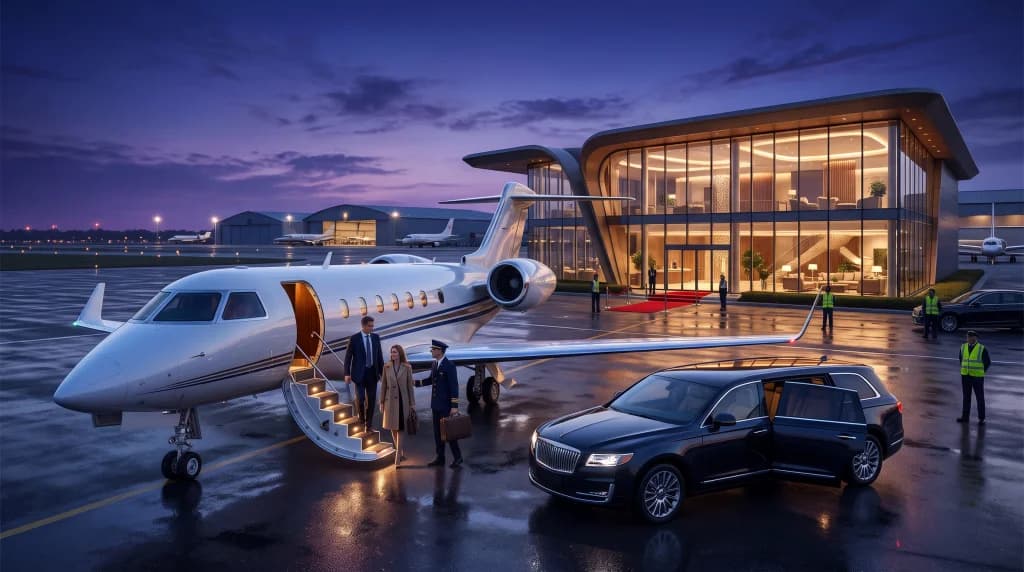
For passengers traveling via business aviation, the airport experience does not begin at the main terminal complex. Instead, cars turn down an unmarked private perimeter road, through a secured access gate, and pull up to an intimate facility that feels more like a boutique luxury hotel or a private club. From the moment the car engine cuts out until an ultra-long-range business jet—such as a Gulfstream G700, Bombardier Global 7500, or Dassault Falcon 8X—commences its taxi roll, often fewer than twelve minutes elapse. How did this discreet branch of commercial aviation develop, and what operational machinery hums quietly behind its polished marble floors?
Historical Origins: From Barnstorming Nomads to Fixed Bases
The term FBO (Fixed-Base Operator) sounds utilitarian, carrying little apparent connection to bespoke luxury. To understand its etymology, one must trace back to the United States during the roaring 1920s. Following the armistice of the First World War, hundreds of demobilized military aviators purchased surplus trainer biplanes at nominal cost, most notably the venerable Curtiss JN-4 "Jenny." Known across North America as barnstormers, these itinerant pilots lived on the wing, landing on farmland and open pastures to offer joyrides, aerobatics, and aerial stunts, collecting cash before moving on to the next county.
This transient lifestyle produced operational instability: there were no standardized maintenance standards, reliable fuel pricing, or systematic airworthiness oversight. The regulatory landscape transformed with the passage of the Air Commerce Act of 1926, which codified mandatory pilot licensing, aircraft certification, and stringent airworthiness standards. Aviation entrepreneurs who chose to establish permanent roots at designated airfields—constructing permanent hangars, offering metered fuel sales, and providing certified mechanical repairs—distinguished themselves as Fixed-Base Operators.
As post-war economic growth accelerated and the first dedicated corporate jet aircraft emerged during the 1960s (such as the pioneering Learjet 23), FBOs adapted to serve corporate demands. No longer mere maintenance hangars and refueling depots for light planes, they transformed into reception facilities for chief executives, foreign dignitaries, and high-profile artists. Over time, those early hangars evolved into expansive luxury terminals that anchor a multi-billion-dollar global industry today.
Inside Modern Executive Aviation: Anatomy of an Elite FBO
Global FBO networks—including Signature Aviation, Jet Aviation, TAG Aviation, and ExecuJet—compete to deliver hospitality environments that seamlessly merge transport infrastructure with private members' clubs. Designed by prominent architectural firms, these facilities feature fine marble, rare woods, custom furnishings, and museum-grade art collections.
Passenger Facilities: Discretion as the Primary Currency
Inside an executive terminal, travelers will find no crowded concourses or noisy departure displays. Facilities are systematically partitioned to ensure complete confidentiality:
- Private VIP Lounges: Reserved for individual families, corporate boards, or high-profile delegations. These spaces provide complete seclusion, en-suite bathrooms with showers, and direct private exits leading onto the apron.
- Executive Boardrooms: Equipped with enterprise video teleconferencing and encrypted data uplinks, allowing executives to fly in, conduct sensitive meetings on-site, and depart without entering congested city centers.
- Bespoke Haute Cuisine: Rather than standard airport retail concessions, guests enjoy curated champagne selections, cigar humidors, and culinary offerings prepared by fine-dining partners. Meals can be enjoyed on-site or packaged in dedicated service galley containers for onboard dining.
- Dedicated Customs and Immigration: Private border control stations staffed by dedicated officers. Passport verifications and customs formalities are handled smoothly in the background while passengers relax in the lounge.
Flight Crew Facilities: Designed for Pilot Rest
An FBO serves not only passengers, but also functions as an operational base for flight crews. Corporate pilots often spend hours on the ground awaiting dispatch schedules or executive arrivals. Modern FBOs therefore invest heavily in dedicated crew accommodations:
- Snooze Rooms: Sound-insulated, darkened rest cabins featuring full-size beds that allow pilots to rest and remain fully compliant with strict Flight Time Limitations (FTL).
- Flight Planning Suites: Dedicated computer terminals equipped with high-speed satellite feeds, flight-planning software, direct access to METAR/TAF weather reports, synoptic surface charts, and coordination channels with Eurocontrol and the FAA.
- Wellness and Recreation: Private gyms, saunas, lounge areas, and entertainment rooms that help crews relax between demanding instrument approaches.
The Twelve-Minute Departure: Step-by-Step Passenger Flow
To grasp the difference between commercial airline transit and executive business travel, consider a standard departure from a premier European FBO (such as London Luton, Paris-Le Bourget, or Geneva):
T - 0:20: Curbside Arrival
A vehicle pulls directly into the covered private portico of the FBO. The passenger has no parking or baggage logistics to consider. A dedicated Customer Service Representative (CSR) greets the traveler by name. Baggage is transferred directly to the ramp crew and loaded onto an apron cart.
T - 0:15: Swift Security and Border Clearances
The passenger enters the main reception lounge. There are no traditional check-in counters. A guest relations agent checks travel documents for border records while the traveler passes through a dedicated, private security checkpoint. The screening hardware matches commercial aviation standards, but the process is orderly, unhurried, and quiet, operating under the established regulatory frameworks for general aviation.
T - 0:10: Tarmac Drive or Drive-Through Hangar Access
Depending on local aerodrome regulations and passenger preferences, boarding takes place via two direct methods:
- Under-the-Wing Drive: With pre-cleared ramp passes and an escort vehicle, the passenger's car drives through an access gate directly onto the apron, parking alongside the aircraft. The passenger steps straight from the car up the airstairs and into the cabin.
- Drive-Through Hangar: Select modern FBOs (such as facilities in Dubai or Las Vegas) utilize climate-controlled, drive-through hangars. The aircraft is staged inside an immaculate hangar where vehicles pull up directly beside the wing, protecting passengers completely from inclement weather and unwanted attention.
T - 0:02: Cabin Door Closure and Taxi Clearance
The flight crew welcomes the passengers aboard, refreshments are served, and the main cabin door is sealed. Because business aviation operators typically utilize flexible non-scheduled flight plans (avoiding standard airline bank constraints where congestion allows), the crew calls for taxi clearance almost immediately after boarding. Less than fifteen minutes after arriving at the airfield, the aircraft is lining up on the runway.
The Operational Core: Ramp Operations, Fuel, and Maintenance
Beyond the refined reception lobbies, an FBO operates as a full-scale aviation service provider. The business model does not rely primarily on lounge amenities or catering fees; the core revenue engine is grounded out on the apron.
A Business Measured in Gallons of Fuel
The financial foundation of an FBO rests on the sale of aviation kerosene, primarily Jet A-1. An ultra-long-range corporate jet can upload thousands of gallons during a single transoceanic turn. The margin applied to fuel delivery (the into-plane fee) underpins the operation's profitability. To remain competitive, FBOs frequently offer a ramp fee waiver, waiving standard apron parking and handling fees (which range from several hundred to several thousand dollars) if the operator purchases a specified minimum fuel uplift.
Hangarage and Aircraft Technical Support
Modern long-range business jets represent capital investments between $20 million and upwards of $80 million. Owners require climate-controlled protection against freezing temperatures, severe hail, and intense solar exposure. FBOs construct massive heated hangars with sealed epoxy floors, offering comprehensive line support:
- Base and Line Maintenance: Certified PART-145 engineers provide overnight turnaround support, resolving minor avionics squawks, changing main wheel assemblies, or carrying out scheduled pre-flight checks.
- De-icing Operations: Dedicated de-icing rigs dispensing Type I and Type IV fluids ensure rapid aerodynamic de-contamination without joining main airport queues.
- Ground Power and Pre-Conditioned Air: Connecting ground power units (GPU) and high-capacity air conditioning carts ensures the cabin reaches a steady, comfortable temperature (such as 21°C) well before boarding.
- Aviation Detailing: Exterior airframe washes, leading-edge brightwork polishing, and specialized interior conditioning for fine leather and wood veneers.
Global Hubs of Executive Aviation: World-Renowned FBOs
Certain private aviation terminals have earned an iconic reputation, serving as key infrastructure for international diplomacy, business summits, and global entertainment events.
Paris-Le Bourget (LFPB) – The European Hub
As the busiest general aviation airport on the European continent, Le Bourget, situated just north of Paris, operates exclusively for private and corporate aviation without scheduled airline flights. The airfield hosts multiple competing FBO providers (including Jet Aviation, Skyvalet, and Astonsky). Facilities like the Astonsky terminal feature contemporary architectural styling, open atrium designs, private wine cellars, and direct ramp views from private suites.
Farnborough Airport (EGLF) – The Gateway to London
Located southwest of central London, Farnborough functions as an efficient dedicated business airport. Designed by the architectural firm 3DReid, the main terminal features an aerodynamic design reminiscent of an aircraft wing profile. Serving major financial institutions and international travelers, the airport provides discreet security handling, the adjacent luxury hotel Aviator, and advanced acoustic monitoring systems.
Al Maktoum International / Dubai South VIP Terminal (DWC)
Spanning more than 5,600 square meters, the Dubai South VIP Terminal is among the largest dedicated private terminal buildings in the world. The facility features marble finishes, private high-end duty-free boutiques, and tailored luxury vehicle fleets for apron transfers, providing support for regional dignitaries and international business leaders.
Conclusion: Time as the Ultimate Commodity
Ultimately, FBO terminals represent more than just quiet departure lounges. They function as instruments designed to conserve time—the one non-renewable asset that personal capital cannot otherwise replenish. While an international commercial traveler typically allocates three to four hours to pre-flight processing, an executive terminal compresses that investment to mere minutes.
For most travelers, these facilities remain unseen behind private security gates, enabling international enterprise, diplomacy, and leadership to move efficiently between continents. The next time you watch an executive jet climb out toward its cruising flight level, you can be certain its passengers departed smoothly from an FBO apron just moments before.