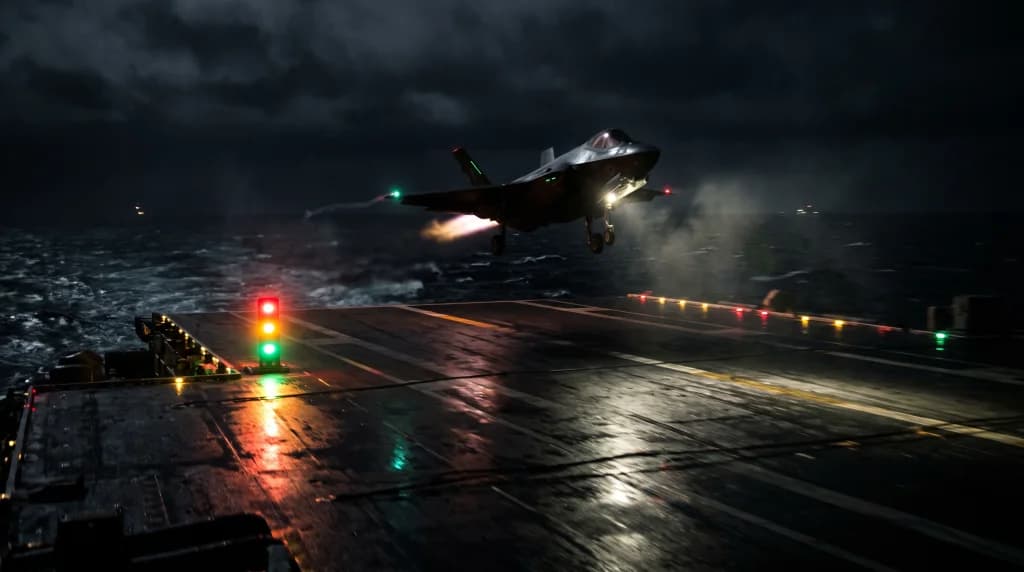
Landing on an Aircraft Carrier at Night: The Most Demanding Maneuver in Flight
Introduction: Gateway to the Black Hole
Ask any naval aviator about the single most terrifying experience of their operational military career, and they will bypass combat sorties over hostile territory, surface-to-air missile engagements, and dogfights without a second thought. Every one of them points to the same recurring nightmare: a night carrier landing on a deck heaving in Sea State 4 or 5 beneath a pitch-black, moonless sky. In the lexicon of US Navy tailhook aviators, this evolution is known as a Night Trap or Blue Water Op, and the visual approach toward the ship through zero-visibility oceanic blackness is described bluntly as "flying into the black hole."
From an altitude of several thousand feet on an overcast, moonless night, the ocean merges with the sky into a monolithic, featureless void devoid of any visible natural horizon. In this total absence of external cues, a 330-meter nuclear-powered supercarrier—whether a Nimitz or Gerald R. Ford class displacing one hundred thousand tons of steel—does not look like a massive floating air base. From the cockpit of an F/A-18E Super Hornet or an F-35C Lightning II, the vessel appears as an infinitesimal, pitching matchbox marked by faint pinpoint lights, cutting through the swells at 30 knots into the dark. The aviator must drive a 20-ton, supersonic strike fighter onto an arresting area less than one hundred meters long, maintaining a descent rate that on land would constitute a severe crash. There is no flare, no margin for hesitation, and no second-guessing: it is a controlled collision, where error budgets are measured in inches and fractions of a second.
The Physiology of Terror: Resting Pulses at 180 Beats per Minute
The acute stress accompanying a night carrier approach is not a matter of subjective perception—it is a measurable, physiological reaction. During the 1970s and 1980s, the Naval Aerospace Medical Institute conducted comprehensive biometric telemetry studies, tracking the vital signs of F-4 Phantom II and F-14 Tomcat crews across diverse flight profiles. Researchers logged heart rate, blood cortisol levels, galvanic skin response, and respiratory frequency during daytime combat strikes into heavily defended airspace in North Vietnam and contrasted them directly against night carrier recoveries.
The empirical data surprised military flight surgeons. In active combat runs facing flak and surface-to-air missiles, seasoned aviators maintained heart rates between 130 and 150 bpm. The moment those same pilots intercepted the glideslope on a night approach to a pitching carrier deck, their heart rates spiked to 180–195 beats per minute. The sympathetic nervous system engaged a full fight-or-flight cascade, flooding the bloodstream with epinephrine, inducing tunnel vision, and degrading fine motor coordination. Aviators returning to ready rooms after an evening recovery were physically and psychologically depleted, their anti-G suits drenched with sweat.
The underlying driver of this visceral response is Spatial Disorientation (SD). The human vestibular system, evolved over millennia for upright bipedal motion governed by Earth's gravity and a reliable visual ground plane, turns lethal over a dark ocean. Somatogravic illusions triggered by rapid linear deceleration and angular acceleration send false sensory inputs convincing the brain that the aircraft is pitching up into a climb, when in reality it is descending toward the wave tops. Yielding to physical sensation during this phase results in disaster—the only defense is total, disciplined reliance on cockpit flight instruments and optical recovery cues.
Flight Deck Dynamics: Angles, Crosswinds, and Arresting Gear
To grasp the technical demands of carrier aviation, one must look closely at flight deck geometry. Modern supercarriers incorporate an Angled Flight Deck, canted roughly 9 degrees to port relative to the ship's longitudinal centerline. Introduced in the 1950s, this design permits simultaneous catapult launches off the bow while providing a clear rollout path for go-arounds during landing. For the approaching pilot, however, this angle creates a distinct aerodynamic problem: because the carrier is steaming forward at high speed, the landing area constantly translates forward and to the right relative to the aircraft's inbound velocity vector. The pilot must apply continuous, nuanced lineup corrections down to touchdown to prevent drifting left off the recovery axis.
The Arresting Zone: Four Wires Dictating Survival
Across the landing deck stretch heavy-duty steel wire ropes (Arresting Wires), connected below decks to advanced hydraulic arresting engines or electromagnetic systems (such as the Advanced Arresting Gear, AAG). Legacy ships feature a four-wire array, while newer configurations use a three-wire layout, numbered sequentially from the stern:
- 1-Wire: Positioned closest to the stern ramp (the Rounddown). Snagging the 1-Wire represents a dangerous recovery, indicating an approach that flew uncomfortably low on glideslope. A fraction of a second of lag or an adverse downdraft risks impacting the vertical steel transom of the carrier—a catastrophe termed a Ramp Strike, which typically shears the landing gear, ruptures fuel cells, and destroys the airframe.
- 2-Wire: An acceptable catch, though below optimum target parameters.
- 3-Wire (The Target Wire): The gold standard of naval aviation. This is the precise touchdown point targeted by the ship's optical glidepath projectors. Catching the 3-Wire confirms ideal energy management, tight glideslope discipline, and yields top marks from the landing signal officers.
- 4-Wire: Trapping the final wire indicates a flat, long, or high approach. Missing all wires entirely results in a Bolter—where the tailhook skips over the cables, sliding across the deck without arresting the aircraft.
Six Degrees of Freedom on the High Seas
A runway on dry land remains fixed and predictable. An aircraft carrier navigating an active sea swell operates across six degrees of freedom simultaneously:
- Pitch: The bow and stern oscillate vertically by dozens of feet. As the stern rises, the touchdown zone moves rapidly upward toward the descending jet, sharply increasing touchdown G-loading.
- Roll: Lateral tilting of the ship that cants the recovery deck left and right relative to the aircraft's wings.
- Heave: Pure vertical displacement of the entire ship driven by ocean swells.
Compounding these motions is the Burble—an area of severe mechanical turbulence, localized vortices, and severe sinking air created in the wake of the carrier's massive island superstructure and square stern. Over the final 1,500 feet of the approach, the aircraft flies directly through this disturbed wake. The resulting instantaneous loss of lift requires an immediate, anticipated power application to prevent the jet from dropping dangerously below glideslope right before the ramp.
Optical Guidance: The Meatball
When vestibular feedback and natural visual cues fail, an aviator flying a night recovery relies completely on a specialized electro-optical deck assembly mounted on the port catwalk: the IFLOLS (Improved Fresnel Lens Optical Landing System), known universally across the fleet as the Ball or Meatball.
The IFLOLS is a gyro-stabilized system of lenses and light sources projecting a 3.5-degree optical glidepath astern the ship. It consists of a vertical stack of amber cell lights positioned between horizontal rows of fixed green datum lights:
- Amber Ball Centered with Green Datums: The aircraft is established on the correct glideslope.
- Amber Ball Above Datums: The aircraft is high. The pilot must gently ease the throttles back, careful not to bleed critical airspeed.
- Amber Ball Below Datums: The aircraft is descending below the glideslope. The lower the amber ball drops, the more urgent the recovery correction. If the ball drops to the bottom and illuminates the red low-cell, the aircraft is in immediate danger of a ramp strike.
Mounted alongside the IFLOLS are vertical columns of flashing red Wave-Off Lights. If a landing signal officer identifies an unstable profile, excessive deck motion, or a fouled landing area, they trigger the wave-off lights. To the pilot, this command is unequivocal: immediately abort the landing, advance throttles to maximum afterburner, and climb away into the holding pattern.
The Recovery Circuit: From Marshall Stack to Case III Recovery
Carrier recoveries conducted at night, or with cloud ceilings below 1,000 feet and visibility under 5 nautical miles, are classified strictly as Case III Recoveries. Visual flight rules are suspended in favor of disciplined instrument flight rules (IFR).
1. Holding in the Marshall Stack
Returning strike aircraft do not fly directly to the carrier. Between 15 and 50 nautical miles astern the ship, aircraft enter the Marshall Stack—a virtual, radar-managed holding pattern operated by air traffic controllers inside the Carrier Air Traffic Control Center (CATCC) deep within the ship's armored hull. Aircraft orbit at staggered 1,000-foot altitudes (e.g., 6,000 ft, 7,000 ft) separated by one-minute time intervals, awaiting individual push times timed to the second.
2. The Inbound Approach
Cleared by CATCC, the pilot leaves the holding fix, initiating a rapid penetration descent at roughly 4,000 feet per minute and 250 knots indicated airspeed toward an initial instrument gate. At 10 nautical miles, the aircraft slows and configures: landing gear down, flaps set to full, and the arresting tailhook extended. The pilot establishes precise approach speed ($V_{\text{APP}}$) and locks in the prescribed Angle of Attack (AoA), verified by the three-light indexer mounted beside the Head-Up Display (HUD).
3. Transition to Visual: The Ball Call
At approximately 0.75 nautical miles from the rounddown, at an altitude of 350 to 400 feet over black ocean, the pilot must acquire the IFLOLS visually. Once in sight, the pilot makes the defining radio transmission of the flight:
"Hornet Ball, 5.2" (Aircraft type, visual confirmation of the Meatball, and remaining fuel state in thousands of pounds).
From the exposed port platform near the touchdown wires, an experienced naval aviator serving as the Landing Signal Officer (LSO) responds:
"Roger Ball, 30 knots, call the ball."
For the final 18 seconds of the approach, the pilot stops cross-checking inside the cockpit. Vision locks onto the amber Meatball, line-up cues, and the AoA indexer. Minute, instinctive throttle inputs are required continuously to balance kinetic energy against the ship's heave.
The Controlled Collision: No Flare and Full Throttle
One of the most persistent habits civilian and land-based air force pilots must break during carrier conversion is the instinct to flare before touchdown. On a paved ground runway, a pilot gently eases back on the stick, levels the descent, and arrests vertical velocity, allowing the tires to kiss the asphalt. Flaring on an aircraft carrier is catastrophic.
Lifting the nose to cushion the touchdown causes the tailhook to skip clean over the arresting wires, or risks stalling the aircraft into the rounddown. Consequently, carrier approaches are flown straight onto the deck with an unyielding sink rate of 700 to 800 feet per minute (approximately 4 m/s). The aircraft flies directly into the steel deck with immense force. Navy landing gear struts, drag links, and shock absorbers are built two to three times beefier than their land-based counterparts to absorb a force that would structurally compromise a standard civil aircraft.
The Rule of Full Power: Overriding Natural Instincts
When a conventional aircraft touches down, the pilot closes the throttles to idle and applies brakes. On an aircraft carrier, the pilot executes the exact opposite: the split second the main tires slam into the deck, the throttles are slammed forward into full military power or maximum afterburner!
This aggressive throttle push is an indispensable safeguard against a Bolter. If the tailhook fails to engage an arresting wire or a cable fractures, the aircraft has insufficient roll distance to stop before running off the end of the angled deck. If the engines were at flight idle, spool-up latency (taking 3 to 5 seconds) would be far too slow: the jet would slide off the deck edge into the sea and be overridden by the ship's bow. At full power, an unhooked aircraft simply climbs back into the air, flying safely through the bolter pattern for another attempt.
Only when the pilot experiences the violent, visceral deceleration of a successful trap—a sustained -3 to -4 G shock that jerks the body forward into the five-point harness, stopping an aircraft from 140 knots to a complete standstill in two seconds across less than 300 feet—do they know the wire has held. Once the LSO confirms the trap over the radio, the throttles are brought to idle, the tailhook is raised, and the aircraft taxis clear of the landing area.
Modern Avionics: The Impact of Magic Carpet
For decades, night recoveries took a significant operational toll on airframes and flight crews. The operational baseline changed substantially in recent years with the fleet introduction of advanced flight control software known officially as Precision Landing Modes (PLM), colloquially dubbed Magic Carpet.
Prior to Magic Carpet, an aviator manually decoupled and balanced three interdependent flight variables using distinct controls: cyclic pitch on the stick regulated angle of attack, throttle governed the glideslope rate of descent, and rudder inputs compensated for the angled deck offset. Correcting one variable invariably unsettled the other two. Magic Carpet integrated these control loops into a single, cohesive digital Fly-by-Wire control law:
- Instead of commanding individual control surfaces, the pilot uses the stick to directly manipulate the Flight Path Vector (FPV).
- If the aircraft needs an adjustment to maintain glideslope, the flight control computers automatically adjust symmetric aileron droop, leading-edge flaps, and engine spools to preserve the programmed angle of attack without requiring constant manual throttle cycling.
- The software dynamically dampens turbulence from the carrier's burble and adjusts for deck heave, reducing the pilot's control inputs in the final seconds from several hundred to just a handful.
The operational metrics of PLM across the F/A-18E/F Super Hornet and F-35C fleets have been decisive: first-pass night boarding rates increased from historical averages of 75–80% to nearly 98%, while the dispersion of touchdown points narrowed to a small radius around the 3-Wire. Even so, automated flight modes do not alter physical limits: severe sea states, avionics failures, and unpredictable carrier deck motion continue to require baseline manual airmanship.
Conclusion: The Defining Standard of Naval Aviation
Landing on an aircraft carrier at night remains one of the most demanding benchmarks of professional flying discipline, procedural precision, and mental resilience. The operating environment offers no leniency or margin for error, forcing aerodynamic limits and machine tolerances into direct contact with human biology.
When the arrestment is complete, the engines spool down, and the canopy opens to the smell of burnt rubber, ocean spray, and JP-5 exhaust fumes, the aviator's pulse slowly normalizes—until the next night launch. As long as floating airstrips operate across open oceans, the Night Trap will stand as the ultimate test of aviation skill, where pilots push past natural human instincts to execute a textbook landing on a pitching deck in the dark.