

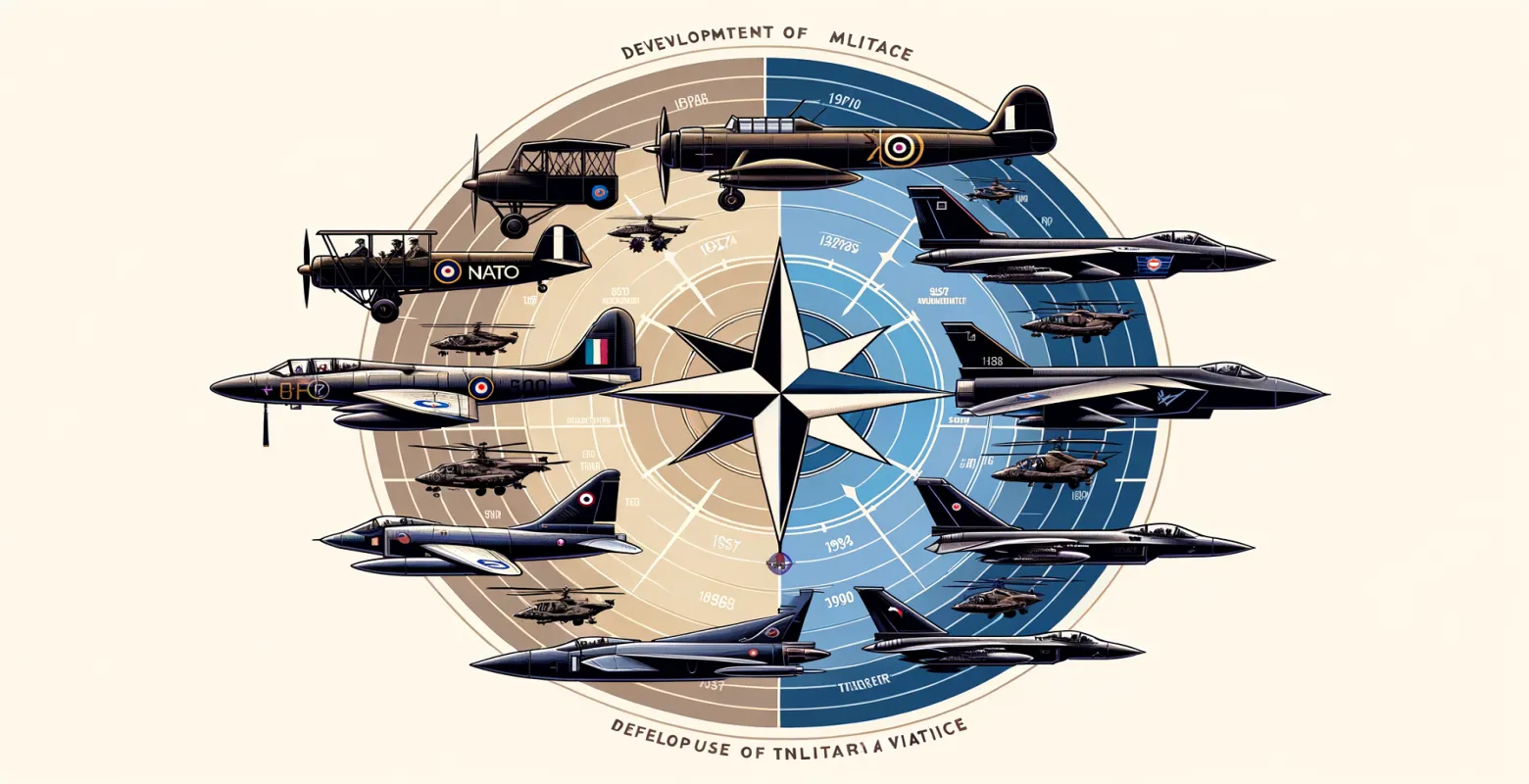
The history of the development of military aviation in NATO
Introduction
Military aviation plays a key role in ensuring international security within the framework of the North Atlantic Treaty Organization (NATO). Since NATO's establishment in 1949, military aviation has undergone remarkable evolution, responding to changing challenges and defense needs. Contemporary NATO military aviation involves not only advanced technology but also complex strategies and international cooperation. In this article, we will examine the history of the development of military aviation in NATO, its significance, and future trends that may impact this crucial defense domain.
History of Military Aviation in NATO
The origins of NATO military aviation date back to the period after World War II when, faced with growing tensions between East and West, Western countries decided to strengthen their defense cooperation. In the early 1950s, NATO began integrating its air forces to effectively counter potential threats from the Warsaw Pact. The first aircraft used by NATO were mainly American and British designs, such as the North American F-86 Sabre and Hawker Hunter, which were utilized for both air defense and ground attacks.
Technological Evolution and Advanced Weapon Systems
NATO military aviation has continuously evolved in response to strategic needs and technological advancements. The 1960s and 1970s saw the introduction of more advanced aircraft, such as the McDonnell Douglas F-4 Phantom II, which became a key fighter in NATO's arsenal. During this period, stealth technologies were also developed, allowing for reduced aircraft detectability by enemy radars.
In the 1980s and 1990s, NATO invested in the development of precision weapon technologies. The introduction of systems like the Joint Direct Attack Munition (JDAM) enabled precise strikes on ground targets from long distances, significantly enhancing operational efficiency. Aircraft such as the F-16 Fighting Falcon and Panavia Tornado became the backbone of NATO air forces, combining advanced technologies with versatile applications.
Contemporary Challenges and Adaptation
Currently, NATO military aviation faces a range of challenges, both technological and strategic. One key aspect is the integration of new technologies, such as drones and artificial intelligence, which can significantly alter the conduct of military operations. Drones like the MQ-9 Reaper are already widely used for reconnaissance and attacks, offering new operational capabilities while minimizing risks to crews.
The increasing importance of cybersecurity is another challenge that NATO air forces must address. Modern military systems are increasingly reliant on digital technologies, making them vulnerable to cyber attacks. NATO is investing in security developments and personnel training in cyber defense to counter potential threats.
International Cooperation and Joint Operations
One of the key elements of NATO military aviation's success is the ability to cooperate and conduct joint international operations. Exercises such as Red Flag and Baltic Operations (BALTOPS) allow for testing the interoperability of air forces from different member countries, which is essential for the effective execution of missions within the alliance.
International cooperation also encompasses joint technological projects, such as the Joint Strike Fighter (JSF) program, which resulted in the creation of the F-35 Lightning II. This modern multirole fighter, used by many NATO countries, is an example of successful technological cooperation that benefits all participants.
The Future of Military Aviation in NATO
The future of NATO military aviation will be shaped by further technological advancements and evolving strategic needs. The introduction of quantum technologies, the development of artificial intelligence, and further miniaturization of weapon systems can significantly impact the conduct of military operations.
Simultaneously, changing geopolitical environments, such as growing tensions in Asian and Arctic regions, may influence NATO's strategic priorities. Military aviation will have to adapt to new challenges, such as increased military presence in regions of high geostrategic importance.
Conclusion
The history of the development of military aviation in NATO is a tale of constant adaptation and innovation in the face of changing challenges. From early fighter aircraft to advanced drone systems and stealth technologies, NATO military aviation plays a crucial role in ensuring international security. Considering the dynamic technological developments and evolving strategic needs, the future of this sector promises to be equally dynamic. It is worth observing how NATO will adjust its air forces to new challenges to continue effectively protecting its members and the values it represents.


Number of comments: 0