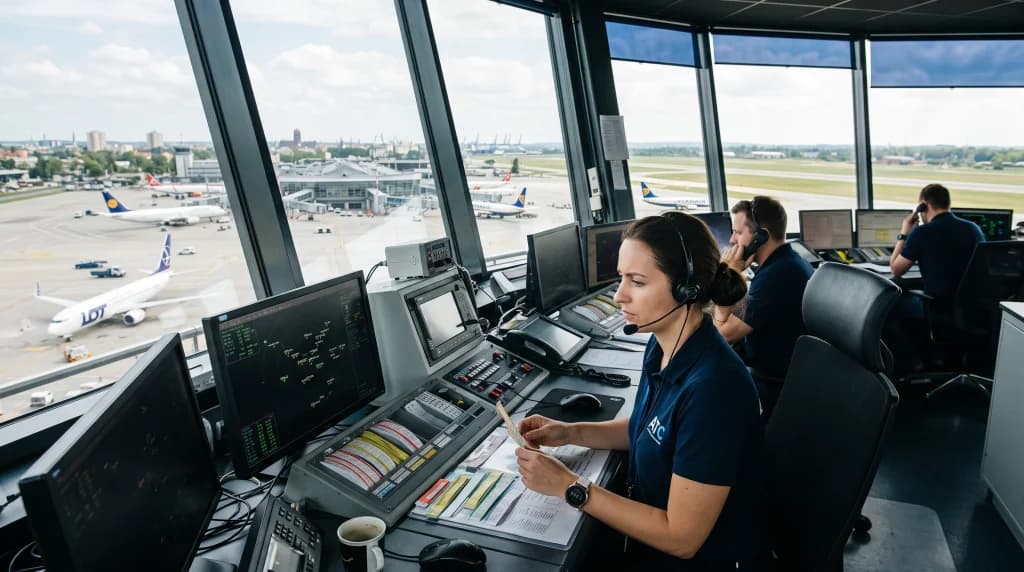
Inside the Air Traffic Control Tower: 60 Seconds During Peak Hours
Introduction: The Glass Fortress Above the Concrete Labyrinth
For a passenger seated by the window, an airport traffic control tower (TWR – Aerodrome Control Tower) is typically nothing more than a sleek, futuristic silhouette rising somewhere in the distance beyond the terminal. It stands as a distinctive architectural landmark, topped by outward-slanted, anti-glare glass panels tinted in dark green or deep graphite. Many picture the interior as an oasis of quiet calm, where well-dressed professionals gaze through binoculars at taxiing aircraft, sip coffee, and issue occasional concise radio calls into a microphone.
The operational reality is entirely different. When morning bank departures or the late-afternoon arrival push hit a major international hub, the Visual Control Room (VCR) transforms into a demanding, high-tempo decision-making center. In this environment, a lapse does not mean a missed deadline or a revised calendar entry. Every word spoken into the frequency coordinates hundreds of tons of aluminum alloys, composite airframes, aviation kerosene, and human lives. Time is measured in split seconds, and the allowable margin for error along the runway centerline is zero.
To understand modern aerodrome control, one must step into the cab at the peak of inbound and outbound traffic. Consider a single sixty-second window in the working life of a tower controller—a minute that would present severe cognitive overload to an untrained observer, but represents a practiced sequence of decisions for the professional working the position.
Anatomy of the Visual Control Room: Staffing the Tower Cab
Before breaking down that sixty-second interval, consider how operational responsibilities are allocated within the Visual Control Room. An aerodrome control tower at a high-density facility does not operate as a single-person post. Workload is divided across specialized operating positions functioning in close coordination:
- Tower Controller (TWR / Air Controller): Responsible for active runway operations. This controller manages the active runway surfaces and the immediate final approach and departure corridors. They issue landing clearances (Cleared to land), departure clearances (Cleared for takeoff), and runway crossing authorizations (Cross runway). This is the position followed second by second below.
- Ground Controller (GND): Manages ground movements across taxiways and apron transition lanes. This controller directs the ground routing of aircraft between parking stands and runway holding points, ensuring wide-body aircraft with wingspans exceeding sixty meters maintain required taxiway clearances.
- Clearance Delivery (DEL): The initial radio contact for outbound flight crews, issuing air traffic control route clearances (ATC Clearances) in accordance with filed flight plans, assigning Standard Instrument Departures (SIDs), and designating discrete transponder squawk codes.
- Tower Coordinator / Assistant: Manages inter-facility coordination with Approach Control (APP), Airport Rescue and Firefighting (ARFF), and airfield operations teams, while keeping Electronic Flight Strips updated across positions.
Surveillance Displays and Digital Tools in Low-Visibility Operations
Direct visual contact through the glass remains a core part of aerodrome control, but modern controllers rely heavily on integrated digital surveillance tools:
- A-SMGCS (Advanced Surface Movement Guidance and Control System): Ground surface radar architecture that combines primary surface radar feeds, Multilateration (MLAT) sensors, and ADS-B signals broadcast by aircraft and airfield service vehicles. Every target appears on the display accompanied by a data tag showing its callsign, ground speed, and status.
- RIMCAS (Runway Incursion Monitoring and Conflict Alert System): A mathematical safety monitor that evaluates the trajectories of airborne and ground targets. If two vehicles or aircraft breach spatial safety buffers on a collision course near or on an active runway, the system triggers visual and audible alerts to warn of an impending runway incursion before it may be evident to the naked eye.
- Approach Monitor Display: A radar screen presenting the extended final approach course, displaying the arrival stream separated by standard three- to five-nautical-mile intervals as aircraft descend along the glideslope at ground speeds of 130 to 160 knots.
- Electronic Flight Strips (EFS): High-resolution touchscreen systems that replace physical paper progress strips. Dragging an electronic strip across boundary lines digitally transfers control and responsibility between the Ground and Tower positions.
Sixty Seconds During Peak Traffic: A Timeline of Micro-Decisions
Consider an operational morning bank at a hub such as London Heathrow, Frankfurt, or Warsaw Chopin. The time is 08:14:00 local. Surface winds are 260 degrees at 14 knots, cloud ceilings sit at 800 feet, and visibility is 4,000 meters. Runway 27 is the active landing and departure surface. Inbound traffic is established on the localizer, and an outbound queue waits at the runway entry points. Working the Tower position is an experienced controller with a decade of service on the glass, operating with sustained focus.
00 to 10 Seconds: Separation Minima and Heavy Wake Vortex Spacing
08:14:00 – On the final approach monitor, a Boeing 777-300ER (callsign: Speedbird 114, landing mass roughly 230 metric tons) descends through 400 feet above ground level. Approach speed $V_{\text{APP}}$ is stabilized at 148 knots. The heavy wide-body is 1.2 nautical miles from the threshold of Runway 27. The crew received landing clearance half a minute earlier, but the runway is not yet vacant. The preceding arrival, an Airbus A320, is rolling out toward a Rapid Exit Taxiway.
08:14:03 – The controller looks out through the cab windows, observing the turn angle of the A320. The narrow-body's main gear rolls past the yellow painted lines of the taxiway holding position. Only once the trailing edge of the airframe clears that holding point is the runway legally clear.
08:14:06 – As the heavy Boeing crosses the threshold, the controller depresses the floor-mounted Push-to-Talk (PTT) switch, issuing a conditional clearance to a waiting regional jet holding at Taxiway Echo:
"LOT 45 Zulu, behind landing Boeing 777, line up and wait runway 27 behind."
08:14:09 – The captain of the LOT Embraer 195 responds with the mandatory readback: "Behind landing Boeing 777, line up and wait runway 27 behind, LOT 45 Zulu." The Line Up and Wait procedure maintains runway throughput by positioning an departure on the centerline while the preceding arrival finishes its deceleration rollout.
10 to 25 Seconds: Wake Turbulence Intervals and Runway Occupancy
08:14:12 – The tires of the Boeing 777 touch down on Runway 27 with visible smoke within the touchdown zone. As 230 tons transfer from the wings to the landing gear, two counter-rotating horizontal vortices form off the wingtips: Wake Turbulence. Under ICAO wake turbulence categorization, the Boeing 777 is classified as HEAVY, whereas the trailing Embraer 195 is categorized as MEDIUM. This pairing requires a mandatory two-minute wake turbulence departure interval (or corresponding radar distance separation). The controller monitors this timing carefully, balancing safety margins with operational flow.
08:14:17 – A glance down at the A-SMGCS surface display shows the Boeing 777 decelerating under reverse thrust and wheel braking, slowing through 50 knots as it approaches Rapid Exit Taxiway Bravo 4. Concurrently, the approach display shows the next inbound: an Air France Airbus A220-300 established at 4.5 nautical miles, indicating 140 knots, with an estimated time to touchdown of roughly 115 seconds.
08:14:22 – The Embraer taxies onto the centerline of Runway 27 to complete its before-takeoff checks, while the Boeing 777 finishes its rollout downfield. In the cab, the coordinator updates the electronic strip system to log the touchdown time of the heavy arrival.
25 to 40 Seconds: Clearing the Active Runway and Frequency Transfers
08:14:26 – The Boeing 777 initiates a 30-degree exit turn into Taxiway Bravo 4. Its horizontal stabilizer and right wingtip clear the runway edge light boundary, clearing the active runway surface.
08:14:28 – The controller presses the PTT pedal: "Speedbird 114, vacating runway, contact Ground 121.9."
08:14:31 – The crew acknowledges: "Ground 121.9, Speedbird 114, good day." Control of the wide-body passes immediately to the ground controller seated at the adjacent console. The tower controller's attention shifts back to the Embraer holding on the threshold and the inbound Air France flight on short final.
08:14:35 – The controller assesses the timing: Can the Embraer begin its takeoff roll, lift off, and satisfy departure separation ahead of the A220, now at 3.5 nautical miles? Dispatching the regional jet now allows the steady headwind to help dissipate the residual wake vortices while keeping the arrival on schedule. Hesitating for five seconds would compromise safety margins, requiring a go-around that burns fuel, introduces delays, and disrupts the approach sequence.
40 to 50 Seconds: Issuing the Takeoff Clearance
08:14:39 – The assessment confirms appropriate margins under Reduced Runway Separation Minima (RRSM) guidelines.
08:14:41 – "LOT 45 Zulu, wind 260 degrees 13 knots, runway 27, Cleared for takeoff!"
08:14:44 – "Runway 27, Cleared for takeoff, LOT 45 Zulu," confirms the crew over the frequency. Its two General Electric CF34 powerplants spool up to takeoff thrust, and the regional jet accelerates down the centerline.
08:14:48 – On the southern airfield perimeter, an airport safety vehicle (callsign Leader 1) holds short of the threshold at Runway 09, requesting entry for a routine Foreign Object Debris (FOD) inspection. Without shifting focus from the departing aircraft, the controller directs the coordinator via the internal intercom: "Advise Leader 1 to hold at Echo 1; entry approved after the Air France arrival."
50 to 60 Seconds: Airborne Hand-Off and Final Approach Clearance
08:14:52 – The Embraer reaches rotation speed ($V_R$), raises its nose, climbs out, and retracts its landing gear. At that same moment, the Air France A220 descends through 600 feet, emerging from the cloud base on the final approach track to Runway 27 at 1.8 nautical miles.
08:14:55 – As the departing regional jet crosses the upwind threshold during its initial climb, the controller transfers the flight to the departure sector: "LOT 45 Zulu, contact Warsaw Departure 128.8, bye!"
08:14:57 – The controller verifies that Runway 27 is clear. The RIMCAS surface monitor confirms no conflicts. The inbound A220 shows a stable approach path on the Precision Approach Path Indicator (PAPI: two white, two red).
08:14:59 – The controller depresses the PTT: "Air France 11 Victor, wind 260 degrees 14 knots, runway 27, Cleared to land."
08:15:00 – "Runway 27, Cleared to land, Air France 11 Victor."
The digital clock advances to 08:15:00. Over sixty seconds, one airliner cleared the runway, another lined up and departed, a third was cleared to land, and an airfield inspection unit was safely held in position. Three hundred tons of transport aircraft and over four hundred passengers navigated a critical surface bottleneck on schedule, with fifty-nine minutes remaining in the operational hour.
Cognitive Performance: Processing Complex Information Streams
What can look like rapid multitasking from the outside is actually an exercise in focused mental prioritization. Human cognition cannot sustain parallel conscious processing of complex, high-stakes tasks without performance loss. Air traffic controllers handle these demands using Rapid Sequential Processing backed by continuous Situational Awareness modeling.
1. Dynamic Spatial Awareness
Controllers do not view surface and radar displays as flat arrays of targets and tags. They translate telemetry metrics—including ground speed, crosswind drift, wake vortex categories, and deceleration rates—into an intuitive four-dimensional mental model (spatial coordinates over time). An experienced controller watches where an aircraft is, while projecting where it will be in 45, 90, and 120 seconds.
2. Standardized Phraseology: Clear and Unambiguous Communication
Aviation radiotelephony leaves no room for ambiguous wording or informal phrasing. Standardized ICAO phraseology functions as a structured verbal protocol where specific terms carry precise legal meanings:
- The word "CLEARED" is reserved exclusively for safety-critical control authorizations: takeoff, landing, or instrument approaches. Other operational instructions use terms like "APPROVED" or "PROCEED" to minimize confusion over noisy radio frequencies.
- The Hearback / Readback loop requires pilots to read back specific instructions verbatim, while controllers verify that every detail is correct. If a crew misidentifies a taxiway designator or altitude restriction and the controller fails to correct it, both share accountability. A controller's listening habits are attuned to catch minor discrepancies in numbers, callsigns, and clearances.
Workload Management and Operational Shift Rotation
Managing aerodrome operations during peak periods demands high cognitive effort. Extended exposure to these stressors can lead to tunnel vision, an attentional narrowing where an individual fixates on a single operational problem—such as an aircraft slow to clear a runway—while missing secondary risks elsewhere on the airfield.
Civil aviation authorities address fatigue risks through strict duty-time limitations:
- Continuous operational time at an active control position is typically capped at 90 to 120 minutes. Controllers then take mandatory 30- to 45-minute rest breaks before returning to position.
- Operational teams apply structured Team Resource Management (TRM) principles. Controllers monitor colleagues on position; if a coordinator notes an air controller speaking too quickly or showing signs of fatigue, they assist with communications or initiate an early relief rotation.
Modern Developments: Remote and Digital Towers
Physical airport control towers are changing as modern surveillance technology matures. Smaller and mid-sized airfields across Scandinavia, Germany, and the UK increasingly adopt Remote and Virtual Towers (RVT).
High-resolution panoramic camera masts, infrared sensors, and LiDAR arrays capture the airfield environment, transmitting low-latency video to centralized digital centers located hundreds of kilometers away. Controllers work before panoramic display arrays enhanced by Augmented Reality (AR) overlays that display wind vectors, target tags, and runway status indicators directly over the visual presentation.
At major global hub facilities managing complex parallel runways and extreme movement rates, the visual perspective from an on-site control cab—supported by primary radar, A-SMGCS, and experienced controllers—remains central to daily operations.
Conclusion: The Skill Behind the Glass
The next time your flight departs through low visibility or lands smoothly at a major international hub, look out across the airfield at the control tower standing above the terminal complex. High above the ramp, a controller is monitoring the surface and sequencing traffic.
Within seconds, controllers balance safety separations, account for invisible wake vortices behind arriving heavy jets, and guide aircraft toward safe operations. Their expertise and focus help keep the world's commercial aviation system running smoothly and safely every day.