Controlled Rest and Cockpit Alertness: How Pilots Manage In-Flight Fatigue
Introduction: The Silent Passenger at Cruising Altitude
The flight deck clock reads 03:40 Coordinated Universal Time (UTC). A state-of-the-art wide-body Boeing 787 Dreamliner cruises through the ink-black night across the Arabian Sea at flight level FL390 (roughly 11,900 meters), bound from Bangkok to Frankfurt. Inside the passenger cabin, a hushed quiet prevails: three hundred passengers sleep in darkness lit only by the soft glow of seatback entertainment displays. Automated flight management systems guide the aircraft along its route with precision down to meters, fly-by-wire envelopes trim the airframe, and twin Rolls-Royce Trent 1000 turbofans maintain a steady hum beyond the windows.
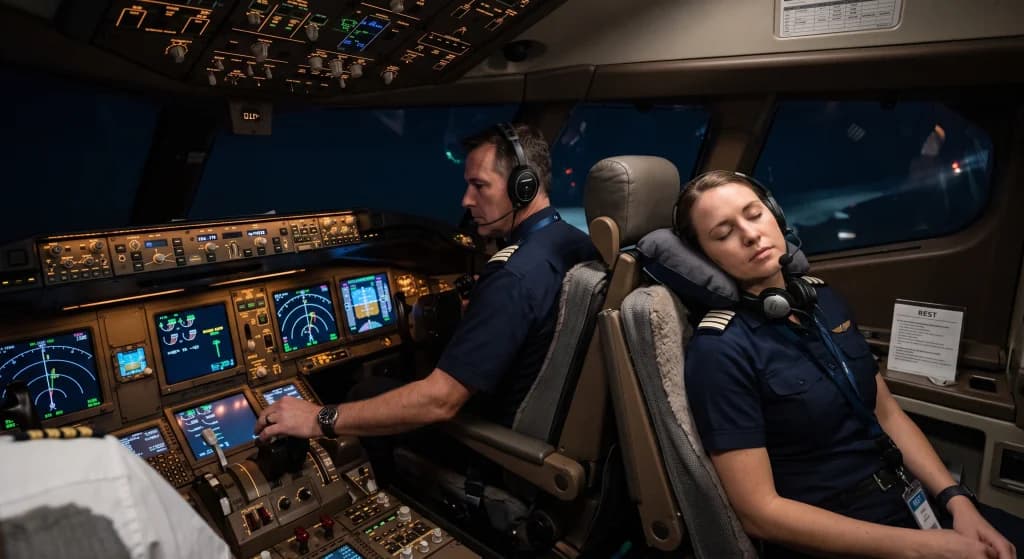
Behind the armored flight deck door, however, a subtle neurobiological struggle is underway that few passengers ever consider. Two seasoned airline pilots are contending with an elemental human vulnerability: accumulated sleep debt, the circadian biological trough (Window of Circadian Low), and the hypnotic monotony of long-range automated cruise flight. Instrument panels cast a subdued luminescence, cockpit ambient temperature is regulated, and air traffic control frequencies have remained silent for dozens of minutes. The first officer's eyelids stay closed a moment too long. The captain's chin dips gently with subtle micro-turbulence. In operational aviation medicine, this state is recognized as microsleep—an involuntary, fleeting lapse of cortical awareness that often occurs without conscious recognition.
Historically, pilot fatigue was treated as an operational taboo, dismissed as a lack of personal resilience or masked with successive cups of black coffee. Today, shaped by decades of aeromedical research and flight data recorder analysis, international civil aviation authorities (EASA, FAA, ICAO) categorize pilot fatigue as a serious operational risk factor in commercial aviation. This shift led to the development of standardized operating procedures: Controlled Rest on the Flight Deck, automated crew alertness monitoring platforms, and data-driven Fatigue Risk Management Systems (FRMS). How does regulated napping work at 900 km/h? Why are flight crews restricted from sleeping longer than 40 minutes, and what is sleep inertia—the cognitive fog that can leave a flight crew member disoriented during critical maneuvers?
Fatigue Physiology at 39,000 Feet: Why the Brain Succumbs
Understanding why pilots nod off requires looking past willpower. Fatigue in long-haul aviation is not a mindset; it is a biochemical limitation driven by three intersecting operational factors.
1. The Window of Circadian Low (WOCL)
Human physiology is regulated by an internal biological pacemaker located within the hypothalamic suprachiasmatic nuclei. This rhythm produces the Window of Circadian Low (WOCL), which typically falls between 02:00 and 05:59 according to an individual's home base body clock. During this window, core body temperature drops, melatonin secretion peaks, and arterial blood pressure decreases as the body shifts toward cellular restoration.
If flight crews must fly an oceanic crossing or conduct an instrument approach during this period, psychomotor reaction times can increase by 50% to 100%, divided attention suffers, and prefrontal executive functions—critical for handling non-normal system alerts—experience degradation equivalent to a blood alcohol concentration of 0.5 to 0.8 per mille.
2. Mild Hypobaric Hypoxia and Dehydration
Modern commercial airliners maintain cabin pressure altitudes between 6,000 and 8,000 feet (1,800 to 2,400 meters above sea level; composite airframes like the Dreamliner and Airbus A350 typically cruise near 6,000 feet). Consequently, the alveolar partial pressure of oxygen is lower than at sea level, reducing arterial blood oxygen saturation (SpO2) from standard 98% baselines down to 90%–93%.
This state of mild subclinical hypobaric hypoxia does not cause overt altitude sickness, but it acts on the central nervous system like a mild sedative: inducing lethargy, mental fatigue, and heavy eyelids. Combined with cockpit relative humidity levels that often fall below 10%, mucous membrane dryness, and the constant broadband acoustic hum of avionics cooling fans and air conditioning packs, it creates an environment conducive to drowsiness.
3. The Automation Paradox: Transitioning from High Workload to Hypovigilance
In a contemporary glass cockpit, flight crews rarely manipulate physical flight controls directly for more than several minutes after departure and prior to touchdown. The bulk of a long-haul flight consists of monitoring automated flight systems. Cognitive psychologists have documented this operational paradox: the human mind is ill-suited for sustained visual monitoring of unchanging, highly reliable automated environments. Lacking external sensory stimulation, the brain transitions into hypovigilance, a diminished arousal state from which an uncommanded descent into microsleep can easily follow.
Controlled Rest: Regulated In-Seat Sleep on the Flight Deck
For decades, legacy safety models operated on a flawed assumption: both pilots had to remain fully alert across 100% of every flight phase. This approach often led pilots to fight exhaustion until both succumbed simultaneously (known as simultaneous unintentional sleep). In a notable 2008 incident, a Boeing 737 operated by go! airlines on a flight from Honolulu to Hilo overflew its destination by dozens of nautical miles into the open Pacific because both crew members fell asleep at 21,000 feet, failing to acknowledge air traffic control radio calls for 26 minutes.
Modern regulatory guidelines (including EASA AMC1 CAT.OP.MPA.210) replaced this expectation with structured operating procedures: Controlled Rest on the Flight Deck. Instead of leaving crews vulnerable to unmanaged microsleep events, operational frameworks allow one pilot to take a sanctioned, controlled in-seat nap under defined parameters.
Phases of the Controlled Rest Procedure
- Operational Eligibility: Controlled rest is strictly limited to non-critical phases of flight—specifically during stabilized, level cruise flight, well clear of high-density airspace, convective thunderstorm cells (CB), and at least 45 minutes prior to the calculated Top of Descent (TOD).
- Pre-Rest Briefing and Handover: The resting pilot transfers primary operational responsibilities to the alert Pilot Flying (PF). The handover includes a comprehensive review of fuel burn against flight plan reserves, upcoming navigation waypoints, expected turbulence encounters, and active ATC communication frequencies.
- Cabin Crew Coordination: The lead flight attendant (Purser) is notified over the interphone that Controlled Rest is commencing. The cabin crew is given a designated check-in window: "Please contact the flight deck via interphone in 40 minutes, or enter the cockpit to verify crew operational status."
- Seat Preparation: The resting pilot motors their seat to its full aft travel limit and engages mechanical locks. This ensures an involuntary muscle spasm or sudden postural slump cannot inadvertently displace the control column, sidestick, rudder pedals, or engine throttle quadrant. Headsets are removed, and eye shades or earplugs may be used.
- Maximum Duration: Capped at 40 Minutes. This time limit is designed around human sleep architecture.
The Sleep Inertia Hazard: The Reason for the 40-Minute Limit
Restricting in-seat sleep to a maximum of 40 minutes (with 20 to 30 minutes considered optimal) is a measure grounded in neurobiology rather than an arbitrary guideline. Human sleep cycles progress through light non-REM stages (N1 and N2) toward slow-wave deep sleep (Stage N3 / Slow-Wave Sleep – SWS), followed by REM sleep.
Slow-wave sleep typically begins between 35 and 45 minutes after sleep onset. In this stage, cerebral metabolic activity drops, brain waves synchronize into high-voltage delta patterns (0.5–4 Hz), and muscle tone decreases significantly. If an operating pilot is abruptly awakened from slow-wave sleep by an in-flight emergency—such as rapid depressurization, an engine flameout, or a Resolution Advisory from TCAS:
- They experience severe sleep inertia.
- During the initial 10 to 20 minutes following sudden waking, mental processing speed, fine motor control, and working memory can be degraded by up to 70%. An individual in this state exhibits spatial disorientation, grogginess, and impaired decision-making when processing complex system alarms.
Awakening a resting pilot after 20 to 30 minutes limits sleep to stage N2. This helps clear metabolic adenosine from the brain's adenosine receptors, providing restorative benefits without triggering deep sleep inertia. Regulatory procedures also mandate a 15-minute operational buffer period following rest before assuming active flight duties. During this time, the pilot hydrates, conducts a mutual briefing with the other crew member, and allows cortical activity to normalize before stating: "I am fully alert and ready to resume pilot duties."
Electronic Safeguards: Automated Crew Alertness Monitoring
If both crew members inadvertently fall asleep simultaneously, an aircraft could historically continue flying on autopilot until fuel exhaustion. Modern commercial transport avionics addresses this by integrating automated crew alertness and activity tracking systems.
1. Pilot Response Monitor (Airbus) and Crew Activity Monitor (Boeing)
Modern airliners such as the Airbus A350, A380, and updated Boeing models feature dedicated Crew Alertness Monitor architectures. Acting as an advanced aviation equivalent to a railway dead-man's switch, the software operates via a background algorithm.
The central flight management computer continuously records physical crew interactions with flight deck controls. If no control input is detected over a set interval (typically 15 to 20 minutes in level cruise), such as:
- Adjustments to autopilot control panels (MCP / FCU),
- VHF radio frequency changes,
- Push-to-Talk (PTT) transmissions on the yoke or sidestick,
- Data entries on the Flight Management System keypad (FMS / MCDU),
the system flags potential crew incapacitation and initiates a tiered alerting sequence.
The Escalating Alert Sequence
- Phase 1 (Visual Prompt): An amber caution message—such as PILOT INACTIVE or CHECK CREW ACTIVITY—pulses on the primary flight displays and system annunciator panels.
- Phase 2 (Acoustic Chime): If no crew input acknowledges the prompt within 15 to 30 seconds, an intermittent, escalating audio chime sounds through cockpit speakers at moderate volume.
- Phase 3 (High-Decibel Master Warning): Continued lack of response for another 15 seconds triggers a full Master Warning. High-intensity aural alarms sounding at levels exceeding 85 dB accompany flashing red visual alerts, designed to break deep sleep states.
- Phase 4 (Cabin Attendant Alert): If the flight deck remains unresponsive after roughly one minute, the system sends an automated notification to the cabin attendant panels, prompting senior cabin crew to enter the cockpit immediately using emergency keypad entry codes.
2. Eye-Tracking Cameras and Artificial Intelligence
Through aerospace research initiatives like Clean Sky and developmental testing by manufacturers including Dassault, Airbus, and Honeywell, advanced Driver Monitoring Systems (DMS) adapted for commercial aviation are being evaluated. Miniature infrared cameras integrated into the cockpit glareshield monitor physiological markers:
- Blink dynamics and eye-closure rates (measured by PERCLOS – Percentage of Eye Closure),
- Gaze tracking across the Primary Flight Display and Navigation Display,
- Micro-expressions, head nodding, and drooping facial posture.
When algorithmic models detect visual markers indicative of early microsleep, the system can trigger haptic seat vibrations or adjust ambient lighting levels, helping restore focus before an uncontrolled lapse occurs.
Long-Haul Operations: Crew Augmentation and In-Flight Rotations
On ultra-long-haul sectors lasting from 12 to 19 hours—such as Singapore to New York or Perth to London—a standard two-pilot crew cannot remain safely within biological performance limits through to final approach. Regulations mandate the assignment of Augmented Flight Crews for these operations.
Crew Composition and Operating Rotations
Depending on planned flight duty periods, long-range departures carry three or four qualified pilots:
- Three-Pilot Crew (Heavy Crew): Typically consists of a captain and two first officers (or a captain, a first officer, and a designated Cruise Relief Pilot). This staffing level ensures two qualified pilots remain at the controls while one crew member rests.
- Four-Pilot Crew (Double Crew): Composed of two captains and two first officers (or one captain and three first officers), permitting two complete flight crews to alternate in scheduled duty cycles (such as 4 hours on duty, 4 hours off).
A key principle in long-haul fatigue planning is scheduling the landing pilot's rest period close to the final descent. The relief crew handles portions of intermediate cruise, allowing the crew members assigned to execute the approach at the destination to complete their sleep periods and return to the flight deck fully rested roughly 60 to 90 minutes before landing.
Dedicated Crew Rest Compartments (CRCs)
To qualify as a compliant Class 1 Rest Facility under civil aviation standards, pilots cannot be assigned standard passenger seats in the business cabin. Wide-body long-haul airframes (Airbus A350, A380, Boeing 777, 787) feature dedicated, acoustically insulated Crew Rest Compartments (CRCs).
These modular rest facilities are installed above the main passenger ceiling (accessed via concealed stairs near the forward galley or cockpit) or within lower cargo deck modules. Each compartment features full-flat bunks equipped with certified restraint harnesses (preventing injuries during severe clear-air turbulence encounters), independent climate control, oxygen supply panels, wake-up alarms, variable LED lighting, and interphone links to the operating crew.
Fatigue Risk Management Systems (FRMS)
Commercial airlines have largely transitioned from rigid duty-time limits to data-informed Fatigue Risk Management Systems (FRMS). These frameworks employ validated biomathematical fatigue modeling software (such as SAFTE, FAST, or CAS).
Before a dispatcher assigns a pilot to a multi-day international rotation, the model evaluates several physiological parameters:
- Sleep opportunity logs over the preceding 72 hours,
- Number of time zones crossed and projected circadian desynchronosis (jet lag),
- Alignment of the Window of Circadian Low with planned descent and landing schedules,
- Total continuous Flight Duty Period (FDP) under night-flying conditions.
If the biomathematical model projects that crew alertness levels will fall below baseline cognitive margins during the landing phase, the scheduling software flags the duty. It may then require adjusting departure times, adding a relief pilot, or modifying the downstream layover. Managing fatigue has shifted from subjective self-assessment to a structured parameter in flight operations planning.
Conclusion: An Evidence-Based Approach to Flight Safety
The concept of airline pilots sleeping in their seats during flight can initially surprise passengers. In practice, regulated controlled rest is an established component of operational safety. The primary risk in commercial flight has rarely been a pilot who recognizes fatigue, notifies their colleague, and takes a scheduled 25-minute nap under structured procedures. A greater concern is a fatigued pilot attempting to push through sleep debt, only to suffer an involuntary microsleep during a critical descent or approach phase.
Modern commercial aviation safety culture treats human sleep requirements with the same analytical rigor applied to fuel reserves and aerodynamics. Through Controlled Rest protocols, automated activity monitors, dedicated crew rest compartments, and biomathematical scheduling models, the industry works to ensure that after hours in transit, the crew guiding the aircraft down through low visibility is alert and ready to manage the landing safely.