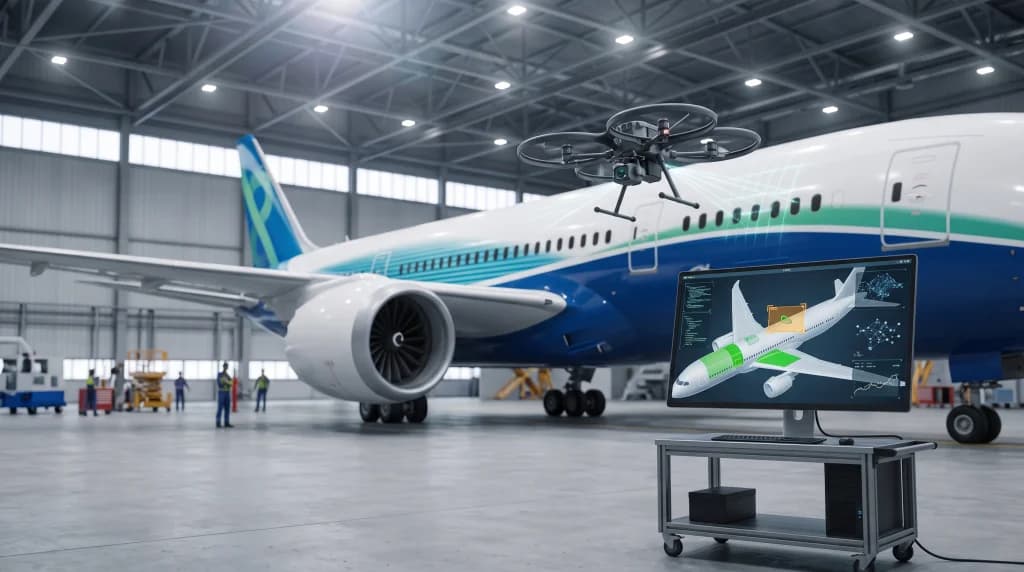
Drone Aircraft Inspections: How AI Reduces Maintenance Downtime
Introduction: The Hangar Revolution Passengers Never See
For most passengers, the journey ends the moment they step off the jet bridge and collect their luggage from the baggage carousel. Yet as the cabin lights go dark and the last traveler departs, a multi-million-dollar airliner enters the hands of maintenance engineering teams. In commercial aviation, an airline's financial success hinges on one uncompromising rule: an aircraft only generates revenue when it is in the air. Every unscheduled hour spent grounded on the apron or inside a maintenance hangar incurs high opportunity costs, disrupts route networks, and leads to substantial financial losses.
For decades, one of the most time-consuming and labor-intensive phases of scheduled maintenance has been the Visual Inspection of the aircraft skin. Examining the vast surface area of wide-body airliners like the Airbus A350 or Boeing 777 traditionally required miles of scaffolding, telescopic cherry pickers, and maintenance crews manually inspecting square meters of composite and duralumin structures with flashlights and magnifying glasses. Today, this process is changing. Airframe maintenance facilities and aprons are adopting autonomous inspection drones powered by Computer Vision and artificial intelligence. This technology compresses skin inspection times from tens of hours—or even days—down to under an hour. This shift in the modern MRO (Maintenance, Repair, and Overhaul) sector demonstrates how combining optoelectronics with neural networks is reshaping safety standards.
Traditional Fuselage Inspection: Labor, Scaffolding, and Human Factors
To understand the impact of this transition, it helps to examine traditional skin inspection practices. The fuselage of a modern jet airliner is a large, geometrically complex structure subjected to severe aerodynamic loads, pressurization cycles, and surface wear at cruising speeds of 900 km/h. At altitude, the exterior skin must withstand lightning strikes, hail, low-altitude bird strikes, and accidental contact with ground support equipment (GSE).
When an aircraft enters a scheduled base maintenance check—such as a C-Check—or undergoes a non-routine inspection following a reported lightning strike, regulations require thorough examination of its exterior skin:
- Heavy Ground Equipment: Maintenance crews erect extensive scaffolding frameworks or maneuver scissor and articulated boom lifts around the aircraft. Setting up, leveling, and securing this equipment can take two to four hours before inspection work begins.
- Risk of Collateral Damage: Operating heavy machinery inches away from flight control surfaces, composite fairings, and wing leading edges introduces the risk of inadvertent contact, potentially causing structural damage that requires immediate repair.
- Inspector Fatigue: Working suspended in a harness high above the hangar floor under uneven lighting for an eight-hour shift takes a toll on visual concentration. After inspecting thousands of individual rivets, identifying hairline cracks, subtle paint blisters, or pinhole-sized lightning strike arc pits becomes increasingly challenging for the human eye.
Consequently, a comprehensive visual inspection on a wide-body aircraft historically took the airframe out of service for 24 to 48 hours, representing a substantial operational cost for airlines.
Digital Reconnaissance: How Autonomous Drones Scan an Airframe
Modern inspection platforms—developed by specialized providers such as Donecle and Mainblades, as well as Airbus via its Advanced Inspection Drone program—differ significantly from consumer-grade quadcopters. They are dedicated, autonomous industrial aerial robots engineered for safe operation inside maintenance hangars and active apron environments.
1. Navigation in GNSS-Denied Environments
Inside steel-reinforced maintenance hangars, GPS satellite signals are generally unavailable or degraded by multi-path interference. Inspection drones instead use specialized local relative positioning systems:
- LiDAR (Light Detection and Ranging): Drones project high-frequency laser pulses to generate real-time 3D point clouds of their surroundings, tracking exact position relative to wings, stabilizers, and fuselage contours.
- Visual Odometry (Visual SLAM): High-speed optical tracking cameras identify spatial features across the hangar and the airframe skin, calculating the drone's position down to the millimeter.
- Virtual Geo-Fencing: Flight software enforces an active safety bubble, preventing the drone from closing within a preset buffer distance (typically 1.0 to 1.5 meters). If an unexpected obstacle appears—such as a technician on a maintenance ladder—the flight controller holds a hover or safely suspends the mission.
2. High-Resolution Imaging Payloads
Rather than using standard video feeds, these drones carry full-frame camera sensors delivering 45 to 60 megapixels of resolution, paired with low-distortion prime lenses. High-output synchronized LED arrays illuminate shadowed areas beneath wings and maintain consistent color balance. During a 40-minute automated scan of a narrow-body Airbus A320, the system captures between 1,500 and 2,500 detailed macro photographs, documenting the airframe at resolutions up to 0.1 mm per pixel.
Artificial Intelligence: Turning Pixels into Diagnostics
Collecting thousands of high-resolution images creates a new challenge: reviewing this volume of raw photography manually would still require hours. To solve this, processing pipelines deploy deep Convolutional Neural Networks (CNNs) to evaluate the image dataset.
1. Building the Digital Twin
The image processing engine maps each individual photograph directly to its corresponding coordinates on a 3D CAD model of the airframe, creating a synchronized Digital Twin of the specific tail number. If a photo captures an area on the left wing trailing edge, the software references the exact access panels, fairings, and rivet lines present in that frame.
2. Semantic Segmentation and Defect Classification
Neural networks trained on large datasets of real-world aircraft defects detect and classify surface anomalies within seconds:
- Lightning Strike Damage: Identifying entry and exit arc points characterized by local paint scorches, melted fastener heads, or damage to outer protective copper mesh within composite structures.
- Dents and Structural Deformations: Using stereoscopic photogrammetry or structured light patterns, algorithms calculate the depth, length, and width of surface dents, comparing these measurements against allowable limits in the Structural Repair Manual (SRM).
- Corrosion and Paint Deterioration: Spotting early-stage aluminum alloy oxidation, paint peeling, and micro-cracking around skin lap joints and structural fasteners.
- Fastener Integrity and Sealant Gaps: Inspecting fuel tank access panel sealants for gaps, cracks, or missing fasteners.
- Missing Exterior Components: Verifying the condition and presence of static discharge wicks along control surface trailing edges, as well as checking required exterior safety markings and placards.
3. Real-Time SRM-Compliant Reporting
Traditionally, engineers manually measured surface dents with mechanical depth gauges, plotted their locations on 2D paper drawings, and cross-referenced thickness charts across pages of technical documentation. AI platforms automate these steps. Upon completing an analysis run, the system outputs an interactive 3D inspection report: every detected defect includes precise geometric coordinates, physical dimensions, and a direct reference link to the applicable SRM section. The engineer's role shifts from manual searching to verifying findings and confirming corrective action.
Operational Case Study: Managing a Lightning Strike Event
Lightning strikes are a routine operational reality in commercial flying. An airliner descends through a frontal squall line, passengers hear a dull thud, and a flash illuminates the wingtip. The aircraft touches down safely, but aviation safety regulations require that it cannot be dispatched again until technical personnel thoroughly inspect the airframe for entry and exit points.
Under conventional workflows, this event frequently caused an Aircraft On Ground (AOG) scenario. Technicians needed 12 to 20 hours to inspect the airframe using ladders and ground equipment, leading to flight cancellations, passenger accommodation costs, and thousands of euros in operational losses.
Using autonomous drone systems, the workflow is streamlined:
- The aircraft taxis onto an apron or into a maintenance bay.
- A two-person maintenance team initiates the drone inspection sequence directly from its transport enclosure.
- The automated scanning flight completes in roughly 30 to 40 minutes.
- Cloud-based machine learning pipelines evaluate the image dataset over the next 20 to 30 minutes.
- The engineer's tablet displays the completed report: entry damage identified on the nose radome, with an exit point located on a horizontal stabilizer static wick. All findings fall within allowable SRM limits without underlying structural damage.
- Within under two hours from touchdown, the engineer digitally signs the Certificate of Release to Service (CRS), returning the aircraft to scheduled operations with minimal delay.
Composites vs. Metals: New Diagnostic Considerations
Modern wide-body airliners like the Boeing 787 Dreamliner and Airbus A350 feature structures composed of more than 50% Carbon Fiber Reinforced Polymer (CFRP) composites, introducing distinct inspection considerations compared to traditional aluminum alloys.
Unlike aluminum, which deforms under impact to leave a visible dent, composite laminates are elastic. A low-energy impact from ground equipment or a bird strike can cause the outer surface to spring back into shape, while the subsurface suffers internal delamination or honeycomb core crushing. This type of damage is termed Barely Visible Impact Damage (BVID).
To inspect modern composites effectively, next-generation drone platforms are incorporating advanced non-destructive testing (NDT) payloads:
- Active Infrared Thermography (IRT): Drones equipped with high-sensitivity thermal imaging sensors work alongside short thermal heat pulses. Variations in thermal conductivity between sound composite material and subsurface delaminations reveal hidden structural defects beneath the paint.
- Phase-Shift Deflectometry: An optical technique that projects fine fringe patterns onto reflective paintwork to measure micro-deflections and subtle surface contour shifts down to micron scales.
Aviation Regulations and Safety Verification
Commercial aviation is governed by strict regulatory oversight, and new maintenance technologies require validation from supervisory bodies like the Federal Aviation Administration (FAA) and the European Union Aviation Safety Agency (EASA) before widespread adoption.
Early industry reception was cautious, driven by concerns over autonomous systems operating in close proximity to expensive airframes. In response, drone developers implemented specialized safeguards, including lightweight airframe bumpers, ducted or soft-edged rotor guards, and triple-redundant collision avoidance sensors.
A key milestone in adopting this technology was formal recognition by major airframe manufacturers. Both Airbus and Boeing have integrated drone-based inspection procedures into their official Aircraft Maintenance Manuals (AMM). Consequently, datasets captured by certified drone inspection systems are recognized by airlines, leasing firms, and national aviation authorities, allowing digital records to fulfill visual inspection requirements directly.
Conclusion: The Future of Digital Hangar Operations
Integrating autonomous drones and artificial intelligence into line and base maintenance operations represents an ongoing digital transition for commercial aviation. Augmenting manual scaffolding setups with automated optical capture, LiDAR mapping, and neural networks provides repeatable inspection data and objective structural records.
For passengers, these behind-the-scenes engineering advancements deliver real benefits: fewer flight cancellations, improved on-time performance, and rigorous structural oversight of the aircraft carrying them across the globe. Modern maintenance hangars are increasingly incorporating advanced analytical tools alongside traditional mechanical trades, using data-driven robotics to help keep commercial air travel safe and efficient.