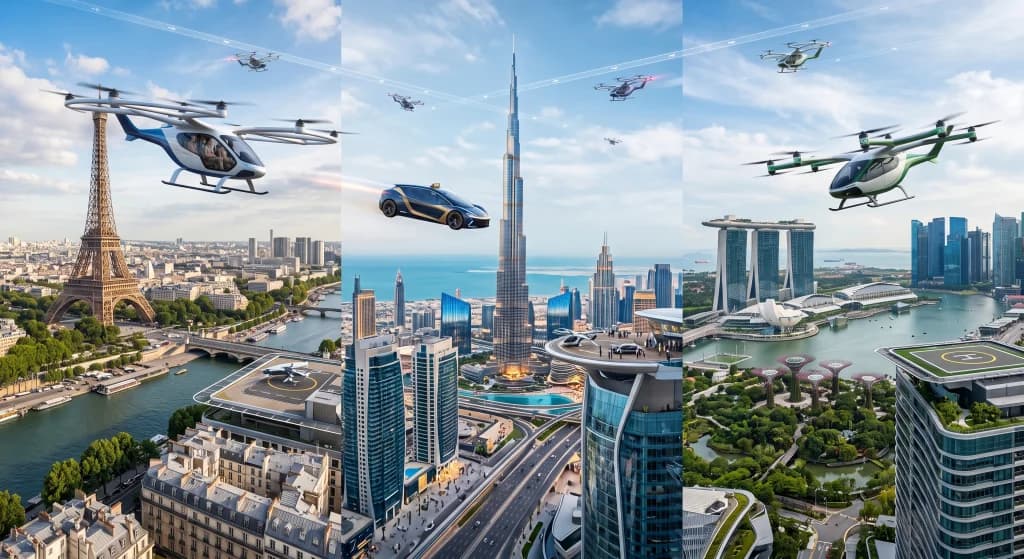
eVTOL Air Taxis: Paris, Dubai, and Singapore in the Race for Urban Skies
Introduction: The Twilight of Asphalt and the Birth of Urban Three-Dimensional Transit
For anyone who has ever spent hours trapped in gridlock along the Boulevard Périphérique in Paris, on Sheikh Zayed Road in Dubai, or across the high-density corridors of Singapore, escaping into the vertical dimension sounds like pure liberation. For decades, the prospect of sky taxis bypassing congested surface arteries remained confined to science fiction and conceptual illustrations. Helicopters, while capable of vertical take-off and landing, never evolved into a mainstream urban transit solution due to insurmountable hurdles: ear-splitting rotor noise, astronomical maintenance and fuel burn from turboshaft engines, high carbon footprints, and stringent urban safety restrictions.
Today, that vision is moving from conceptual art to certified operational reality. The eVTOL (electric Vertical Take-Off and Landing) sector has entered its decisive operational and regulatory testing phase. It represents the intersection of high-density battery chemistry, Distributed Electric Propulsion (DEP), lightweight carbon-fiber composite structures, and full-authority digital fly-by-wire flight control systems. Three global hubs—Paris, Dubai, and Singapore—have taken the lead in this race, investing capital into vertiport infrastructure, designated low-altitude air corridors, and airspace integration. How do these aircraft operate, what engineering constraints govern their commercial deployment, and which city will be the first to establish a commercially viable Urban Air Mobility (UAM) network?
The Anatomy of an eVTOL Aircraft: Beyond the Traditional Helicopter
A common misconception when evaluating the eVTOL sector is viewing these vehicles merely as electrified helicopters. The aerodynamic and structural differences are fundamental, driven by abandoning the single central rotor assembly in favor of Distributed Electric Propulsion (DEP).
1. Distributed Electric Propulsion (DEP) and Redundancy
A conventional helicopter relies on single critical mechanical failure points: the main reduction gearbox, the swashplate assembly, and the torque-countering tail rotor. A mechanical failure in any of these components during a low-altitude hover is frequently unrecoverable. eVTOL designs eliminate these Single Points of Failure. Architectures like the Volocopter VoloCity utilize 18 independent electric motors paired with fixed-pitch propellers mounted across an overhead structural ring. Meanwhile, designs from Joby Aviation and Archer Aviation feature 6 to 12 tilting nacelles.
Losing one, two, or even three motors does not result in catastrophic loss of control. Digital flight management computers compensate in milliseconds by increasing output across opposing functional motors. By eliminating complex multi-stage mechanical gearboxes, driveshafts, and hydraulic actuators, DEP dramatically lowers mechanical vibration, reduces structural fatigue, and slashes scheduled maintenance overhead.
2. Acoustic Signature: Operating Within Urban Envelopes
Helicopters are largely incompatible with continuous operations over dense urban centers because they generate noise levels between 85 and 100 dB(A), largely caused by Blade-Vortex Interaction (BVI), where a advancing blade slices through the turbulent tip vortex shed by the preceding blade. In contrast, eVTOL airframes are engineered to meet strict acoustic limits: emitting between 45 and 60 dB(A) in level cruise at altitudes of 150 to 300 meters.
To a pedestrian on the ground, this acoustic footprint blends into background street ambient noise, measuring quieter than a passing passenger car. This reduction is achieved through smaller propeller diameters, lower blade-tip speeds well below the transonic regime, and digital phase-offset control between adjacent rotors to actively cancel sound wave peaks.
3. Three Aerodynamic Architectures: Multirotor, Lift+Cruise, and Vectored Thrust
Aviation engineers have developed three distinct configurations based on mission profiles:
- Multirotors (e.g., Volocopter VoloCity): A pure multi-rotor layout without conventional wings. Lift and forward thrust are generated entirely by vertical thrusters. Best suited for ultra-short intra-city routes of 15 to 25 km, they offer exceptional low-speed agility but suffer from poor lift-to-drag efficiency in forward cruise.
- Lift + Cruise (e.g., Eve Air Mobility / Embraer, Beta Technologies): These platforms feature independent propulsion systems for hover and cruise. Dedicated vertical lift propellers operate exclusively during take-off and landing before being feathered or locked in low-drag alignments. A rear pusher propeller drives forward cruise, with lift generated by a conventional fixed wing. This provides a balance between mechanical simplicity and operational range.
- Vectored Thrust / Tiltrotor (e.g., Joby S4, Archer Midnight): The aerodynamically optimal and technically complex approach. Rotors tilt from a vertical position during lift-off through a 90-degree transition phase into a horizontal tractor or pusher configuration. The airframe converts into a high-efficiency conventional airplane, achieving cruise speeds of 240 to 320 km/h with operational ranges exceeding 150 km on a single charge.
The Battery Density Bottleneck: The Physics of Mass and Energy
While aerodynamics and digital flight controls are technically mature, energy storage density remains the primary engineering constraint. Standard Jet A-1 kerosene yields an energy density of roughly 12,000 Wh/kg. By contrast, state-of-the-art commercial aerospace lithium-ion battery packs currently achieve pack-level densities between 250 and 300 Wh/kg.
This reality imposes severe structural weight penalties. Battery packs in aircraft like the Joby S4 or Archer Midnight weigh between 600 and 900 kg, consuming up to a third of the aircraft's Maximum Take-Off Weight (MTOW). The remaining weight budget must cover the carbon-composite airframe, flight avionics, safety systems, and a payload of only 2 to 4 passengers with carry-on luggage.
Furthermore, EASA and FAA airworthiness standards enforce mandatory Reserve Energy Requirements. Every commercial flight must retain sufficient onboard reserve power to divert to an alternate vertiport or conduct a 20-to-30-minute hold after a missed approach. This narrows the usable Depth of Discharge (DoD) of the battery cells, effectively restricting early commercial routes to stage lengths of 30 to 80 km.
Paris: Pioneer Demonstrations Under European Scrutiny
The French capital emerged as the proving ground for Europe’s UAM deployment through a partnership between airport operator Groupe ADP (Aéroports de Paris), regional transit authority RATP, and German developer Volocopter. The objective was straightforward: prove that electric air taxis could be safely integrated into one of the world's most congested and closely monitored terminal airspace complexes.
The Parisian Vertiport Network
Rather than relying on theoretical simulations, Groupe ADP constructed a full-scale UAM test hub at Pontoise-Cormeilles-en-Vexin airfield outside Paris. The installation validated passenger processing pipelines: biometric boarding gates, compact security screening workflows, High-Power DC Charging infrastructure, and battery-swapping logistics.
The operational network mapped out critical point-to-point connections:
- Shuttle corridors connecting Paris-Charles de Gaulle (CDG) with Le Bourget.
- Suburban integration lines linking Paris-Orly Airport to surrounding districts.
- A floating vertiport barge moored along the Seine at Quai d’Austerlitz, intended for emergency medical transport (rapid transport of donor organs and pathology samples between AP-HP hospital clusters) and point-to-point passenger hops.
Meeting EASA Standards: The SC-VTOL Hurdle
Europe’s safety framework is the most rigorous in global aviation. The European Union Aviation Safety Agency (EASA) established the Special Condition for VTOL (SC-VTOL) regulatory standard. For the Enhanced category—required for commercial operations carrying paying passengers over congested urban centers—EASA set a maximum catastrophic failure probability of 10-9 per flight hour.
This matches the airworthiness safety target required of modern commercial wide-body airliners like the Airbus A350 and Boeing 787. Achieving this benchmark requires exhaustive verification runs, multi-channel fly-by-wire architectures, and demonstrated resistance against battery Thermal Runaway cascades. While this standard has extended commercial entry timelines, an EASA type certificate remains the definitive benchmark for public and regulatory confidence.
Dubai: Rapid Deployment and the Joby Aviation Alliance
While European regulators follow a cautious, component-level path toward certification, Dubai has focused on rapid, scaled commercial deployment. Led by the Roads and Transport Authority (RTA) and the Dubai Civil Aviation Authority (DCAA), the emirate executed an exclusive, six-year operational agreement with California-based Joby Aviation alongside infrastructure specialist Skyports Infrastructure.
Connecting Dubai International to Palm Jumeirah in 10 Minutes
Dubai’s coastal, linear urban layout makes it an optimal operating theater for vectored-thrust eVTOL aircraft. The Joby S4, configured for a pilot and four passengers, cruises at 320 km/h.
Traveling from Dubai International Airport (DXB) to the tip of Palm Jumeirah during peak evening traffic requires 45 to 70 minutes by road. An eVTOL air taxi covers that distance in 10 to 12 minutes, routing clear of ground traffic via designated coastal VFR corridors over the Persian Gulf. The initial network focuses on four hub locations:
- Dubai International Airport (DXB): A dedicated terminal providing intermodal transfers for premium long-haul passengers.
- Palm Jumeirah: A vertiport located near key hotel and residential developments.
- Dubai Downtown: Serving the business district adjacent to the Burj Khalifa and Dubai Mall.
- Dubai Marina: Providing rapid transit access to the southern residential and commercial core.
Environmental Extremes: Operating in High Ambient Heat and Ingested Dust
Dubai exposes eVTOL systems to challenging environmental conditions. Summer surface temperatures regularly surpass 45°C to 48°C, with coastal humidity levels reaching 90%. For battery-electric systems, these conditions present distinct operating hurdles:
- High ambient temperatures complicate thermal management during rapid High-Power DC turnaround charging, accelerating battery degradation if cooling systems fall short.
- High density altitudes in extreme heat reduce air density, requiring rotors to generate higher thrust through increased collective pitch or higher RPM during hover, which increases energy consumption.
- Suspended quartz dust causes abrasive wear on the leading edges of composite rotor blades and demands robust ingress protection for electric motor bearings and cooling intakes.
Operating reliably through an Arabian Gulf summer will serve as an effective durability test for eVTOL subsystems operating in extreme heat.
Singapore: Regional Connections and Automated Airspace Management
Singapore represents a distinct model for urban aerial mobility. Constrained by its compact territory (roughly 730 km²), high population density, and busy airspace around Changi Airport and military air bases, the city-state has focused heavily on airspace automation and cross-border connectivity.
The Civil Aviation Authority of Singapore (CAAS) and UTM
Routing dozens of low-altitude aircraft between 100 and 500 meters above ground level cannot be managed through traditional voice communications and approach radar. Towering urban skylines produce radar shadow zones, line-of-sight signal degradation, and complex microscale urban wind shear patterns.
Singapore has become a primary testing center for Unmanned Traffic Management (UTM) platforms. This digital network integrates high-bandwidth 5G data links and real-time trajectory negotiation:
- Every air taxi is assigned a dynamically deconflicted 4D Trajectory profile (latitude, longitude, altitude, and time calculated down to fractional seconds).
- Vehicle separation is automated via cloud-based algorithms and onboard ADS-B and DAA (Detect and Avoid) systems.
- Geofencing protocols continuously enforce dynamic No-Fly Zones around government centers, industrial installations on Jurong Island, and primary approach lanes for Changi and Seletar airports.
Cross-Border Regional Links
Singapore’s transport planners view eVTOL platforms not merely as domestic transit, but as tools for cross-border economic connectivity. Beyond shuttle flights linking the Marina South Financial District with regional industrial zones like Pulau Bukom, planners are targeting direct links into the Malaysian state of Johor and the Indonesian Riau Archipelago (Batam and Bintan). Navigating security checks and sea crossings by ferry currently takes up to two hours; an eVTOL flight across the Singapore Strait reduces transit time to under 15 minutes.
Vertiports: The Ground Infrastructure Backbone
Aircraft development represents only half of the urban aviation equation. Scaling operations requires purpose-built vertiports: modular, high-throughput ground infrastructure combining aspects of a regional airport, high-voltage electrical substation, and rapid transit terminal.
Specialized vertiport designs from developers like Skyports and Urban-Air Port incorporate three critical operational zones:
- FATO (Final Approach and Take-Off Area): The cleared obstruction-free approach and departure zone, equipped with optical lighting arrays and precision landing guidance sensors.
- TLOF (Touchdown and Lift-Off Area): The load-bearing physical pad engineered to support dynamic landing forces from composite gear configurations.
- Vehicle Stands and Turnaround Bays: Apron positions where aircraft taxi clear of the active pad to deplane passengers and connect to charging systems. Urban vertiports require dedicated grid connections of 1 to 2 megawatts (MW) to deliver the high-rate DC charging needed for 10-to-15-minute turnaround cycles.
Challenges Facing Mass-Market Adoption
Despite significant capital investment and successful prototype demonstrations, moving from premium early-adopter services to everyday public transportation requires clearing several major barriers:
1. Public Acceptance: Acoustic and Visual Footprints
Even with sound profiles averaging 55 dB, high-frequency operations across urban centers will raise quality-of-life concerns. Municipalities must address residential pushback regarding low-altitude visual disturbance, privacy questions, and public perception of overhead air traffic risks.
2. The Cost Curve: Moving Beyond Premium Services
During initial deployment, eVTOL seat pricing will resemble luxury limousine transfers or on-demand charter flights (roughly $4 to $6 per passenger-kilometer). Scaling down to $1.50 to $2.00 per kilometer—bringing fares in line with premium ride-hailing services—relies on high fleet utilization, automated production lines for composite airframes, and the long-term transition to autonomous, pilotless operations that eliminate the weight and cost of a flight crew.
3. Pilot Workforce Constraints
Until fully autonomous flight control systems receive regulatory certification, every commercial air taxi requires a licensed pilot. Amid an existing global shortfall of commercial airline transport pilots, training a specialized corps of eVTOL pilots—qualified to handle rapid transitions between vertical and forward aerodynamic flight regimes—demands time and investment in Level D Full Flight Simulators (FFS).
Conclusion: The Horizon of Urban Flight
The race to establish commercial air taxi operations between Paris, Dubai, and Singapore is more than a contest of engineering prestige. It represents the development of an aerial transit layer that could reshape 21st-century cities much like underground railways and passenger automobiles did in centuries past.
Paris establishes the benchmark for rigorous airworthiness certification and high-density airspace integration under EASA. Dubai provides the operational scale, infrastructure funding, and operating environment for commercial networks. Singapore develops the digital airspace management tools needed to safely coordinate high-density traffic in three dimensions. As these programs advance, urban transit is beginning to move beyond surface infrastructure, opening quiet, point-to-point electric transit through the open skies above.