IATA One ID and Biometrics: Will Boarding Passes Disappear in 3 Years?
Introduction
When magnetic stripe boarding passes were first introduced in 1974, the world considered it the ultimate peak of travel convenience. Three decades later, the arrival of 2D barcodes (PDF417) alongside digital passes in Apple Wallet and Google Pay sparked another revolution: travelers no longer had to frantically search their pockets for a printed airport card. Yet even today, in an era of pervasive smartphones and artificial intelligence algorithms, navigating an international airport often feels like an obstacle course. On average, a passenger must pull out identity documents, scan barcodes, and present a passport four to seven times per journey: at bag drop, security checkpoint entrances, border control, business lounge reception desks, departure gates (boarding), and arrival immigration.
This fragmented, legacy process is rapidly coming to an end. The International Air Transport Association (IATA), alongside the International Civil Aviation Organization (ICAO) and global airport technology leaders such as SITA and Amadeus, is advancing an architecture designed to fundamentally transform passenger flow and check-in within the next three years. This initiative centers on the IATA One ID concept and traveler Digital Travel Credentials (DTC). The vision is simple yet transformative: your face becomes your sole ticket, passport, and visa, enabling a seamless walk-through passenger journey from the terminal curb to your aircraft seat—without stopping and without reaching for your phone.
What Is IATA One ID? The Digital Identity Architecture
The One ID concept is a global IATA standard designed to eliminate repetitive identity and travel document checks by establishing a unified, secure digital identity token. It does not rely on a centralized global database containing millions of facial images—a model that would face justifiable pushback from regulators and privacy advocates. Instead, One ID leverages a decentralized framework built upon Self-Sovereign Identity (SSI) principles, ensuring travelers retain exclusive ownership and custody of their biometric data.
The One ID ecosystem is built on three core technological pillars:
- Digital Travel Credential (DTC): Developed by ICAO as the cryptographically secure digital equivalent of a physical biometric passport (ePassport). Data stored inside the passport's secure NFC chip is extracted and transferred into a certified Digital Identity Wallet on the passenger's smartphone, maintaining full legal standing as a travel credential.
- Advance Digital Verification (Contactless Travel): Prior to departure, travelers securely share their verified identity profile and biometric data with airlines and destination border agencies using end-to-end encrypted protocols—well before arriving at the terminal.
- Single Biometric Token: During the initial touchpoint at the airport (or remotely at home via a smartphone camera), an encrypted facial biometric vector is generated and linked to the Passenger Name Record (PNR). This temporary token remains active solely for the duration of the journey and is purged shortly after arrival at the final destination.
The One ID Passenger Journey: Step-by-Step
To grasp the operational benefits, consider how a standard air journey looks when One ID systems achieve full-scale deployment.
Step 1: Remote Check-in and Biometric Enrollment
The process starts inside the airline's mobile app. The traveler taps their physical passport against the smartphone's NFC reader to authenticate the government-signed digital identity certificate. Next, the user completes a quick facial scan with active liveness detection to safeguard against spoofing attempts using printed photos or 3D masks. The algorithm matches the scan against the high-resolution reference image stored on the passport chip. Upon establishing a 99.99% match, the system issues a secure DTC token, completes check-in, and automatically verifies entry requirements (eVisa / ETA) directly against destination immigration databases.
Step 2: Automated Biometric Bag Drop
Upon arriving at the departure hall, the passenger walks up to a self-service bag drop unit. Instead of scanning a mobile boarding pass, they look directly at a camera mounted above the conveyor belt. The system authenticates the traveler's identity in under 300 milliseconds, automatically generates bag tags (or updates an active Electronic Bag Tag), and accepts the luggage. The entire interaction is completed in under 20 seconds.
Step 3: Walk-Through Security Access
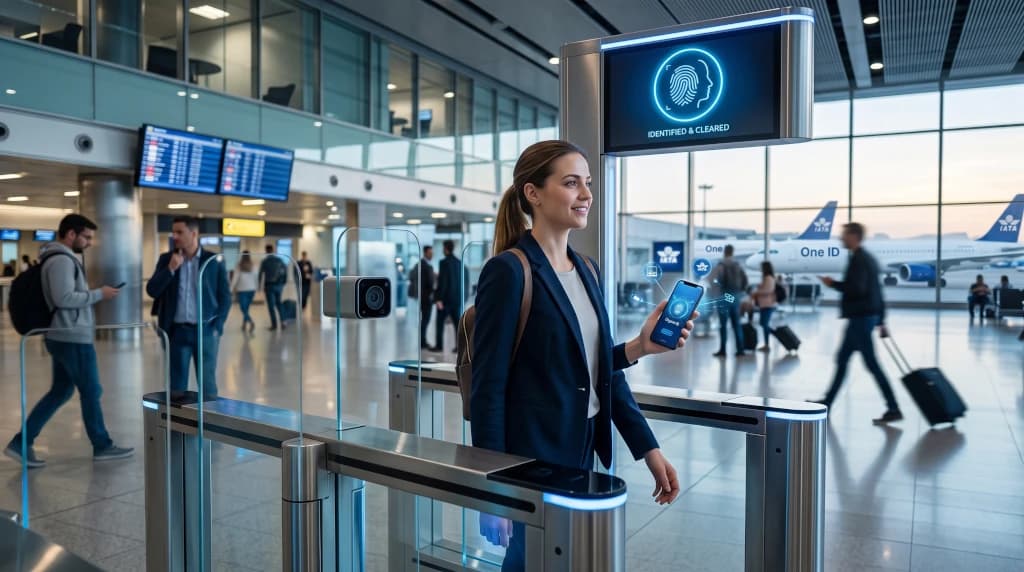
At the security checkpoint entrance, automated e-Gates equipped with biometric sensors open dynamically as the passenger approaches. There is no need to display a boarding pass to a security officer. When combined with next-generation computed tomography (CT) cabin baggage scanners—which eliminate the need to unpack liquids and laptops—security queue wait times drop by more than 60%.
Step 4: Contactless Biometric Boarding
The airport's most notorious bottleneck—the boarding gate—is completely re-engineered. Automated e-Gates match the faces of passengers walking at normal speed. Before the traveler steps onto the jet bridge, the system confirms their presence on the flight manifest, verifies their assigned seat, and unlocks the gate barrier. Boarding a wide-body aircraft carrying 350 passengers is cut from the traditional 40 minutes down to just 15–18 minutes.
Pioneering Hubs: Where Biometrics Are Live Today
While cross-border interoperability continues to expand, One ID is already delivering measurable results across several key international aviation hubs.
1. Singapore Changi (SIN): The Touchless Mega-Hub
Singapore Changi Airport serves as a global benchmark for biometric automation. Across its terminals—most notably the advanced Terminal 4—the airport has deployed an integrated facial and iris recognition infrastructure. Singaporean authorities have implemented passport-free departure clearance for residents and registered inbound tourists, utilizing biometrics captured upon initial arrival.
2. Dubai International (DXB): Smart Gates and the Biometric Tunnel
Emirates, in partnership with Dubai immigration authorities, has established an integrated end-to-end biometric corridor. Premium and economy passengers can utilize the Smart Tunnel—a continuous walkway where dozens of embedded cameras capture facial geometry and iris data in real time, clearing immigration without requiring manual document inspection.
3. India: The DigiYatra Ecosystem
India's DigiYatra initiative represents one of the largest deployments of biometric passenger processing by volume. Built upon decentralized digital identity frameworks, it enables domestic passengers across major airports including Delhi, Bengaluru, and Mumbai to navigate curb-to-gate touchpoints entirely via facial recognition anchored to their smartphone's local cryptographic storage.
Key Challenges: Obstacles to Universal Adoption
Despite significant efficiency and security advantages, transitioning completely away from physical and barcode-based boarding passes within three years involves navigating legal, technical, and operational hurdles.
1. Data Privacy and Regulatory Frameworks (GDPR / Privacy Laws)
In jurisdictions such as the European Union, biometric templates are classified as sensitive personal data subject to stringent protections. The foundational principle of voluntary participation (Opt-In) remains mandatory: passengers cannot be compelled to use biometric processing as a sole condition of carriage. Airlines and airports must continue to maintain parallel, conventional manual processing lanes for travelers who choose not to enroll.
2. Cross-Border Interoperability and Trust Networks
On long-haul international flights, the primary challenge remains secure, bilateral data exchange between sovereign governments. For a passenger to travel from London to Tokyo without presenting a passport, border agencies in both the UK and Japan must recognize equivalent DTC standards and maintain secure cryptographic public-key infrastructures (PKI). While ICAO provides technical specifications, international treaty ratifications take time.
3. Biometric Spoofing and Cybersecurity Safeguards
The rapid advancement of generative AI and synthetic deepfakes requires biometric capture hardware to maintain rigorous anti-spoofing standards. Modern airport sensor arrays increasingly combine visible-spectrum cameras with multi-spectral infrared imaging, 3D depth mapping, and subcutaneous vascular pulse analysis to guarantee presentation attack detection (PAD).
Will Paper and Barcodes Disappear Within 3 Years?
Looking toward the 2028–2029 horizon, will physical boarding passes and mobile QR codes become obsolete? The most realistic trajectory points toward a hybrid travel environment where biometrics dominates primary aviation corridors.
On domestic and regional sectors across North America, Europe, China, and the Middle East, biometric adoption rates are projected to reach 70–80% of regular passenger volumes. On long-haul international routes, physical biometric passports will remain an essential fallback requirement carried in passengers' pockets, primarily referenced during technical interruptions, customs spot checks, or exceptional immigration procedures.
Conclusion: A New Era in Frictionless Air Travel
The biometric shift championed by IATA One ID represents an operational imperative rather than a mere technical novelty. With global air passenger traffic projected to reach 8 billion journeys annually over the next 15 years, airports cannot simply double physical terminal footprints or scale manual check-in counters proportionally.
Automation, decentralized digital identity, and streamlined walk-through processing provide the necessary foundation to maintain global aviation flow. Your face is set to become the universal key navigating the terminal environment. While traditional boarding passes have served commercial aviation for decades, the industry's future is shifting toward an invisible, digital, and frictionless standard.