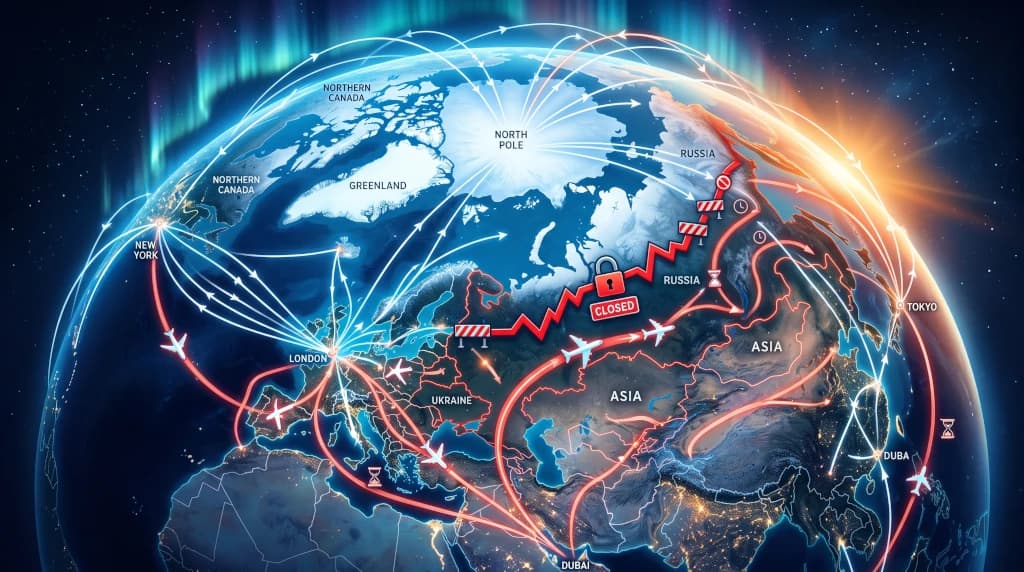
Polar Corridors Under Pressure: How Airspace Closures Reshape Intercontinental Flights
Introduction
For a passenger glancing at a traditional wall map in Mercator projection, the shortest path from Paris to Tokyo appears as a straight line cutting through Central Europe, China, and the Sea of Japan. In the three-dimensional reality of our planet, however, geometry obeys fundamentally different laws. The shortest distance connecting two points on a sphere is a great circle (orthodrome). For this reason, transpolar and trans-Siberian routes were for decades the holy grail of commercial aviation—vast sky corridors slicing through the Arctic and Siberia that shaved hours off journeys between Europe, North America, and East Asia.
Yet this globally optimized route network, meticulously engineered over decades, has fractured under the weight of tectonic geopolitical shocks. The closure of Russian airspace to Western carriers, military and political conflicts across the Middle East, and persistent instability in the Caucasus have triggered an unprecedented crisis in long-haul flight operations. Polar and subpolar corridors have come under immense pressure, forcing flight dispatchers to plot detours that add up to four hours to a single flight leg. Let us examine how geopolitics forced a complete redraw of the world flight map and explore the technical, economic, and environmental ramifications left in its wake.
The Golden Age of Transpolar Routes: From Cold War Dreams to Cross-Polar Operations
To understand the current crisis, one must revisit the genesis of polar aviation. During the Cold War, Soviet airspace remained hermetically sealed. Commercial flights traveling between Europe and East Asia were forced into lengthy technical fuel stops in Anchorage, Alaska, circumnavigating the USSR from the north. The opening of Siberian airspace in the 1990s was hailed as one of globalization's greatest victories—flight durations dropped sharply, and airlines began saving hundreds of millions of dollars annually in fuel burn.
The true technological milestone arrived in 1998 with the formal activation of official ICAO polar routes, designated as Polar 1, Polar 2, Polar 3, and Polar 4. These corridors enabled direct, nonstop links between the East Coast of North America and Asia (such as New York to Hong Kong or Chicago to Beijing) by flying straight over the North Pole.
Operating in extreme polar latitudes demanded adherence to exceptionally strict technical and operational protocols:
- True North Navigation: In the vicinity of the magnetic pole, traditional magnetic compasses become completely unreliable. Aircraft switch their primary flight navigation reference to True North, relying on Inertial Reference Systems (IRS/INS) backed by ring laser gyroscopes and GPS satellite constellations.
- Fuel Freeze Management: In polar cruise conditions, ambient outside air temperatures regularly plunge below -70°C. Standard Jet A-1 aviation fuel freezes at approximately -47°C. Flight crews must continually monitor fuel tank temperatures and, if necessary, increase Mach speed (generating aerodynamic skin friction heating) or descend to warmer air layers.
- ETOPS Evolution: The certification of ETOPS 180, 240, and eventually 370 minutes enabled modern twin-engine wide-body jets (such as the Boeing 777, 787, and Airbus A350) to traverse desolate Arctic regions where suitable diversion airports are hundreds of miles apart.
The Great Detour: Geopolitical Shock and Blocked Skies
The outbreak of full-scale war in Ukraine in 2022 and subsequent reciprocal sanctions closed the airspace of the Russian Federation to carriers from the European Union, the United Kingdom, the United States, Canada, Japan, and South Korea. Overnight, 17 million square kilometers of Russian airspace vanished from Western flight management computers.
This disruption coincided with escalating tensions across the Middle East. Flight restrictions and airspace closures over Iran, Iraq, Israel, Syria, and Yemen severely compressed the remaining southern corridors. Airspace available for safe, predictable transit shrank into narrow, congested bottlenecks.
The New Flight Geography from Europe to East Asia
Airlines faced an acute operational challenge: how to link London, Frankfurt, Paris, or Warsaw with Tokyo, Seoul, and Beijing without entering Russian skies. Two primary route architectures emerged:
- The Northern Corridor (Arctic via Greenland and Alaska): Aircraft track north over Scandinavia, Greenland, Northern Canada, and Alaska, before descending across the Pacific Ocean past the Kamchatka Peninsula into Japan. While geographically longer, this routing leverages favorable high-latitude wind patterns.
- The Southern Corridor (via the Caucasus, Central Asia, and South Asia): Flights head southeast through Turkey, Georgia, Azerbaijan, the Caspian Sea, Kazakhstan, Uzbekistan, and China, or further south through the Persian Gulf, India, and Southeast Asia. However, this route suffers from severe airway congestion and restricted air traffic control sector capacity.
Flight Time Spikes and Market Asymmetry
Rerouting flight paths has driven an immediate, tangible surge in block times. Finnair's flagship flight AY61 from Helsinki to Tokyo-Narita, which previously took around 9 hours and 30 minutes via the Siberian corridor, now takes between 13 and 14 hours depending on routing and prevailing jet streams.
This dramatic increase in flight time has created a pronounced competitive asymmetry. While Western carriers must fly costly detours, Chinese airlines (such as Air China, China Eastern, and China Southern) and select Middle Eastern and Indian operators continue to utilize Russian airspace freely.
This dynamic has produced stark commercial disparities:
- Shorter Flight Times and Lower Operating Costs: A Chinese carrier on the Paris–Beijing route flies 2 to 3 hours faster than its European competitors, burning tons less fuel per flight and offering significantly lower ticket prices.
- Western Route Suspensions: Squeezed by non-competitive travel times and soaring operational costs, legacy carriers including British Airways, Lufthansa, and Virgin Atlantic were forced to suspend or scale back multiple prestigious routes to mainland China and Hong Kong.
Physics and Flight Operations: Fuel, Payload, and Jet Streams
Adding 2,000 to 3,000 kilometers to a flight plan is not merely an endurance test for passengers and crew—it pushes aircraft design limits to the edge. In long-haul operations, a fundamental rule applies: the more fuel loaded to cover distance, the heavier the aircraft becomes, which in turn increases fuel burn per nautical mile.
1. The Payload/Range Penalty
To enable a twin-engine wide-body airliner (such as a Boeing 787-9) to complete a 14-hour mission while carrying statutory reserves for distant diversion alternates, flight dispatchers must carefully manage maximum takeoff weight (MTOW). This often results in strict weight restrictions:
- Capping passenger capacity by blocking seats from being sold.
- Drastically reducing underfloor belly cargo capacity, depriving airlines of a crucial, high-margin revenue stream.
2. Managing Jet Streams
Along new Arctic and transcontinental routings, harnessing or avoiding upper-level jet streams—narrow bands of wind blowing west-to-east at speeds exceeding 250–350 km/h—is critical. Eastbound flights (e.g., Europe to Tokyo via the Arctic) capitalize on massive tailwinds to recoup lost ground. Conversely, westbound flights heading directly into severe headwinds face heavy resistance, occasionally requiring scheduled technical refueling stops (such as in Anchorage or Fairbanks).
Crew Management and Fleet Utilization: The Compounding Clock
Longer stage lengths upend flight and duty time limitations (FTL). Sector times exceeding 12 to 13 hours can no longer be legally operated by a standard two-pilot crew.
This operational shift introduces significant structural costs:
- Augmented Flight Crews: Flights require three or four pilots (such as two captains and two first officers) operating on rotation while utilizing dedicated onboard Crew Rest Compartments (CRC).
- Reduced Fleet Productivity: When an aircraft spends 4 to 6 additional hours in the air per round trip, an airline cannot maintain its historical weekly flight frequencies with the same number of hulls. Maintaining the same schedule requires deploying additional wide-body aircraft worth hundreds of millions of dollars.
Conclusion: A New Paradigm for Global Airspace
The strain on polar flight corridors demonstrates how deeply modern aviation is bound to international geopolitics. The era of frictionless flight along optimal great circle paths over Eurasia has closed for the foreseeable future. The sky, treated for three decades as a seamless, open highway, is once again demarcated by geopolitical boundaries.
Airlines must continue to adapt through operational agility, deploying ultra-long-range next-generation aircraft (such as the Airbus A350-1000 and Boeing 777-9) and advanced flight-planning software that dynamically optimizes vertical profiles and fuel burn. For travelers, long-haul journeys between continents have once again become epic voyages requiring extra patience, longer flight times, and an appreciation for the complex logistics operating behind every ticket.