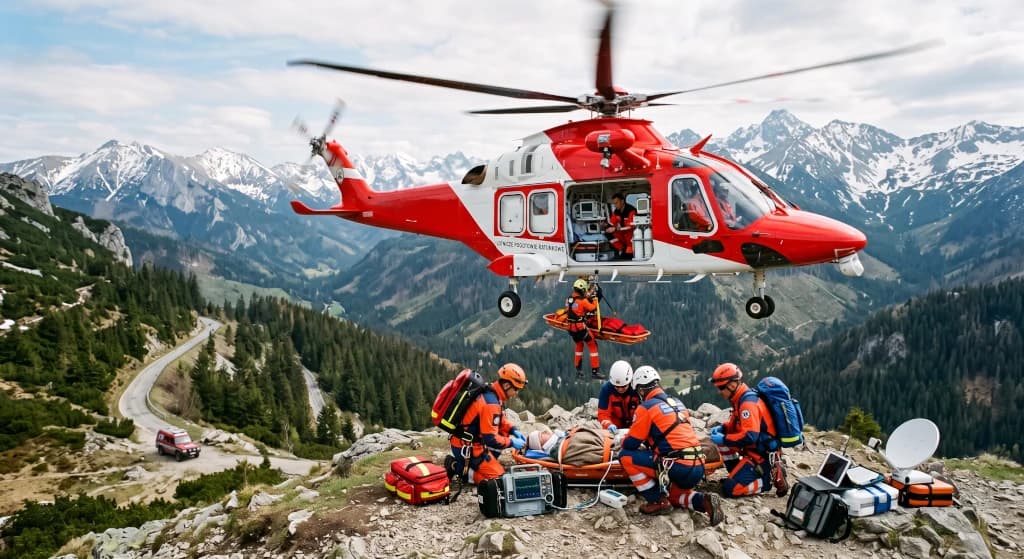
Air Ambulances: Logistics and Technology in MEDEVAC Medical Flights
Introduction
When human life hangs in the balance at thirty thousand feet, the margin for error shrinks to zero. In an airspace where temperatures plummet to -50°C and atmospheric pressure cannot naturally sustain human respiration, airborne hospitals—known in industry parlance as Air Ambulances or medical evacuation (MEDEVAC) flights—serve as the ultimate lifeline for critically ill patients. An air ambulance is far from a standard private business jet equipped with a makeshift stretcher and a first-aid kit. It is a state-of-the-art Intensive Care Unit (ICU) housed within a pressurized fuselage of aluminum alloys and composite materials traveling at 800 km/h.
Every year, tens of thousands of medical missions are carried out worldwide: from dramatic patient repatriations across continents and neonatal incubator transports to ultra-urgent organ transplant deliveries where every single second counts. Behind each flight lies a colossal logistical machine, specialized air traffic control protocols granting the highest operational priority, sophisticated aerospace medical technologies, and flight crews specifically trained in the nuances of aeromedical missions. Let us take an in-depth look into the logistics, engineering, and physiology driving one of the most demanding sectors in modern aviation.
The Medical Fleet: From Turboprop Workhorses to Long-Range Heavy Jets
The aircraft types selected for aeromedical operations are never chosen by chance. Each airframe is carefully evaluated based on operational range, cruising speed, short-field takeoff and landing (STOL) performance, and cabin volume required to conduct complex resuscitation procedures unhindered.
1. Turboprop Aircraft (King Air, Pilatus PC-12/PC-24)
For flight distances up to 1,500–2,000 kilometers, turboprops remain the undisputed workhorses of the industry, led by the legendary Beechcraft King Air series (B200, B350) and the single-engine Pilatus PC-12. Their greatest advantage is their ability to operate from short, unimproved grass or gravel runways in remote, isolated regions. The Swiss-built Pilatus PC-24 jet—dubbed the "Super Versatile Jet"—has also gained immense popularity by pairing jet speeds with rough-field capabilities and a factory cargo door specifically designed for effortless stretcher loading.
2. Mid-Size Light and Medium Jets (Learjet, Citation, Hawker)
For decades, the backbone of European and North American medical evacuations has been built around the Bombardier Learjet family (models 35A, 45XR, 60) and Cessna Citation series (Mustang, XLS, Sovereign). Learjets earned their reputation as the "sports cars of medevac" thanks to phenomenal climb rates, exceptional cruise speeds, and high service ceilings (up to 45,000–51,000 feet, allowing them to overfly major storms and turbulence). However, their compact cross-section requires medical crews to work in a hunched or kneeling posture.
3. Long-Range Heavy Jets (Challenger, Falcon, Gulfstream)
When a critically ill patient must be repatriated non-stop from Bangkok to Frankfurt or from Buenos Aires to New York, heavy wide-cabin business jets take center stage. Aircraft such as the Bombardier Challenger 604/650, Dassault Falcon 7X/8X, and various Gulfstream models provide full stand-up cabin height, intercontinental non-stop range, and ample floor space to install two independent intensive care setups alongside accommodations for the patient's family.
A Flying ICU: Medical Technology Adapted for Aviation
Installing complex medical equipment inside an aircraft cabin is a major engineering hurdle. Life-saving devices that rest on stable tables in ground hospitals must comply with strict aviation safety standards (such as FAA/EASA certifications under Supplemental Type Certificates – STCs) before being cleared for flight.
Key technological systems onboard an air ambulance include:
- Crashworthy Mounting Systems (9G Certification): Every medical device—from cardiac monitors to defibrillators—must withstand forces up to 9G (nine times the acceleration of gravity) to ensure it does not become a lethal projectile during an emergency landing.
- Dedicated Stretcher Modules (Lifeport / Spectrum Aeromed): An integrated aero-medical sled secured directly onto aircraft seat tracks, housing built-in medical air compressors, power inverters (converting 28V DC aircraft power to 230V/115V AC), and centralized oxygen and vacuum ports.
- High-Capacity Oxygen Systems: Large, dedicated compressed medical oxygen cylinders holding thousands of liters are permanently integrated into the airframe. For fire safety, these systems feature dual shut-off valves and external overpressure relief ports.
- Advanced Life-Support Apparatus: Flight-certified transport ventilators (which dynamically adjust to cabin pressure fluctuations), mobile ECMO units (extracorporeal membrane oxygenation acting as an external heart-lung machine in flight), point-of-care blood gas analyzers providing lab-quality results in two minutes, and specialized infusion pumps designed to eliminate flow errors caused by ambient pressure drops.
Flight Physiology: Battling the Laws of Physics at Cruising Altitude
One of the most critical challenges facing a flight physician is the physiological effect of altitude and gas laws on an unstable patient. According to Boyle’s Law, the volume of a gas is inversely proportional to its pressure. In a conventional commercial aircraft, cabin altitude is maintained at an equivalent of 2,000 to 2,400 meters above sea level.
While a healthy traveler merely feels their ears pop, for a critically ill MEDEVAC patient, ambient pressure drops can be catastrophic:
- Gas Expansion in Body Cavities: Trapped gas inside the gastrointestinal tract, the skull following head trauma, the eye globe, or the pleural cavity expands by up to 30%. This expansion risks tearing surgical sutures, triggering tension pneumothorax, or causing permanent ocular damage.
- Hypobaric Hypoxia: The drop in the partial pressure of oxygen in the ambient air demands an increase in the fraction of inspired oxygen ($FiO_2$) administered via the ventilator to maintain tissue perfusion.
The Sea Level Flight Profile
For patients suffering from acute stroke, severe cerebral edema, untreated pneumothorax, or decompression sickness (in divers), the flight crew executes a dedicated Sea Level Flight profile. The pilots maintain a cabin altitude close to sea level (0–300 meters above sea level). This operational constraint requires flying at a significantly lower true altitude (for example, 15,000 feet instead of 40,000 feet), which increases aerodynamic drag and fuel consumption, requiring meticulous flight planning for technical fuel stops.
Rescue Logistics: Clockwork Bed-to-Bed Precision
The actual flight is only one phase of an intricate operational chain. The gold standard in modern aeromedical repatriation is the Bed-to-Bed protocol, where the aeromedical provider assumes continuous clinical custody from the sending hospital bed directly to the receiving facility.
This protocol follows a strict sequence:
- Medical Assessment (Fit-to-Fly Evaluation): The medical director evaluates medical records, imaging, and lab markers to determine transport viability and select the appropriate clinical crew (e.g., intensivist, flight nurse, pediatric specialist, or perfusionist).
- Diplomatic Clearances and Overflight Permits: The 24/7 Operations Control Center (OCC) secures urgent overflight and landing permits, airport slots, and ramp-side customs and immigration clearance for the medical team.
- Ground Ambulance Coordination: Mobile Intensive Care Units (MICU) are coordinated at both departure and arrival airports to guarantee seamless patient transfers with zero tarmac waiting time.
MEDEVAC and STS/HOSP Status: Priority in Global Air Traffic Control
Within international Air Traffic Control (ATC) systems, aircraft carrying unstable patients receive special status codes in their flight plans (FPL): STS/MEDEVAC or STS/HOSP (for urgent organ transfers or scheduled medical flights).
This designation grants the crew operational priority on par with head-of-state flights:
- Direct Routing: Air traffic controllers route medical aircraft out of congested airway queues, offering direct vectoring from waypoint to waypoint.
- Priority Sequencing: During departures and arrivals, commercial traffic is placed into holding patterns to grant the air ambulance immediate runway clearance.
- Turbulence Avoidance Approvals: Controllers prioritize immediate altitude deviations upon pilot request when flight doctors need a perfectly stable environment to perform delicate clinical interventions (such as intubation or central venous catheterization).
Conclusion: Quiet Heroism on the Edge of the Skies
Air ambulances stand at the pinnacle of modern aviation and emergency medicine. Behind every successful flight lies seamless teamwork: pilots flying with absolute precision, physicians delivering critical care in tight quarters, and dispatchers overcoming complex cross-border logistical hurdles around the clock.
In our hyper-connected world, having access to an international aeromedical safety net offers invaluable peace of mind. While these missions rarely make evening headlines, it is high in the quiet skies at forty thousand feet that aeromedical teams fight daily battles to protect what matters most—human life.