Mood Lighting and Cabin Architecture: How Airlines Control Passenger Well-Being
Introduction
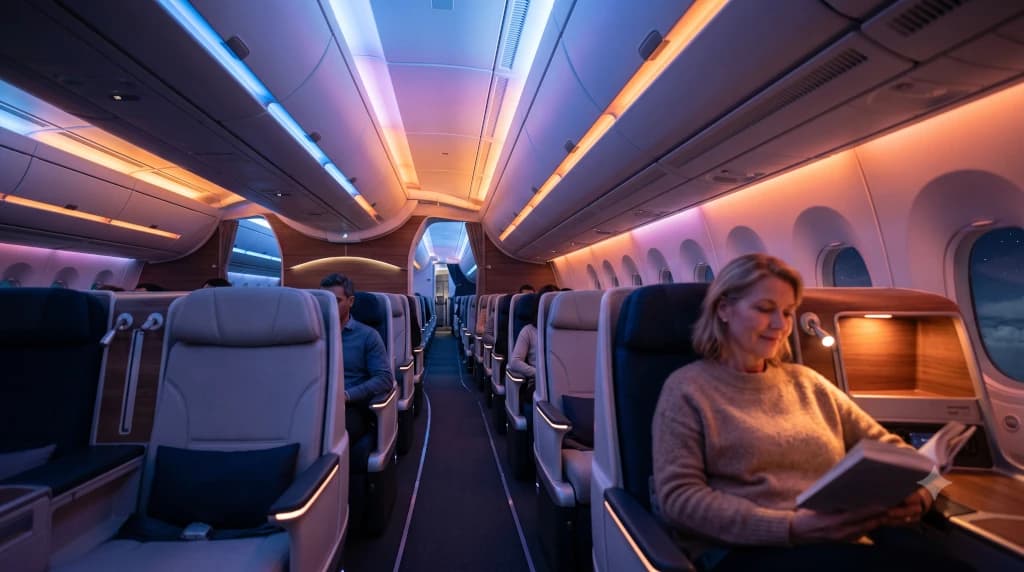
When you step across the threshold of a modern passenger aircraft, you get the distinct impression of entering a subtly crafted sanctuary. Soft, deep shades of blue and violet wash across the cabin ceiling, hushing the hustle and bustle of the departure gate. Hours later, just before meal service, the light softly transitions into warm, honeyed tones, only to gently mimic a fresh dawn right before landing. This is no coincidence or purely aesthetic flourish designed to impress business class passengers. It is the result of sophisticated psychological engineering and advanced neuroscience, blending cabin neuroarchitecture, chronobiology, and state-of-the-art LED technology.
Modern commercial aviation understands all too well that flying is an unnatural and highly stressful experience for the human body. Being enclosed in a narrow metallic cylinder, forced into a seated position, subjected to dry air and shifting time zones creates an invisible cocktail of tension. That is why airlines and aerospace giants—led by Airbus and Boeing—invest hundreds of millions of dollars researching how interior architecture and light affect spatial perception, cortisol levels, and passenger metabolism. Let us take a closer look at how aviation leaders use light and design to subtly influence our senses, making long-haul flights feel shorter, safer, and infinitely more pleasant.
The Psychology of Light: What Is "Mood Lighting" and How Does It Control Our Biology?
At the heart of the digital revolution in aircraft interiors is the introduction of Mood Lighting powered by advanced LED (Light Emitting Diode) matrices. Before this technology entered passenger cabins, airlines were constrained by traditional fluorescent tubes. These operated on a binary on/off switch, generating an unnatural, harsh, flickering glare that heightened fatigue and triggered irritability.
The technological breakthrough allowed engineers to program lighting scenarios consisting of millions of color shades, offering smooth, imperceptible tonal transitions lasting up to thirty minutes. This is far more than mere decoration. The primary goal of aviation lighting designers is to optimize the human circadian rhythm by influencing the production of two key hormones: melatonin (responsible for sleep and relaxation) and cortisol (the stress and alertness hormone).
The Geometry of Colors Onboard
Lighting engineers at firms like Collins Aerospace or Diehl Aviation operate with a precisely tuned color palette, where each shade serves a specific therapeutic and emotional function:
- Deep Blue and Indigo (Cool Calming Phase): Used most frequently during boarding and preparation for sleep. Blue light of a specific wavelength helps lower heart rate, blood pressure, and post-security anxiety levels.
- Amber, Warm Gold, and Candle Tones (Melatonin Stimulation): These replace harsh whites during dinner service and before lights-out. A warm spectrum devoid of blue light prompts the pineal gland to secrete melatonin, preparing the body for deep, restorative sleep.
- Golden Dawn and Pastel Pink (Artificial Sunrise): One of the most critical challenges on long-haul routes. Instead of abruptly switching on overhead lights, the system dynamically increases intensity over 15 to 30 minutes, shifting from soft violet through pink to warm amber. This gentle process wakes passengers naturally, minimizing the morning cortisol spike.
- Bright, Saturated White (Entry Reset): Used briefly during cabin cleaning and passenger turnarounds on the ground to signal cleanliness, hygiene, and modern efficiency.
Cabin Neuroarchitecture: How to Trick the Human Brain and Create the Illusion of Space
Lighting, however, is only half the battle. The second pillar of well-being engineering is aircraft interior architecture. From an evolutionary standpoint, enclosing a human in a narrow, unescapable tube just a few meters wide is deeply unnatural, triggering subconscious claustrophobia. Aircraft interior architects face a daunting task: how to visually expand the cabin without reducing seat density, which determines airline profitability?
1. Organic Curves and Fluid Lines (Skylights and Coffers)
Modern interior concepts (such as Airspace by Airbus or the Boeing Sky Interior) eliminate sharp angles, vertical partitions, and visually heavy obstructions. Instead, gentle, organic architecture dominates. Ceilings are visually elevated using illuminated recessed coffers that create the illusion of an open sky. Transitions between overhead storage bins and side walls are softly rounded, preventing the eye from focusing on the physical boundaries of the cabin.
2. Redesigned Overhead Bins
Innovations in luggage storage were not merely practical (fitting more carry-on bags), but profoundly psychological. Traditional overhead lockers opened downward, intruding into the headroom of passengers and creating an overwhelming feeling of mass pressing from above. Modern systems (such as Pivot Bins) swing upward and retract deep into the ceiling structure. As a result, the space above aisle seats opens up dramatically, giving the impression of a much taller, more spacious cabin.
3. Visual Texture and Color Management
Airlines, in partnership with design studios such as PriestmanGoode or Teague, use intricate geometric patterns on carpets, bulkheads, and seat upholstery. Tonal transitions—moving from darker shades near the floor to bright, near-white elements at the ceiling—leverage the principle of atmospheric perspective. The brain subconsciously interprets a light top as the sky and a dark bottom as the ground, significantly reducing spatial stress.
Fighting Jet Lag: Chronobiology at 10,000 Meters
The ultimate expression of lighting architecture's impact on passengers is seen in anti-jet-lag scenarios deployed on ultra-long-haul routes lasting 16 to 19 hours. Flights from London to Perth, New York to Singapore, or Doha to Auckland are endurance tests for the human body.
When an aircraft crosses up to ten time zones in a single flight, traditional meal and sleep times cease to make sense. Modern Cabin Management Systems (CMS) are synchronized with the destination time zone rather than the point of departure. This means the crew does not illuminate the cabin simply when passengers feel hungry, but gradually dims and shifts lighting hues to "reset" the biological clock long before touchdown.
On latest-generation aircraft like the Airbus A350-1000 or Boeing 787 Dreamliner, these lighting systems are supported by optimized cabin environments. A lower cabin altitude pressure (equivalent to around 1,800 meters above sea level instead of the traditional 2,400 meters) combined with higher humidity enhances the effect of the lighting, making body recovery during the "artificial night" phase far more effective.
A Sensory Experience: Scent, Sound, and Acoustics
While light and architecture play primary roles, a complete sensory design requires engaging the remaining senses. Airlines know full well that the nervous system processes its environment holistically.
- Acoustic Innovations (Silent Cabin): Modern aircraft interior design uses specialized dampening mats made of composite laminates and wall finishes engineered to absorb low-frequency engine drone. Reduced noise levels allow relaxing lighting scenarios to achieve their full psychological effect.
- Aromatherapy and Signature Scents: Leading airlines (such as Singapore Airlines with its famous Stefan Floridian Waters scent, Delta, or Cathay Pacific) diffuse custom signature fragrances through the cabin. Featuring notes of lavender, lemongrass, bergamot, and sandalwood, these scents are scientifically proven to soothe the nervous system while masking technical equipment odors.
Conclusion: An Illusion Serving Our Health
Is the word "manipulation" an exaggeration when discussing interior architecture and mood lighting? From the perspective of passenger psychology—not at all. It is a refined, positive manipulation of human perception designed to ease primitive anxiety, shorten perceived travel time, and protect the body against the exhausting effects of jet lag.
The modern passenger cabin has become an advanced psychological laboratory. Every curve of an overhead bin, every shade of violet or gold on the ceiling, and every subtle dimming sequence serves a single purpose: to convince your brain that you are not inside a metal cylinder flying at 900 km/h, but in a safe, comfortable environment engineered specifically for your well-being. Even the most discerning observer can appreciate this engineering mastery—because even when we know we are experiencing an illusion, we willingly surrender to it on every flight.