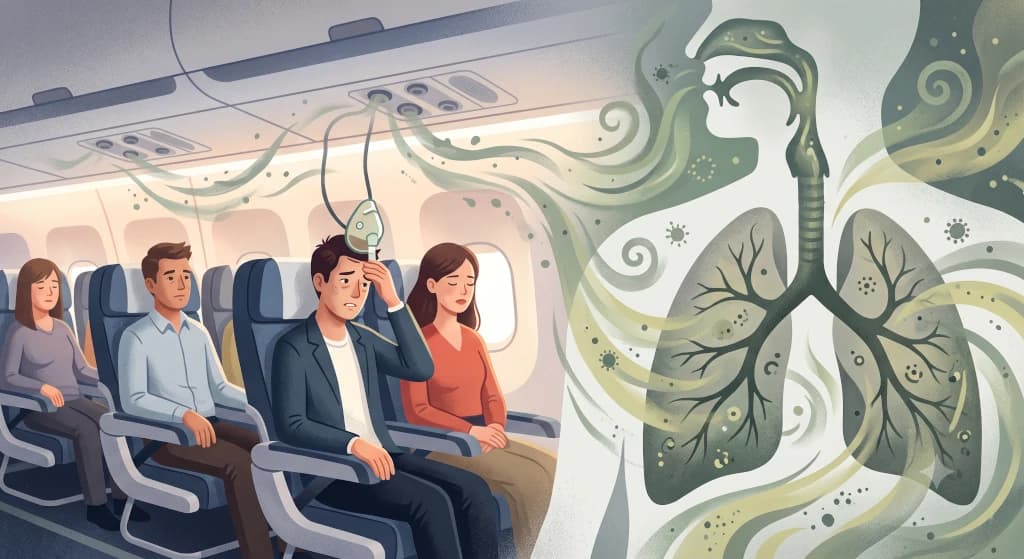
Aerotoxic Syndrome: Is Passenger Cabin Air Safe for Your Health?
Introduction
When you take your seat in a passenger aircraft at a cruising altitude of ten thousand meters, you rarely stop to think about what you are actually breathing. Outside the thin windowpane lies a lethal environment: rarefied air, temperatures dropping to -50°C, and air pressure incapable of supporting human life. To enable us to travel the globe in comfort, modern passenger jets transform their fuselages into sealed pressure vessels. But where does the oxygen that hundreds of passengers and crew members breathe inside this closed system actually come from?
The answer to this question opens the door to one of the most closely guarded, controversial, and fiercely debated secrets of modern commercial aviation: a phenomenon known as Aerotoxic Syndrome. For decades, a quiet battle over cabin air quality has been waged among pilots, cabin crew, and independent toxicologists. Could the ventilation systems of modern aircraft be a source of slow poisoning? What invisible substances can enter human lungs during a transatlantic flight, and why has the aviation industry historically approached this topic with such immense detachment? It is time to examine the anatomy of a problem that affects everyone who fastens their seatbelt before takeoff.
Anatomy of the Ventilation System: What Is "Bleed Air"?
To understand the origin of the hazard, we must dive into the basics of aeronautical engineering and understand how the Environmental Control System (ECS), which has dominated aircraft design for the last several decades, operates.
In the vast majority of modern passenger aircraft (such as the popular Airbus A320 or Boeing 737 families), the air supplied to the cabin is not drawn directly from the outside through dedicated intakes. Instead, aircraft utilize bleed air—air tapped directly from the compressor section of the jet engines. The process unfolds as follows:
- Intake and Compression: Ambient, freezing atmospheric air enters the engine intake, where powerful compressor stages compress it under immense pressure. As a result of physical compression alone, the air temperature rises rapidly, reaching several hundred degrees Celsius.
- Air Bleeding: Before this hot air reaches the combustion chamber (where it is mixed with Jet A-1 fuel and ignited), a portion is "intercepted" and routed through high-pressure manifolds to the air conditioning system.
- Cooling and Mixing: The hot bleed air enters heat exchangers and Air Cycle Machines, where it is cooled to an appropriate temperature. It is then mixed in approximately a 50/50 ratio with recirculated cabin air (which passes through HEPA filters) and blown into the passenger cabin overhead.
On paper, this is a brilliant and highly efficient engineering design. However, the system has one critical vulnerability: the engine compressor section is located in immediate proximity to shaft bearings that require constant, intense lubrication with synthetic engine oils.
Where Does the Hazard Originate? The "Fume Event"
Jet engine shaft bearings operate under extreme conditions of high temperatures and immense rotational speeds. To prevent synthetic oil from leaking into the compressed airstream, advanced labyrinth and carbon seals are utilized. However, these seals are not immortal—they suffer gradual mechanical wear, and micro-vibrations or pressure fluctuations can cause them to lose their perfect seal.
When a seal fails, minute quantities of synthetic engine oil (or hydraulic fluid) pass directly into the hot bleed air stream. At temperatures reaching hundreds of degrees Celsius, the oil undergoes pyrolysis—a process of thermal decomposition without combustion. At this point, a fume event occurs.
In extreme cases, a fume event manifests as visible hazy smoke in the cabin accompanied by a sharp, characteristic odor reminiscent of dirty socks, heated plastic, or burning oil. In most cases, however, the contamination is completely invisible to the eye and difficult to detect by smell alone.
What Is Actually in Contaminated Cabin Air?
Modern jet engine lubricants are sophisticated synthetic formulations containing highly toxic organic additives. Key harmful components include:
- Organophosphates (e.g., TOCP – Tri-Ortho-Cresyl Phosphate): Added as anti-wear agents to withstand extreme pressures. These compounds are potent neurotoxins that affect the human nervous system in a manner similar to chemical warfare agents (such as sarin or soman) or organophosphate pesticides.
- VOCs (Volatile Organic Compounds): Toxic hydrocarbons, aldehydes, and carbon monoxide produced during the thermal degradation of synthetic oil.
- Hydraulic Fluid Breakdown Products: Containing irritating tributyl phosphates, which cause severe irritation of the respiratory tract and mucous membranes.
What Is Aerotoxic Syndrome and What Are Its Symptoms?
The term Aerotoxic Syndrome was first introduced to medical literature in 1999 by an international team of scientists: Dr. Chris Winder (Australia), Dr. Jean-Christophe Balouet (France), and Dr. Harry Hoffmann (USA). They described a constellation of neurological, respiratory, and systemic symptoms observed in individuals exposed to cabin air contaminated by oil pyrolysis products.
Symptoms are generally divided into two categories: acute (occurring during or immediately after a flight) and chronic (developing as a result of long-term, repetitive exposure).
Acute Symptoms (During or Immediately After Flight):
- Headaches, dizziness, and cognitive impairment ("brain fog").
- Nausea, vomiting, and gastrointestinal distress.
- Irritation of the eyes, nose, and throat, accompanied by a dry, persistent cough.
- Loss of motor coordination, difficulty concentrating, and numbness in limbs.
- Chest tightness and shortness of breath.
Chronic Symptoms (Long-Term Effects):
- Permanent peripheral nervous system damage (peripheral neuropathy).
- Chronic fatigue, depression, anxiety disorders, and short-term memory impairment.
- Chronic respiratory issues (symptoms resembling asthma or COPD).
- Cardiac arrhythmias and muscle weakness.
For a passenger taking a single flight once or twice a year, the risk of developing permanent health damage is relatively low—the human body typically metabolizes and eliminates trace amounts of toxins. However, pilots and cabin crew members are on the front lines, spending 80 to 100 hours per month in pressurized cabins. Dozens of cases in aviation history document promising careers of captains and flight attendants brought to a sudden end due to a complete loss of medical fitness caused by irreversible neurological damage.
The Most Dangerous Scenario: In-Flight Cockpit Incapacitation
From an operational safety standpoint, aerotoxic syndrome ceases to be merely a occupational health issue and becomes a direct threat to the lives of everyone onboard. During a severe fume event, the pilots are the first to inhale toxic vapors in the enclosed flight deck environment.
Inhaling organophosphates and carbon monoxide in a confined cockpit can lead to incapacitation—a pilot's partial or total inability to perform flight duties. Impaired cognitive functions, tunnel vision, spatial disorientation, or slowed reaction times in both pilots during a critical approach phase is a direct recipe for disaster.
Official accident investigation reports from around the world (including the UK's AAIB and the US NTSB) contain numerous accounts of incidents where flight crews had to don emergency oxygen masks under positive pressure, declare an emergency (MAYDAY), and perform precautionary landings because cockpit air had become unbreathable.
Why Is the Issue Downplayed? Industry Politics and Economics
If this issue has been known to engineers and medical professionals for over two decades, why are air quality sensors not universally installed at gates, and why is the aviation industry reluctant to discuss it publicly? The answer lies in multi-billion-dollar liabilities and complex legal accountability.
The official stance of most aircraft manufacturers, airlines, and regulatory bodies (such as the FAA and EASA) has remained consistent for years: "Cabin air quality meets all applicable health standards, and concentrations of potentially harmful substances during normal operations are far too low to cause chronic health effects."
Formally recognizing Aerotoxic Syndrome as an occupational disease caused by flight conditions would carry monumental consequences:
- Multi-Billion Dollar Liabilities: Airlines and manufacturers would face thousands of class-action lawsuits from affected crew members and passengers.
- Enormous Technical Costs: Retrofitting air conditioning systems across thousands of active aircraft worldwide, alongside mandatory installations of advanced carbon filtration systems and toxin detectors.
- Operational Disruptions: Every reported odor leak would require immediate aircraft grounding and component replacement.
A Shift in Design: The Boeing 787 Dreamliner and New Technologies
Technological progress has begun to resolve this structural design flaw. A major breakthrough in ventilation design came with the introduction of the Boeing 787 Dreamliner.
Designing the Dreamliner from a clean sheet, Boeing engineers made a revolutionary decision: they completely eliminated the traditional Bleed Air system in favor of a Bleedless Architecture. On the B787, cabin air is drawn directly from outside the aircraft through dedicated inlets on the fuselage and compressed using electrically driven Cabin Air Compressors. This air never comes into contact with engine oil or the hot turbine section!
This design eliminates the risk of engine-sourced fume events. Furthermore, newer conventional aircraft are increasingly equipped with advanced activated carbon filters (capable of capturing VOCs and organophosphates) and early oil-vapor detection systems.
How Can Passengers Protect Themselves During a Flight?
While passengers cannot alter the engineering design of the aircraft they fly on, knowing basic safety awareness regarding cabin air quality is beneficial:
- Pay Attention to Odors: If you notice a sharp, chemical odor resembling burnt oil, dirty socks, or hot plastic after engine startup, report it immediately to the cabin crew.
- Keep Personal Air Vents Open: Air from individual overhead gaspers passes through HEPA filters (which excel at capturing airborne bacteria and viruses, though they do not stop gases). A steady stream helps maintain localized circulation around your face.
- Activated Carbon Masks: Standard surgical or FFP2/N95 masks do not filter chemical vapors or gases. Respirators fitted with an activated carbon layer offer better protection against VOCs and organophosphates.
- Report Post-Flight Symptoms: If you experience unusual nausea, severe headaches, visual disturbances, or coordination issues after a flight, seek medical evaluation and inform your physician of your recent air travel to document potential exposure.
Conclusion: The Need for Full Transparency in the Skies
Cabin air is generally safe from a biological standpoint—HEPA filtration systems effectively remove the vast majority of airborne viruses and bacteria. However, chemical contamination originating from engine bleed systems has long remained a sensitive topic within the aviation industry.
Aerotoxic syndrome is not a conspiracy theory, but a real challenge in occupational medicine and transport engineering. The adoption of bleedless architecture (as seen on the Dreamliner), alongside growing public awareness and pressure from pilot unions, is gradually compelling regulators and airlines to implement higher air quality standards. Transparency in cabin air monitoring remains the key to ensuring that passengers and flight crews can breathe easy at any altitude.