The Art of Aircraft Painting: How Much Does Paint Weigh and How Does It Impact Fuel Burn?
Introduction
When standing by the panoramic window of an airport terminal waiting for your flight, your attention is inevitably drawn to the massive fuselages gleaming in the sun. From classic, snow-white hulls with a subtle logo on the vertical stabilizer to colorful, intricate special liveries promoting movies, sporting events, or local culture—the paint coating of a modern passenger aircraft is the first thing a passenger sees. However, for aeronautical engineers, fleet planners, and performance specialists, the outer layer of paint is far more than just a business card and a marketing tool.
Commercial aircraft painting is a fascinating intersection of art, aerodynamics, advanced material chemistry, and relentless economics. Every liter of paint applied to an aircraft's fuselage adds weight, and in commercial aviation, every additional kilogram translates to higher fuel consumption, increased carbon emissions, and direct financial costs amounting to hundreds of thousands of dollars per year. What is the physics and chemistry behind painting a jetliner? How much does this spectacular protective layer actually weigh, and how does it impact aerodynamic drag and flight economy?
From Bare Aluminum to Modern Composites: A History of Fuselage Coatings
To fully understand why modern aircraft are painted in such a specific way, we must look back to the so-called golden age of aviation. In the 1950s and 60s, many airlines—led by giants like American Airlines and Eastern Air Lines—opted for a signature look featuring polished, bare aluminum. Their aircraft fuselages shone like mirrors, decorated with only minor color accents along the windows.
This decision was not driven purely by aesthetics. A polished aircraft saved on paint mass (which, for a Boeing 707, meant a weight reduction of about 150–200 kg). It appeared to be an ideal economic solution. However, reality quickly challenged these assumptions. Polished aluminum required extremely labor-intensive and costly maintenance. The fuselages had to be polished regularly with specialized compounds up to several times a year to prevent tarnishing and corrosion. Furthermore, bare metal provided no protection against UV radiation, extreme temperature fluctuations (from +50°C on the tarmac to -60°C at cruising altitude), and harsh chemicals like de-icing fluids or hydraulic oil leaks.
The materials revolution and the arrival of modern alloys and composite materials (such as carbon-fiber reinforced polymers used in the Boeing 787 Dreamliner and Airbus A350) ultimately sealed the fate of unpainted aircraft. Unlike metals, composites require absolute protection against UV rays, which degrade epoxy resin structures. Paint transitioned from an option to a technological necessity.
Anatomy of Aircraft Painting: How Is the Outer Layer Structured?
An airliner's paint coating is a precisely engineered, multi-layer system. It bears little resemblance to painting a passenger car or a house wall. The total coating thickness is measured in hundredths of a millimeter (typically 0.1 to 0.2 mm), and the application process demands strictly controlled environmental conditions in specialized paint hangars.
A standard coating system on a modern aircraft consists of three primary layers:
- Primer Layer: The first coat applied directly to the prepared, degreased, and scuffed fuselage surface. The primer (usually epoxy-based with added corrosion inhibitors) ensures optimal adhesion for subsequent layers and protects the aircraft structure from oxidation and micro-damage.
- Basecoat: This layer supplies the aircraft's color, containing pigments, decorative elements, logos, and airline livery. Modern systems utilize highly flexible polyurethane basecoats. Flexibility is crucial, as an aircraft fuselage expands ("swells") and contracts during every flight cycle due to cabin pressurization changes.
- Clearcoat: The outer protective lacquer that provides a deep gloss, protects pigments from fading under intense high-altitude sunlight, and makes it easier to wash away contaminants like engine soot and insect debris.
How Much Does the Extra Paint Weigh? Hard Data for Popular Aircraft Types
Let us turn to the key question: how does this complex process translate into aircraft weight? The answer depends on the aircraft's size, the painting technology used, and the graphic complexity of the livery.
A fundamental physical fact must be kept in mind: liquid paint weighs significantly more than the dried coating left on the aircraft. Solvent content accounts for 50–60% of liquid paint mass, all of which evaporates during the drying and curing process. Consequently, the weight of wet paint delivered to a hangar can be quite staggering.
Here are estimated values for the **dry paint coating mass** across various aircraft classes:
- Regional Narrow-body Aircraft (e.g., Embraer E195, ATR 72): Dry paint mass ranges from 70 to 120 kg.
- Popular Narrow-body Aircraft (e.g., Boeing 737-800, Airbus A320): The outer coating weighs between 150 kg and 250 kg on average. For complex special liveries, this figure can rise to 300 kg.
- Medium and Large Wide-body Aircraft (e.g., Boeing 787-9, Airbus A330): The dry paint weight across the fuselage and wings is approximately 300 to 500 kg.
- Giants of the Sky (Boeing 747-8, Airbus A380): For the world's largest passenger aircraft, the Airbus A380, the paintable surface area exceeds 3,100 square meters! Covering such an expansive area requires over half a ton of liquid paint, leaving a dry weight penalty of 600 to 650 kg.
To visualize this scale: the paint weight on a single Airbus A320 equals the combined weight of two to three adult passengers plus their checked luggage. In the case of an A380, we are talking about the weight equivalent of an entire rugby team alongside their coaching staff!
Impact of Paint Weight on Fuel Burn and Operating Costs
In aviation, every additional kilogram carries a direct, quantifiable cost. The physical principle is straightforward: a heavier aircraft requires wings to generate more lift, demanding greater engine thrust, which directly translates to higher fuel burn.
Airline performance engineers use a metric known as the Fuel Cost Penalty, or the annual fuel burn rate per kilogram of added weight. This factor depends on the aircraft's average annual flight hours and route lengths. On average, 1 additional kilogram onboard a short-to-medium haul narrow-body aircraft consumes between 0.03 and 0.05 kg of fuel per flight hour annually.
Economic Calculation: A Fleet Example
Let us analyze a concrete scenario. Imagine a medium-sized airline operating a fleet of 50 Boeing 737-800 aircraft, with each plane averaging 3,000 flight hours annually.
If the airline chooses an elaborate, multi-layered special livery that increases the dry paint mass on each aircraft by 80 kg compared to a lightweight, minimalist scheme:
- Additional fuel burn per aircraft: 80 kg × 0.04 kg fuel/hr × 3,000 hrs = 9,600 kg (9.6 metric tons) of fuel per year for a single jet.
- Additional fuel burn for the fleet (50 jets): 9.6 t × 50 = 480 metric tons of fuel per year.
- Financial Cost: With jet fuel (Jet A-1) priced around 800–900 USD per ton, the airline incurs an extra expense of 384,000 to 432,000 USD annually simply to haul the heavier paint.
- Environmental Impact: Burning 480 tons of jet fuel releases over 1,500 metric tons of carbon dioxide (CO2) into the atmosphere each year.
Why Are Most Planes White? "Eurowhite" and Aerodynamics
When looking out at modern airport aprons, the dominance of white liveries is hard to miss. Most airlines adopt what is known as the **Eurowhite** scheme—a stark white fuselage featuring a colored tail logo and perhaps modest lettering along the forward cabin. While aviation spotters often decry this design trend as dull, the choice is backed by compelling economic, physical, and operational rationales.
1. Thermal Properties (Albedo)
White exhibits the highest light reflectivity (albedo). A light-colored fuselage reflects most solar radiation, preventing the aircraft interior from overheating while parked on a sunlit tarmac. This reduces the load on Auxiliary Power Units (APUs) and air conditioning systems, saving hundreds of liters of fuel on the ground and curbing component wear.
2. Protection of Composite Materials
Key structural elements in modern airframes are sensitive to elevated temperatures. Under direct sunlight, dark paint on composite skin can reach temperatures exceeding 80°C, potentially compromising structural integrity over time. White paint maintains skin temperatures at significantly lower levels.
3. Pigment Density and Fewer Layers
White pigment (primarily titanium dioxide) offers exceptional opacity and coverage. Achieving uniform coverage requires a much thinner paint layer compared to dark, metallic, or vibrant colors, which demand multiple coats. A thinner layer directly translates to less weight.
4. Ease of Inspection and Safety
Against a white backdrop, maintenance personnel can instantly spot anomalies: structural micro-cracks, fluid leaks (engine oil, hydraulic fluid), bird strike marks, or hail damage.
Surface Roughness and Aerodynamic Drag (Riblets)
Paint weight tells only half the efficiency story. The second critical factor is the **surface quality** of the applied paint finish. An aircraft cruising at speeds around Mach 0.85 (~900 km/h) encounters immense aerodynamic drag, a major portion of which is skin friction drag.
When an aircraft's paint becomes aged, faded, chipped, or poorly applied (creating an "orange peel" texture), the smooth airflow over the airframe is disrupted. Instead of maintaining laminar flow, micro-turbulences form rapidly within the boundary layer. Estimates suggest that a weathered, rough paint surface can increase skin friction drag enough to bump total fuel consumption up by an extra 1 to 2%! Over an aircraft's operational lifespan, this adds up to substantial sums.
Inspired by Nature: Riblet Coatings
Engineers and researchers have taken surface science a step further by tailoring paint structures to actively *reduce* drag. Drawing inspiration from nature—specifically shark skin denticles—innovative films and coatings featuring **riblets** were developed. Riblets are microscopic, longitudinally aligned grooves etched into the outer surface that organize micro-vortices in the boundary layer.
Lufthansa Technik, in partnership with chemical giant BASF, developed a technology named **AeroSHARK**. This specialized film surface replicates shark skin and is applied to the fuselage and engine nacelles. The results are impressive: applying AeroSHARK film to Boeing 777 aircraft reduces total drag by over 1%, yielding fuel savings of roughly 400 tons and cutting CO2 emissions by 1,200 tons per aircraft annually!
How Is a Giant of the Skies Painted?
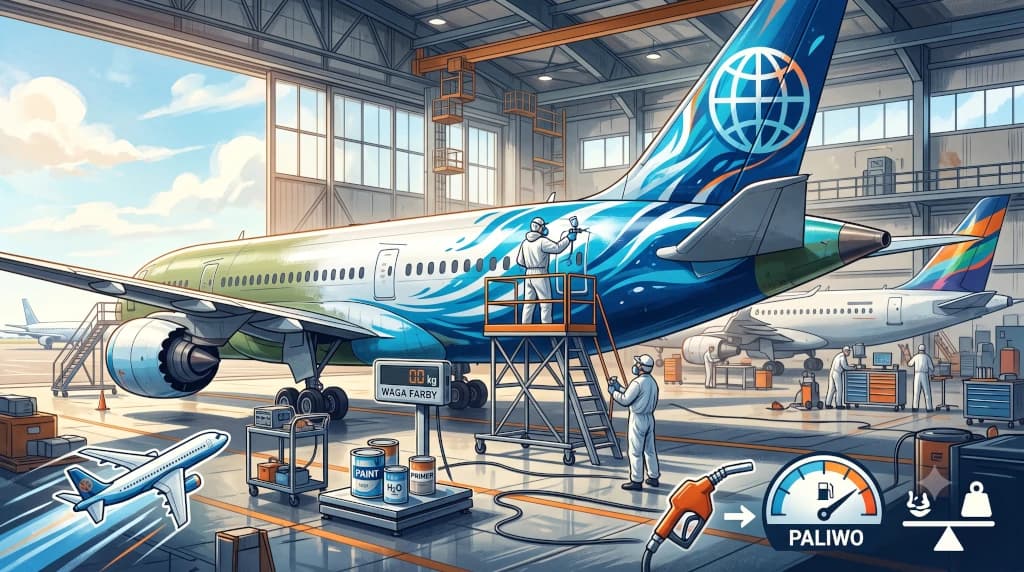
Painting a commercial jetliner is a masterpiece of logistics and engineering. The aircraft is towed into a specialized climate-controlled hangar where temperature (typically 20–25°C) and relative humidity are rigidly regulated. Slight environmental deviations can cause improper paint curing or air entrapment.
Step by step, the process unfolds as follows:
- Paint Stripping: Before applying new paint to a used aircraft, the old coating must be removed completely. Chemical strippers (eco-friendly formulations) or mechanical methods (such as plastic media blasting or dry-ice blasting) are utilized. Removing old paint from a large wide-body jet sheds hundreds of kilograms of redundant weight.
- Cleaning and Masking: The airframe is washed and thoroughly degreased. Technicians then carefully mask off sensitive components: Pitot tubes, static ports, cabin windows, seals, landing gear assemblies, and engine intakes.
- Primer and Paint Application: Skilling technicians (often assisted by automated painting robots) apply the coats using High-Volume Low-Pressure (HVLP) spray equipment. Coating thickness is monitored continuously with electromagnetic induction gauges.
- Curing and Weighing: Once the clearcoat is applied, the aircraft cures in an elevated-temperature environment (around 40–50°C). Finally, the aircraft is placed on precision platform scales under its landing gear wheels to establish its new dry operating weight and re-calculate its center of gravity (Weight and Balance).
Conclusion: The Fine Line Between Aesthetics and Economics
Painting an airliner involves far more than aesthetics and showcasing brand logos at 35,000 feet. It is a carefully calculated engineering decision where every gram of applied paint is weighed against hundreds of thousands of liters of fuel, airframe longevity, and environmental responsibility.
The modern aviation industry continually searches for optimal trade-offs. Through advancements in polyurethane chemistry, ultra-thin coatings, and biomimetic surfaces, modern aircraft can look striking while shedding unnecessary weight. The next time you board a flight, take a moment to look at the fuselage—that paper-thin coat of paint is a true marvel of aeronautical engineering, working silently every day to keep your flight safe, smooth, and efficient.