

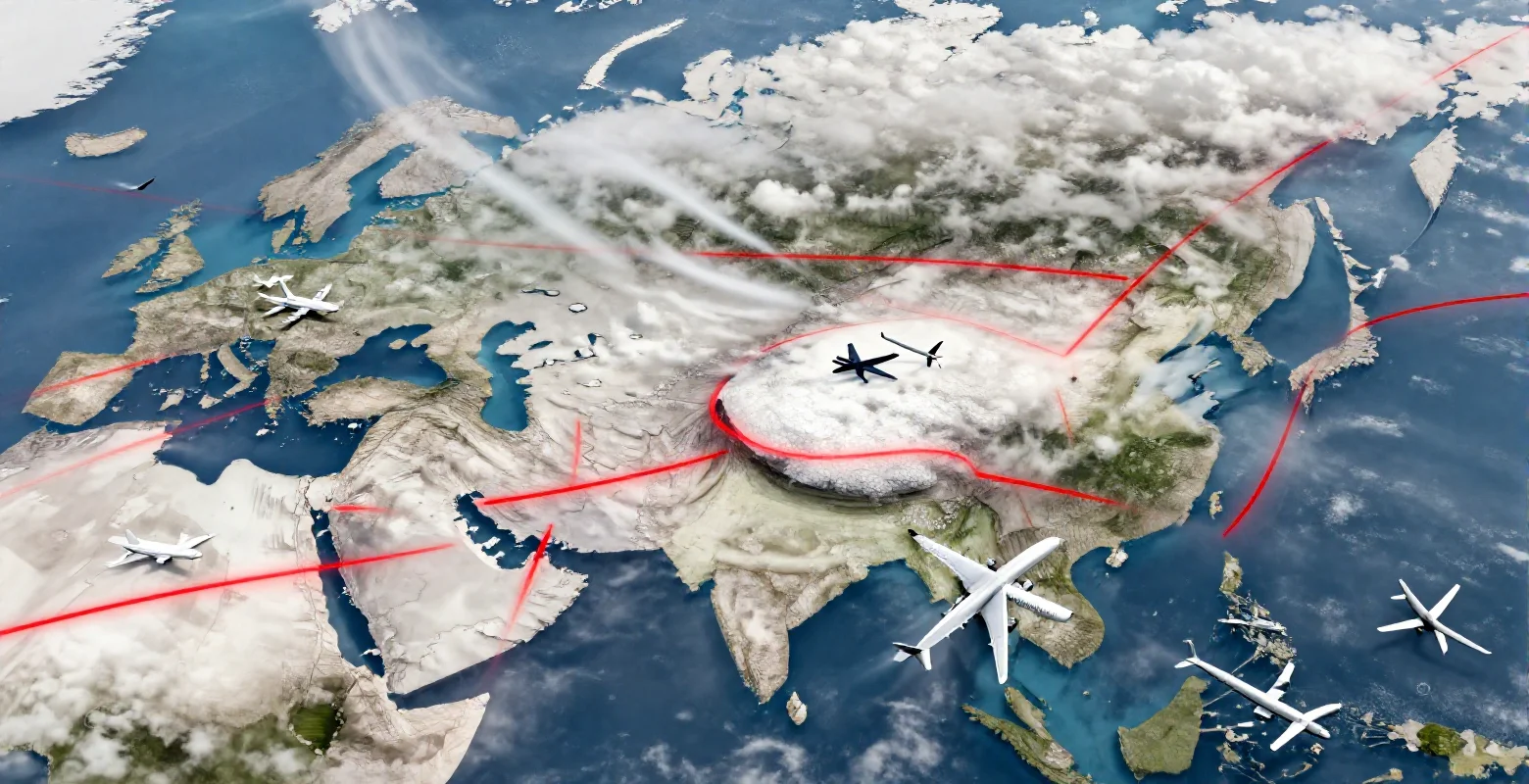
Geopolitics Above the Clouds: Why Airlines Avoid the Airspaces of Certain Countries
Introduction
Civil aviation has always been a stage for subtle geopolitical games. Airspace, though seemingly neutral, becomes a battleground for the influence and interests of states. In recent decades, we have observed an increasing number of cases where airlines are forced to change flight routes due to international tensions. Why does this happen? What mechanisms govern these decisions? And what consequences do they carry for the industry and passengers?
Politics as a Factor Shaping Flight Routes
Decisions to avoid specific airspaces often arise from political tensions or armed conflicts. An example can be the situation after Russia's annexation of Crimea in 2014, when many Western airlines stopped using Russian airspace over the Black Sea. This resulted in longer flight times and increased fuel costs.
Another example is the war in Ukraine, which forced airlines to avoid airspace over that country. According to IATA data, prior to the conflict, about 1,000 aircraft flew daily through Ukrainian airspace. After the outbreak of war, this number dropped to nearly zero, impacting global communication routes.
Economic and Operational Consequences
Changing flight routes is not only a matter of safety but also a significant economic challenge. Lengthening a route means higher fuel consumption, which translates into higher operational costs and ticket prices for passengers.
- According to IATA estimates, avoiding conflict zones can increase fuel consumption by as much as 20% on long routes.
- Airlines must also account for additional fees for using alternative airspaces, which burdens their budgets.
- In extreme cases, some routes become unprofitable and are suspended.
International Regulations and Freedom of Air Navigation
International cooperation in flight safety is based on conventions such as the Chicago Convention. However, in practice, states often use their right to close their airspace as a tool of political pressure.
- The European Union has imposed a flight ban on Russian carriers after the invasion of Ukraine, which hit the Russian aviation sector.
- Meanwhile, China regularly restricts access to its airspace for aircraft from Taiwan, viewing this as part of its policy towards the island.
Perspectives and Challenges
In the face of increasing geopolitical tensions, airlines must increasingly adapt their strategies. The development of technologies such as real-time airspace monitoring systems (e.g., ADS-B) allows for quicker responses to changes, but does not eliminate the underlying problem – political instability.
Conclusions
Geopolitics remains a key factor influencing the shape of the global air transport system. Although airlines strive to minimize losses, the long-term effects of these decisions are felt by both carriers and passengers. In the face of escalating conflicts, the future will require even greater flexibility and innovation in route planning.


Number of comments: 0