

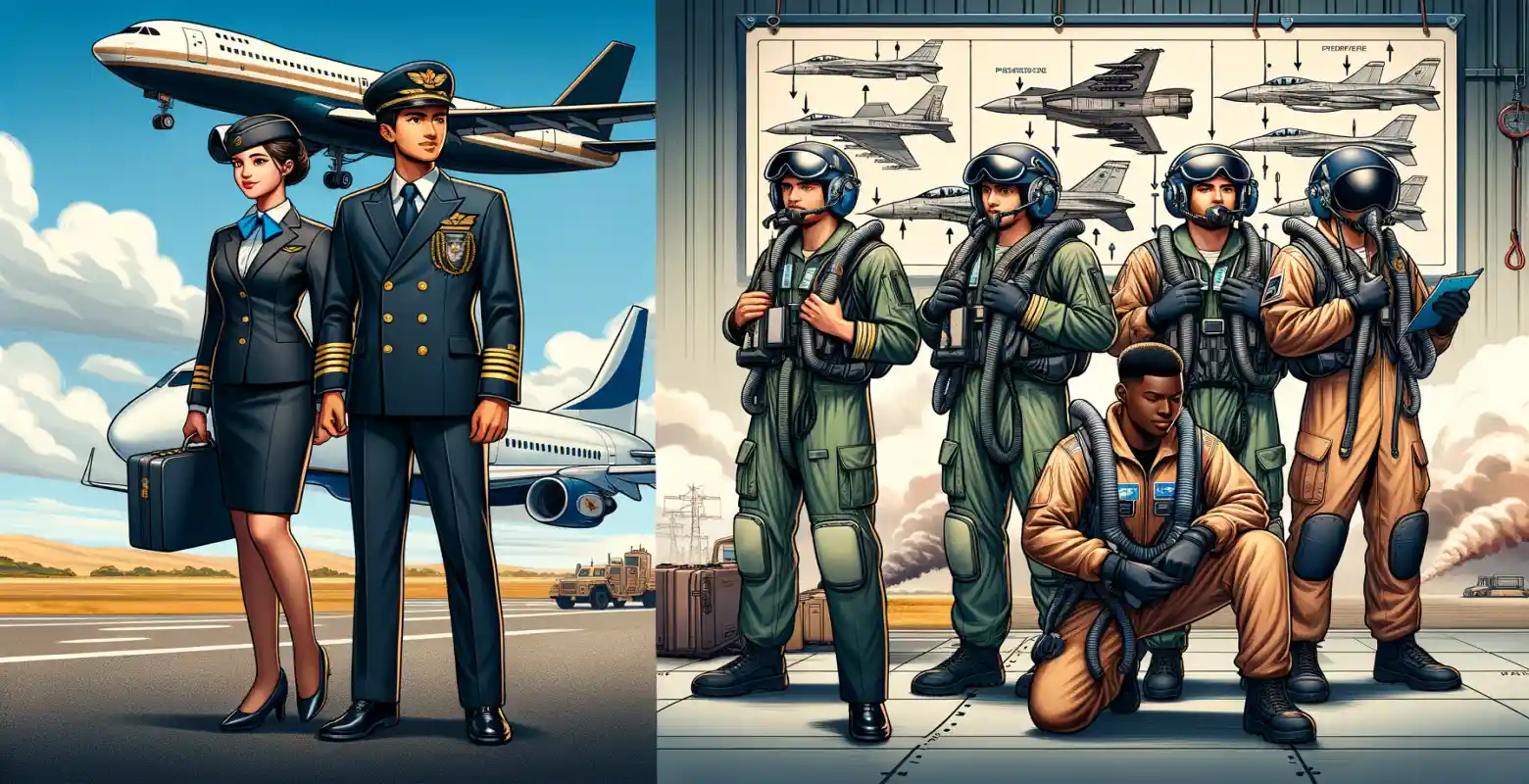
What are the differences in training between civilian and military pilots?
Introduction
Pilot training is an extremely complex process that requires not only theoretical knowledge but also practical skills. Depending on the type of aviation – commercial or military – the training differs in both scope and methodology. Understanding the differences between training for commercial and military pilots is crucial not only for those directly involved in aviation but also for anyone interested in aviation safety and efficiency. In this article, we will examine the key differences and specifics of training in both fields of aviation.
Theoretical and Practical Training
Commercial aviation requires pilots to have thorough theoretical knowledge in areas such as meteorology, navigation, aerodynamics, and aviation regulations. Theoretical training is the foundation that enables pilots to understand the complexity of commercial flights. Furthermore, practical training focuses on operating modern passenger aircraft equipped with advanced navigation systems and autopilots.
Military aviation, on the other hand, places greater emphasis on combat maneuvers, tactics, and operations in challenging conditions. Military pilots must be prepared for various operational scenarios, requiring intensive training in aerial combat, precision landing in adverse conditions, and carrying out missions in threat situations. Practical training is more diverse and intense, encompassing both day and night flights as well as combat flight simulations.
Equipment and Simulators
In commercial aviation, pilots often use advanced simulators that replicate real conditions of commercial flights. These simulators feature realistic cockpits and allow pilots to train in various scenarios, from normal operations to emergency situations. This enables pilots to gain experience without the risks associated with actual flights.
In military aviation, simulators are also highly advanced, but their main purpose is to prepare pilots for combat missions. Military simulators often include enemy action simulations, allowing pilots to practice evasion maneuvers, aerial combat, and team coordination. Additionally, military pilots have access to a wide range of equipment, from fighter jets to combat helicopters, necessitating a varied approach to training.
Selection Process and Requirements
Selection of commercial pilots is a complex process but less rigorous than in the case of military aviation. Candidates must meet specific health and psychological requirements, complete the appropriate flight school, and obtain a commercial pilot's license. Experience in commercial flights and theoretical knowledge are crucial here.
Selection of military pilots is much more demanding. Candidates must undergo advanced psychological, medical, and fitness tests. Military training is intensive and longer, as pilots must be ready for actions in extreme conditions. Additionally, they are required to have the ability to make quick decisions and work effectively in a team.
Future Trends and Challenges
In commercial aviation, one of the main trends is automation. The introduction of modern technologies, such as artificial intelligence and autonomous systems, is changing the way pilots are trained. In the future, pilots will need to focus more on managing systems rather than traditional piloting skills.
Military aviation faces challenges related to the increasing complexity of combat operations. New technologies, such as drones or electronic warfare systems, require pilots to have additional skills. In the future, training for military pilots will need to account for increasingly complex operations in a dynamically changing combat environment.
Summary
Training for commercial and military pilots differs in many aspects, from theoretical and practical approaches to the selection process and requirements. Although both types of aviation present pilots with immense challenges, each focuses on different aspects and skills. Understanding these differences is crucial for a better appreciation of the complexity of modern aviation and the role pilots play in ensuring the safety and efficiency of aviation operations. Faced with rapidly evolving technologies and changing needs, both commercial and military aviation will need to adapt their training approaches to meet future challenges.

Number of comments: 0