

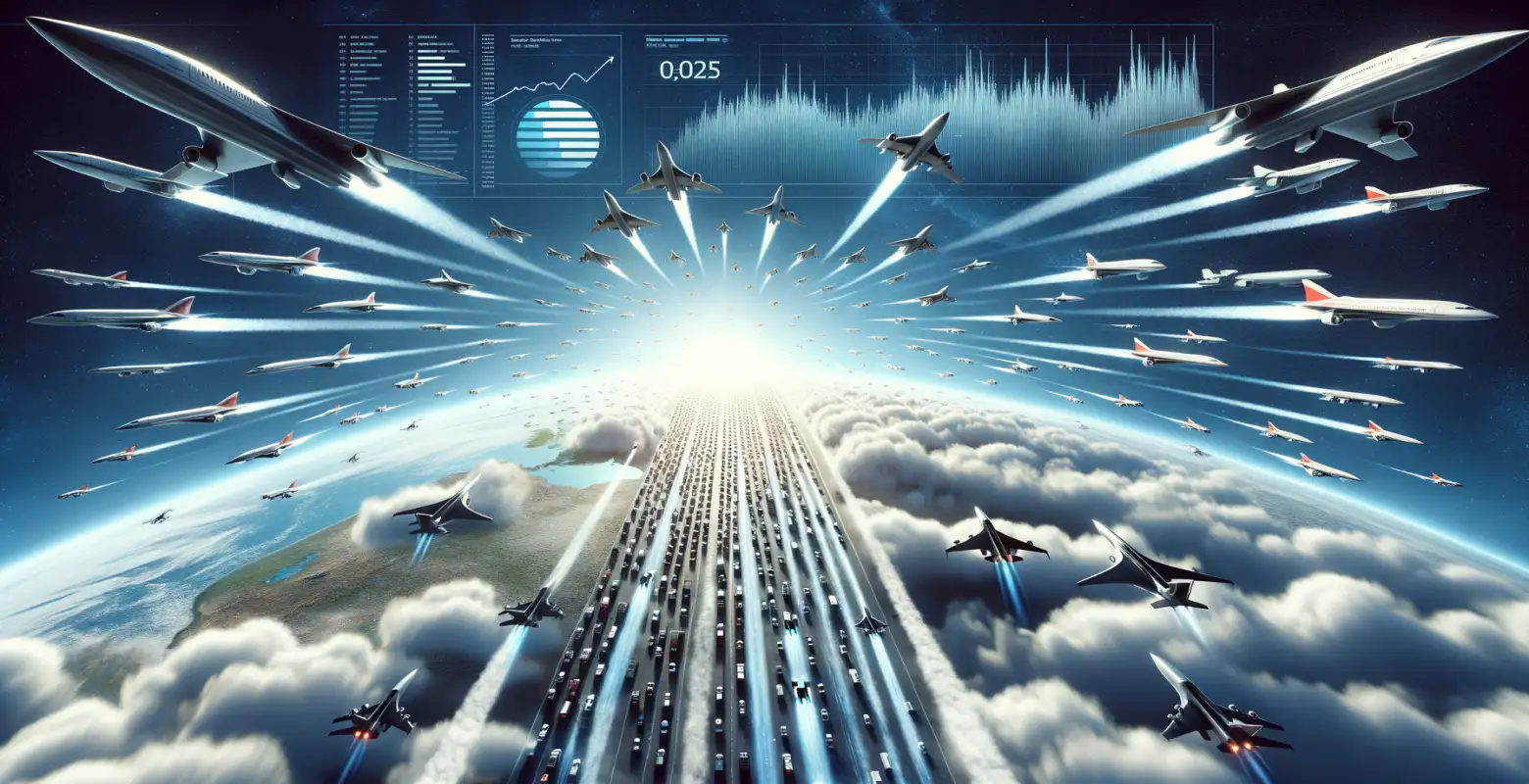
Increase in the number of supersonic flights in 2025
Introduction
In recent years, aviation has been experiencing a technological renaissance that is redefining the boundaries of speed and range in air travel. One of the key elements of this transformation is the resurgence of supersonic flights. In 2025, the increase in the number of supersonic flights is not only predicted but also anticipated by industry experts. Why is this phenomenon so significant? What benefits and challenges does this aviation revolution bring? This article provides a detailed insight into the development of supersonic flights, their technological foundations, and forecasts for the future.
History of Supersonic Flights
Supersonic flights are not a new concept in the world of aviation. In the 1960s, aircraft such as the Concorde and Tupolev Tu-144 began their supersonic journeys, ushering in a new era of speed in civil aviation. The Concorde, with a cruising speed of about 2,180 km/h, shortened the transatlantic travel time to just three and a half hours. Unfortunately, high operating costs, noise, and the 2000 crash led to the retirement of the Concorde in 2003.
New Technologies in Supersonic Flights
Since then, technological advancements have overcome many of the challenges that stood in the way of continuing supersonic flights. Modern composite materials, improved aerodynamics, and advanced propulsion systems have significantly reduced noise and operational costs. Leading airlines, such as Boom Supersonic and Aerion Corporation, are working on new models of supersonic aircraft that are intended to be more economical and environmentally friendly. Boom Supersonic plans to introduce its Overture model, which is capable of reaching a speed of Mach 2.2.
Benefits of Supersonic Flights
One of the key benefits of supersonic flights is the significant reduction in travel time. This allows travelers to save valuable time, which is particularly attractive for business travelers. Additionally, the development of supersonic aviation can stimulate innovations in other technological sectors, enhancing efficiency and competitiveness. In the longer term, such flights can also contribute to the development of new tourist markets that were previously inaccessible due to long travel times.
Challenges Associated with Supersonic Flights
Despite many advantages, supersonic flights also face numerous challenges. One of the most serious issues is the noise, known as the "sonic boom," that occurs when an aircraft exceeds the speed of sound. Although new technologies allow for the reduction of this phenomenon, it remains a significant problem, especially in the context of flights over populated areas. Additionally, supersonic flights require significant investments in airport infrastructure and the adaptation of safety regulations, which can be a challenge for many countries.
The Future of Supersonic Flights
The increase in the number of supersonic flights in 2025 is not only possible but also likely, considering current technological trends and investments in the aviation sector. It is expected that within the next decade, supersonic flights will become more accessible and affordable for a wide range of travelers. Innovations related to alternative fuels, as well as progress in noise management, can make these flights more sustainable and environmentally friendly.
Conclusion
Supersonic flights, once a symbol of luxury and technological progress, are regaining importance in the 21st century. With modern technologies and growing demand for fast travel, they may become an integral part of the global transportation system. Despite the challenges they face, the opportunities they offer are too significant to ignore. In 2025, we can expect further advancements in this field that will bring us closer to realizing the vision of a global village where distances are no longer a barrier. For readers interested in the future of aviation, it is worth following the development of supersonic technologies and their impact on shaping future trends in air travel.

Number of comments: 0