

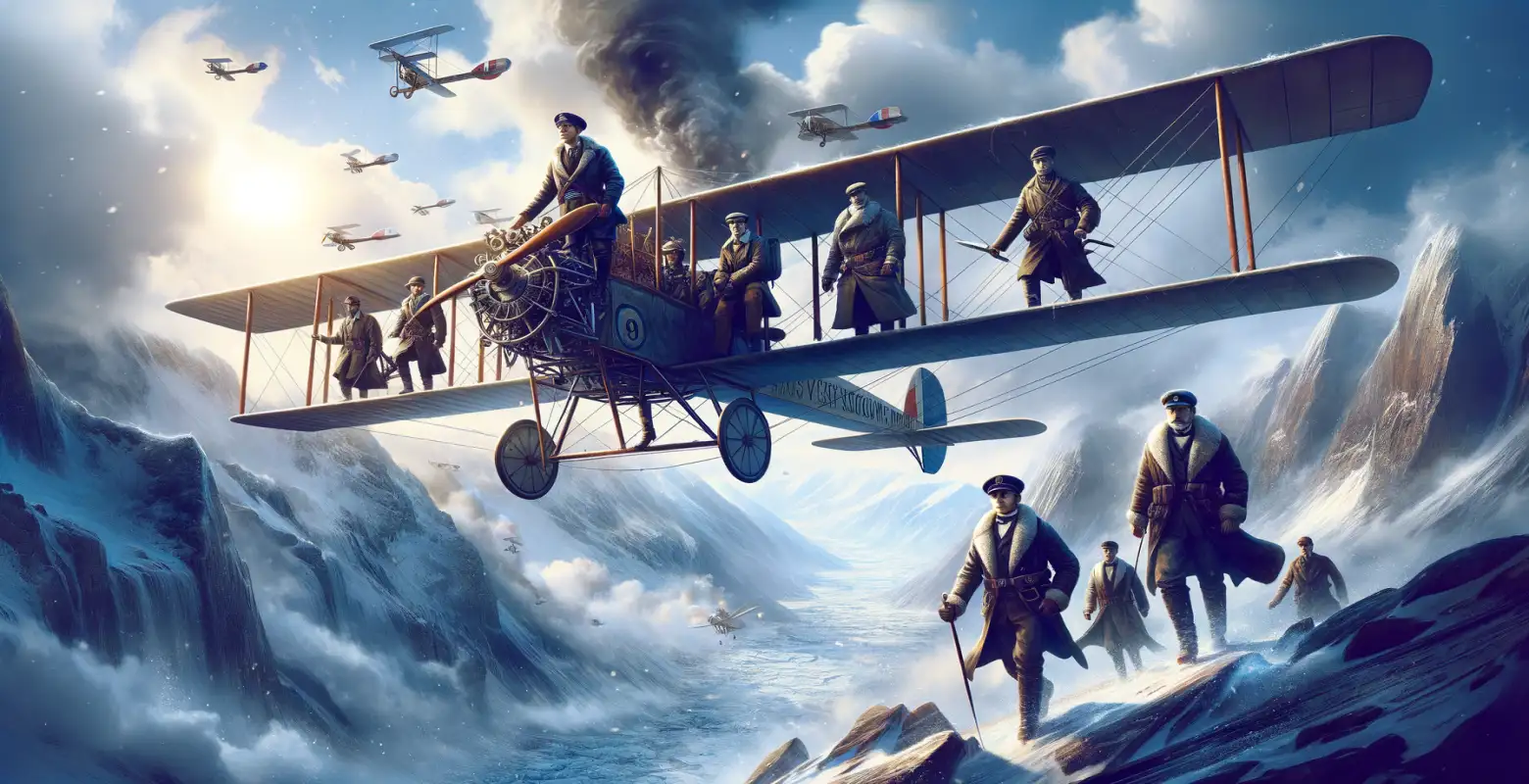
The most extraordinary flights in history - bold pioneers
Introduction
Aviation has always fascinated people with its ability to cross boundaries and achieve what seems impossible. The history of aviation is full of brave pioneers who risked their lives to push the limits of what is possible in the air. Their achievements not only revolutionized air travel, but also contributed to technological and scientific progress. In this article, we will take a look at the most extraordinary flights in history that changed the world and inspired future generations to explore the unknown. Why are these flights still important? Above all, they show how determination and innovation can change the reality in which we live.
First Steps in the Skies: Wright Brothers
The Wright Brothers, Orville and Wilbur, are widely recognized as the creators of the first operational airplane. Their historic flight took place on December 17, 1903, in Kitty Hawk, North Carolina. This event was the culmination of years of research and experiments, including work on glider designs and control systems. Although their early flights lasted only a few seconds, they were proof that human flight in a heavier-than-air machine is possible.
The innovative approach of the Wright brothers involved creating a control system that allowed the pilot to control the flight in three dimensions. Their invention was groundbreaking and paved the way for further aviation development. The success of the Wright brothers was not only the result of their genius, but also of their perseverance in the face of many failures and technical imperfections.
Lindbergh's Flight Across the Atlantic
Charles Lindbergh became an aviation icon thanks to his solo flight across the Atlantic in 1927. His plane, Spirit of St. Louis, took off from New York and landed in Paris after 33.5 hours. It was the first solo, nonstop flight across the Atlantic, demonstrating that such journeys are possible and practical.
Lindbergh's flight was significant not only for the development of commercial aviation, but also for increasing the interest of investors and the public in new possibilities of air travel. His courage and determination became an inspiration for subsequent generations of aviators and engineers.
First Space Flights: Yuri Gagarin
Yuri Gagarin is a name forever inscribed in history as the first human to journey into space. On April 12, 1961, Gagarin launched aboard Vostok 1 and orbited the Earth in 108 minutes. This was a groundbreaking moment in the space race between the Soviet Union and the United States, initiating a new era of exploration beyond our planet.
Gagarin's flight not only proved that humans can survive in space, but also accelerated the development of space technologies with far-reaching implications for science and technology. His mission inspired future generations to explore space and raised questions about the future of humanity in the context of exploring new worlds.
First Moon Landing: Apollo 11
The landing on the Moon by the crew of Apollo 11 in 1969 was one of the most remarkable achievements in the history of aviation and space exploration. Neil Armstrong and Buzz Aldrin became the first humans to set foot on the lunar surface, and Armstrong's words "That's one small step for man, one giant leap for mankind" became a symbol of human aspiration to push boundaries.
The Apollo 11 mission was the result of intense development of rocket and space technologies, requiring the collaboration of thousands of scientists, engineers, and technicians. It was a monumental step forward not only for the American space program, but also for all of humanity, demonstrating that dreams of interplanetary travel can become reality.
Longest Balloon Flight: Breitling Orbiter 3
Breitling Orbiter 3 was the first balloon to circumnavigate the Earth without landing. This flight took place in 1999, with a crew consisting of Bertrand Piccard and Brian Jones. Their journey lasted 19 days, 21 hours, and 47 minutes, covering over 46,000 kilometers. It was an extraordinary feat that proved that circumnavigation is possible not only for airplanes and spacecraft, but also for balloons.
The success of Breitling Orbiter 3 was the result of advanced balloon technology that allowed the crew to control the altitude of the flight and utilize appropriate air currents. It was an achievement that inspired future generations to explore the Earth's atmosphere and beyond.
Space Race: SpaceShipOne
SpaceShipOne was the first privately built spacecraft to cross the boundary of space, winning the Ansari X Prize in 2004. This historic flight was a milestone for commercial space travel and inspired the development of the space industry, now including companies such as SpaceX, Blue Origin, and Virgin Galactic.
SpaceShipOne proved that private enterprises can play a key role in space exploration, opening new opportunities for space tourism and commercial missions beyond Earth. The success of this project initiated a new era of private space travel, which is becoming increasingly accessible.
Conclusion
The history of aviation and space exploration is full of extraordinary flights that have forever changed our perception of the possibilities of air and space travel. From the Wright Brothers' first flight, through Lindbergh's solo flight across the Atlantic, to the Moon landing and private space missions – these achievements show how far we can go to realize our dreams of flying and exploration.
Each of these flights was not only a technical success, but also proof that human determination and innovation can transform our dreams into reality. As technology advances, we can expect more groundbreaking flights that will shape the future of travel and space exploration. For readers interested in this fascinating topic, it is worth following the development of new aviation and space technologies that promise even more remarkable achievements in the years to come.



Number of comments: 0