

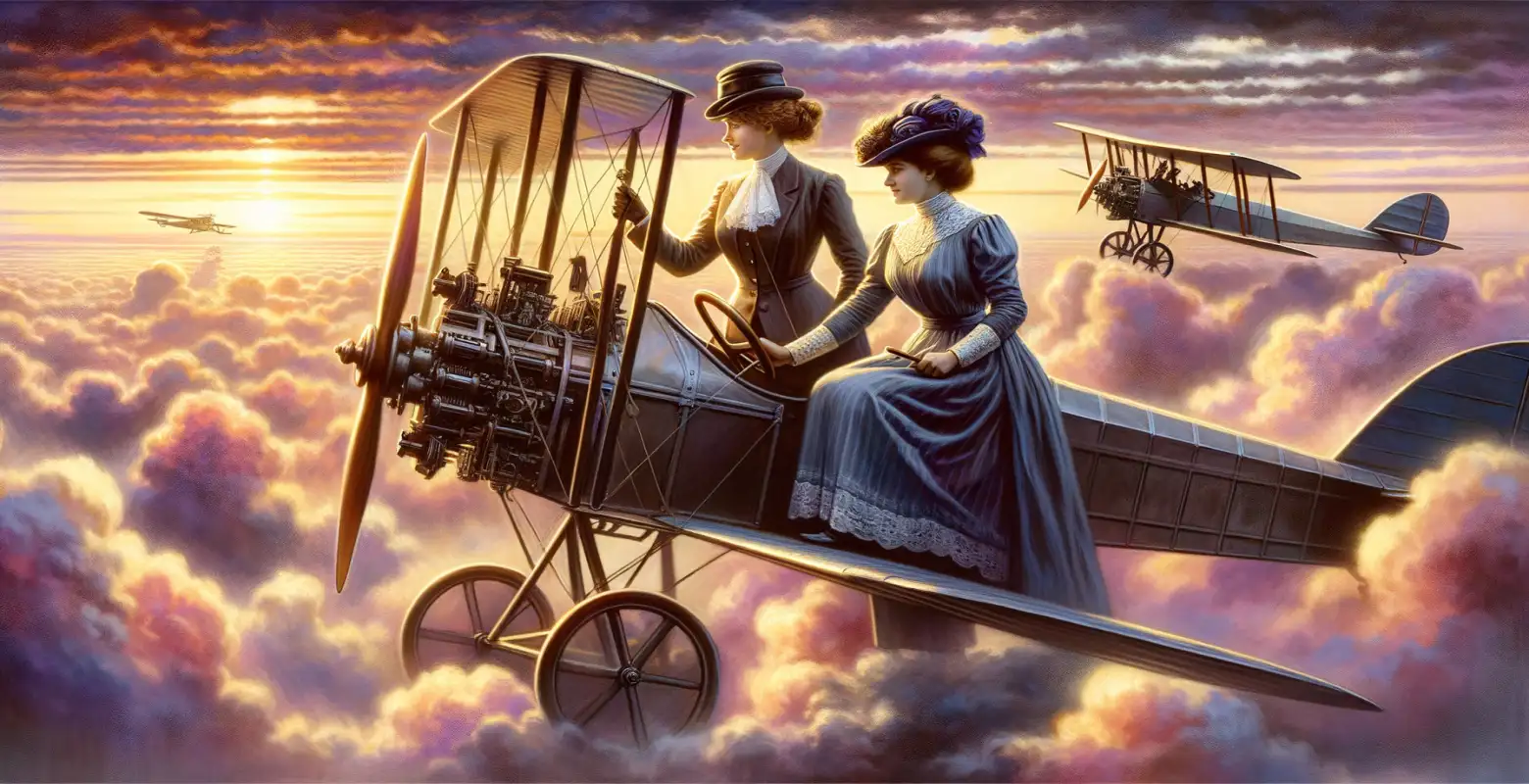
Aviation pioneers - the first women at the controls of airplanes
Introduction
Aviation, since its inception, has been one of the most fascinating and revolutionary technological achievements of humanity. Although the beginnings of this industry were dominated by men, brave women quickly began to conquer the airspace, both as pilots and engineers. Their determination and passion contributed to changing the perception of gender roles in this male-dominated environment. In this article, we will look at the female aviation pioneers who broke barriers and paved the way for future generations of women in this field. We will tell about their accomplishments, the challenges they faced, and the influence they had on contemporary aviation.
Beginnings: Women in Aviation at the Turn of the 19th and 20th Centuries
At the end of the 19th century, aviation was just beginning to develop. As aviation technology began to take shape, women who desired to soar into the skies emerged. One of the first was Blanche Stuart Scott, who in 1910 became the first woman in the United States to pilot an airplane. Although her flight was short and unofficial, it paved the way for many other women.
In Europe, courageous women also started entering the world of aviation. Raymonde de Laroche was the first woman in the world to obtain a pilot's license, which occurred in France in 1910. Her achievement was a milestone that showed women could be just as competent as men in the art of piloting.
Challenges and Breaking Barriers
Aviation pioneers faced numerous challenges, both technical and social. Early airplanes were dangerous and difficult to pilot, requiring not only courage but also great skills. Women also had to fight against prejudices and stereotypes suggesting they were not capable of piloting airplanes. However, the determination of these women was unwavering.
Bessie Coleman, the first African American and the first Native American woman to obtain a pilot's license, had to travel to France to fulfill her dream. In the United States, there were no aviation schools that accepted women or African Americans. Her story is an example of courage and determination in pursuing a goal despite all odds.
Women in Aviation During World War I and II
Both World Wars were pivotal moments for women in aviation. During World War I, women began working as mechanics and engineers, replacing men who went to the front lines. In World War II, their role expanded even further. In the United States, the Women Airforce Service Pilots (WASP) were crucial to wartime efforts, flying transport planes and conducting other non-combat operations.
Lidia Litwiak, known as the "White Rose of Stalingrad," was one of the most famous female fighter pilots in history, fighting on the Eastern Front as part of the Soviet Air Force. Her courage and skills were a testament to how far women had come in military aviation.
Post-War Era of Opportunities and Contemporary Achievements
After the end of World War II, women began playing an increasingly significant role in civil aviation. In 1964, Jerrie Mock became the first woman to complete a solo flight around the world, demonstrating that there are no limits to the determination and skills of female pilots.
Modern aviation continues to benefit from the contributions of many remarkable women. Eileen Collins was the first female space shuttle commander, and her examples inspire subsequent generations of women to engage in technical and scientific professions. In 2020, Zara Rutherford became the youngest woman to circumnavigate the globe in an ultralight aircraft, showing that women continue to push the boundaries of possibilities in aviation.
The Future of Women in Aviation
The future of women in aviation looks promising. More and more women are entering aviation-related professions, both as pilots and engineers, air traffic controllers, and managers. Organizations such as Women in Aviation International promote women's participation in aviation and aerospace, offering support and scholarships.
Technologies such as autonomous aviation systems and the development of space flights create new opportunities for women in this industry. With a growing awareness of the importance of diversity in the workplace, women have greater chances to play key roles in shaping the future of aviation.
Conclusions
Aviation pioneers were not only the first women at the controls of airplanes but also icons of social and technological change. Their determination and achievements paved the way for future generations, showing that passion and skills have no gender. Today's women in aviation continue this tradition, pushing the boundaries of possibilities and introducing innovations in this dynamic field. We encourage readers to further explore the history of women in aviation and support their participation in this fascinating industry.


Number of comments: 0