

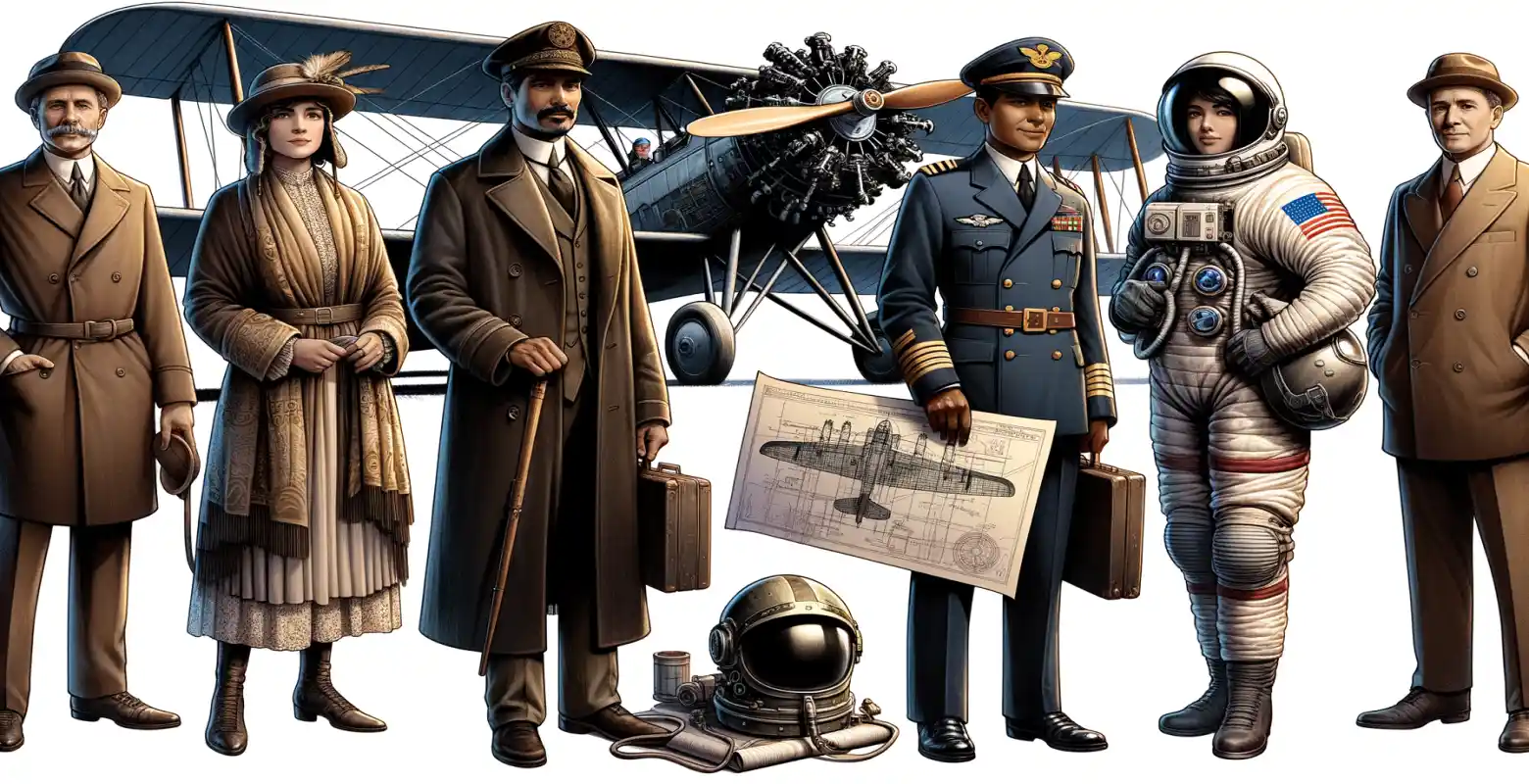
The most important figures in the history of aviation
Introduction
Aviation is one of the most important fields of modern technology, which has revolutionized travel, transport, and the military in less than a century. From the early attempts to take flight to modern commercial and military flights, certain figures have had a huge impact on the development of this industry. Understanding the history of aviation allows us to see how much has changed over the decades and how much we owe to pioneers who overcame technical, physical, and psychological barriers to lift man into the skies. In this article, we will introduce the key figures who played a crucial role in the development of aviation – from inventors, through engineers, to pilots.
The Wright Brothers: The Beginnings of Aviation
Wilbur and Orville Wright are names known to anyone interested in the history of aviation. The Wright Brothers are considered the creators of the first controlled, heavier-than-air aircraft that could sustain flight. Their groundbreaking flight took place on December 17, 1903, in Kitty Hawk, North Carolina. Although their first flight lasted only 12 seconds and covered a distance of 36.5 meters, it was a milestone in the history of aviation.
The success of the Wright Brothers was the result of years of research, trials, and errors. They introduced many innovative technical solutions, such as the system of control by warping the wings, which remains the foundation of aircraft control to this day. Future aeronautical engineers and pilots drew inspiration from their work, and their machine – the Flyer I – revolutionized the way people thought about flying.
Amelia Earhart: Symbol of Breaking Barriers
Amelia Earhart was the first woman to fly solo across the Atlantic. Her feat in 1932 not only made history but also became an inspiration for millions of women around the world. Earhart, known for her determination, courage, and extraordinary piloting skills, became a symbol of the struggle for gender equality in aviation.
Earhart not only broke gender barriers but also proved that women can succeed in a field dominated by men. Her disappearance during an attempt to circumnavigate the globe in 1937 remains one of the greatest mysteries in the history of aviation, and her legend lives on to this day.
Charles Lindbergh: The First Transatlantic Flight
Charles Lindbergh gained worldwide fame in 1927 when he became the first person to make a solo, nonstop flight across the Atlantic. His aircraft, the Spirit of St. Louis, completed the journey from New York to Paris in 33 hours and 30 minutes. Lindbergh was not only an excellent pilot but also a technician who contributed to the development of long-range aircraft design.
Lindbergh's flight was a huge step forward for commercial aviation, as it demonstrated that long-distance intercontinental flights were possible. His success inspired the development of airlines and solidified the position of aviation as a means of international transportation.
Igor Sikorsky: Inventor of the Helicopter
While many people associate aviation mainly with airplanes, one cannot forget about another key invention – the helicopter. Igor Sikorsky, a Russian engineer and inventor, is considered the father of modern helicopters. His first successful helicopter flight took place in 1939, and the models of helicopters he developed laid the foundation for contemporary vertical take-off machines.
Sikorsky believed that helicopters had enormous potential in rescue operations, transportation, and the military, which was proven in later years. His invention revolutionized the aviation industry, and helicopters became an indispensable element of modern logistics, medicine, and defense.
Neil Armstrong: Aviation in Space
Although best known as the first man to set foot on the Moon, Neil Armstrong also had a rich career in aviation. Before becoming an icon of space exploration in 1969, Armstrong was a test pilot and participated in research programs on supersonic aircraft.
Armstrong represents another stage in the development of aviation – the transition from Earth's atmosphere to space. His Apollo 11 mission was not only a technological triumph but also a testament to human ambition to surpass the boundaries of the impossible. As a pilot, engineer, and astronaut, Armstrong played a key role in the history of aviation and space exploration.
Hans von Ohain and Frank Whittle: Pioneers of Jet Engines
During World War II, the development of aviation accelerated like never before. Key roles in this were played by the pioneers of jet engines – Hans von Ohain from Germany and Frank Whittle from the United Kingdom. Independently, they worked on the concept of the jet engine, which revolutionized military and commercial aviation.
Jet engines enabled the construction of faster and more efficient aircraft, which not only determined the outcome of the war but also ushered in a new era in passenger aviation. Thanks to their inventions, it became possible to introduce commercial aircraft to the market, such as the Boeing 707, which dominated civil aviation in the second half of the 20th century.
Contribution of Engineers and Designers
In addition to pilots and inventors, it is worth mentioning the engineers who played a crucial role in the development of aircraft design and aviation technology. One of the most important figures is Kelly Johnson, an American aeronautical engineer who designed some of the most advanced military aircraft, including the legendary Lockheed SR-71 Blackbird. His innovative approach to designing long-range and high-altitude aircraft had a huge impact on aviation technology.
Summary
Aviation is one of the most dynamically developing technological sectors. From the pioneering flights of the Wright Brothers, through the historic achievements of Amelia Earhart and Charles Lindbergh, to modern jet technologies and Igor Sikorsky's helicopters, the history of aviation is a tale of courage, innovation, and the pursuit of pushing boundaries. Contemporary challenges, such as ecology and the development of unmanned aviation, indicate that the future of aviation will be as exciting as its past.



Number of comments: 0