

The role of black boxes in the investigation of air disasters
Introduction
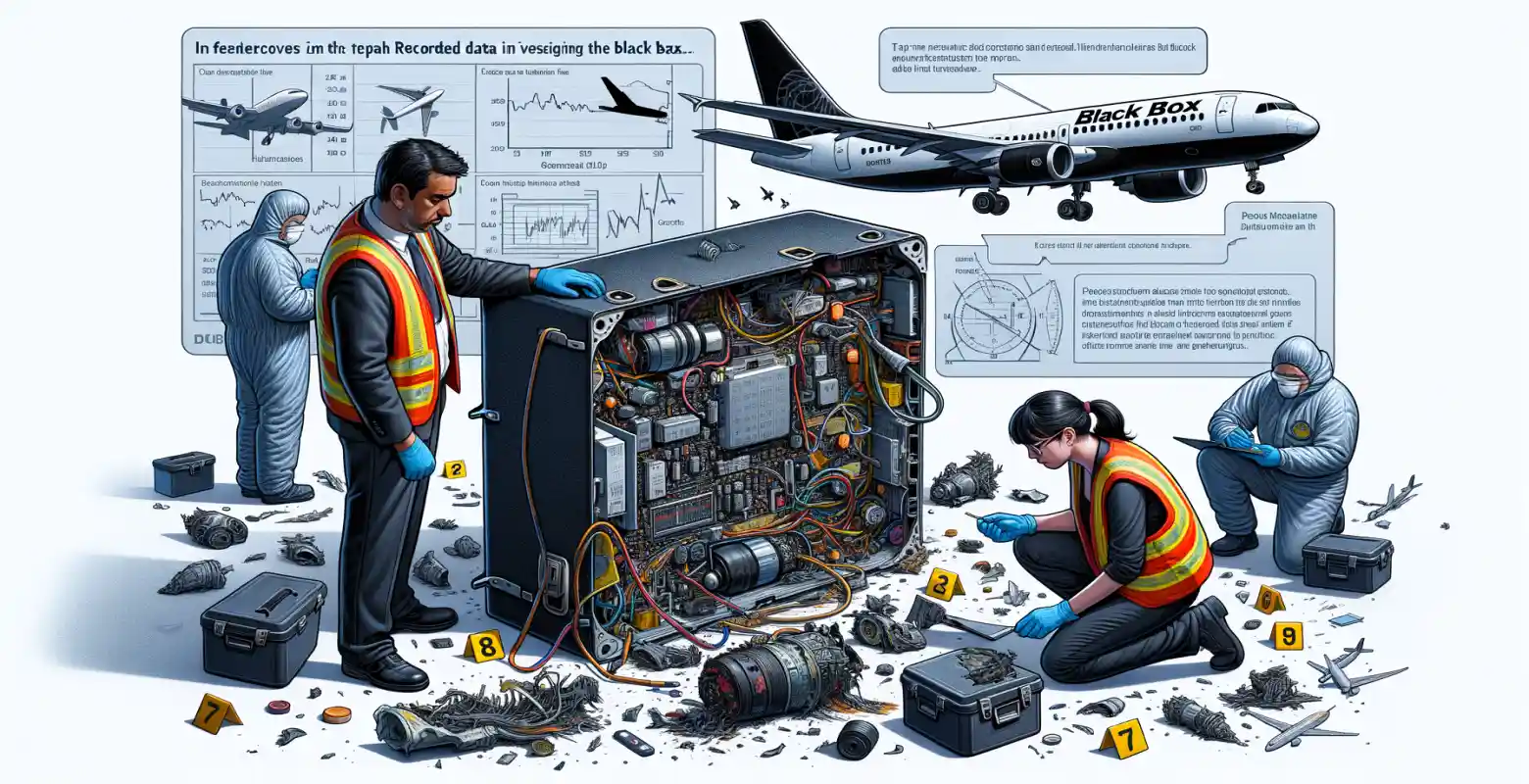
Air disasters, although relatively rare, often carry tragic consequences and arouse great interest among the public. Analyzing such events is crucial for understanding their causes and for preventing similar accidents in the future. In this context, the invaluable role of the so-called black boxes, or flight data recorders, comes into play. Despite their name, these devices are usually not black but orange, which facilitates their retrieval. In this article, we will examine how black boxes contribute to the investigation of air disasters, what their main functions are, and what challenges and opportunities are associated with their use.
What are black boxes?
Black boxes, officially known as cockpit voice recorders, are devices installed on aircraft to record operational data and cockpit sounds. There are two main types of recorders: flight data recorders (FDR) and cockpit voice recorders (CVR). FDR collects data on parameters such as speed, altitude, acceleration, and aircraft position, while CVR records cockpit sounds, including pilot conversations and acoustic signals.
History and development of black box technology
The first attempts to create flight recording devices date back to the 1930s. However, it was not until the 1950s that the production of black boxes on a large scale began, in response to the increasing number of air disasters. The introduction of these devices was a breakthrough in aviation safety research. Over the years, this technology has evolved, increasing its accuracy, capacity, and resistance to damage. Modern black boxes are equipped with advanced security systems that protect data even in extreme conditions.
The role of black boxes in investigating air disasters
Black boxes play a crucial role in the process of investigating air disasters. They provide investigators with essential information that allows them to reconstruct the events leading up to the disaster. Analyzing data from FDR and CVR enables the identification of technical, procedural, or human factors that may have contributed to the accident. Without these devices, investigations would be much more challenging and less precise.
Unique challenges related to black boxes
Search and recovery of black boxes after a disaster is often a significant challenge, especially if the accident occurred at sea or in remote areas. Black boxes are equipped with acoustic locators that emit signals to facilitate their location, but searches can last for weeks or even months.
Data protection is another crucial aspect. Recorders must withstand extreme conditions such as high temperatures, pressure, and impacts. Modern black boxes can survive fires and immersion in water at depths of several thousand meters.
Benefits of using black boxes
Black boxes significantly contribute to improving aviation safety. By analyzing data from recorders, it is possible to detect design flaws, procedural errors, or crew training issues. Conclusions from such analyses are used to update safety regulations and train aviation personnel. Furthermore, this data can serve as evidence in legal proceedings regarding responsibility for the accident.
The future of flight recorder technology
As aviation technology advances, so do black boxes themselves. The future may bring new solutions, such as streaming data live to ground databases, which could facilitate analysis and shorten the time needed to find the causes of a disaster. Additionally, technologies allowing for automatic analysis of recorder data are being developed, which could increase the efficiency of investigations.
Summary
Black boxes play an irreplaceable role in investigating air disasters. Thanks to them, it is possible to accurately reconstruct the events leading up to an accident, which is crucial for improving aviation safety. Despite the challenges related to their location and data protection, their contribution to the development of aviation technology and procedures is invaluable. In the future, we can expect further development of this technology, leading to even greater safety in air travel.

Number of comments: 0