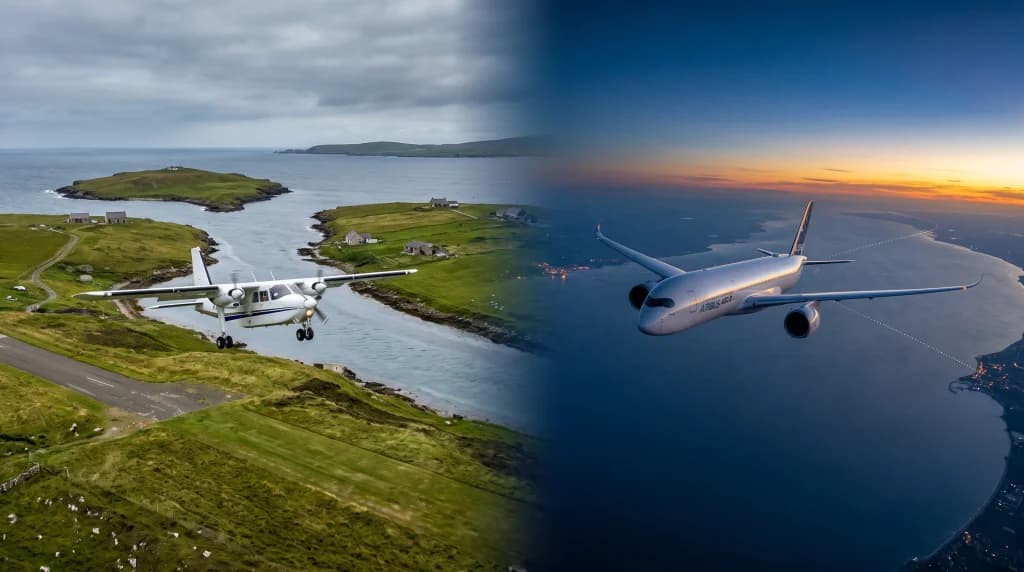
The World's Longest and Shortest Commercial Flights: From 90 Seconds in Scotland to 19 Hours to New York
Introduction: Two Extremes of Modern Commercial Aviation
Commercial aviation thrives on extremes. On one end of the spectrum, modern aerospace engineering lets a passenger enjoy dinner in Southeast Asia, sleep through two full nights inside the cabin of a widebody airliner, and step off on the East Coast of the United States without a single stop along the way. On the other end, within that exact same airline reservation system—complete with an official airline code and a standard boarding pass—you can buy a ticket for a scheduled flight shorter than a flight attendant's safety briefing, during which the aircraft never even retracts its landing gear.
Both poles—Ultra Long Haul (ULH) marathons and the world's shortest scheduled commercial flights—offer a fascinating case study in geography, aerodynamics, airline economics, and human endurance. Let's take a closer look at the record-holders in both categories: from Scotland's Orkney archipelago, where flying feels more like hopping a local bus than boarding a plane, to nearly 19-hour polar and transpacific crossings where every ton of fuel and every single passenger seat are calculated with surgical precision.
90 Seconds Airborne: The World's Shortest Scheduled Passenger Flight
The undisputed world record for the shortest scheduled commercial flight has belonged continuously since 1967 to Scottish regional carrier Loganair, operating between two tiny islands in the Orkney archipelago off the northern coast of Scotland: Westray (WRY) and Papa Westray (PPW).
The numbers behind this route read almost like a timetable typo:
- Runway-to-Runway Distance: Just 1.7 miles (2.7 kilometers)—shorter than the length of a single main runway at Warsaw Chopin Airport. On a clear day, a pilot lined up on the runway threshold in Westray can easily see the landing strip on neighboring Papa Westray just across the narrow sea strait.
- Scheduled vs. Record Flight Time: In airline booking systems, the scheduled block time (from engine start to shutdown) is listed as two minutes, yet actual airborne time from liftoff ($V_{\text{LOF}}$) to touchdown typically lasts just 60 to 90 seconds. The all-time route record, set with a brisk tailwind by veteran pilot Stuart Linklater, stands at an astonishing 53 seconds.
- Aircraft and Onboard Service: The route is flown by a twin-engine, high-wing Britten-Norman BN-2 Islander turboprop carrying up to eight passengers and a single pilot—there is no flight attendant and no beverage trolley, so the captain delivers the safety briefing before taking the controls.
Why maintain such a brief air link at all? The strait separating the two islands is notoriously choppy, and the ferry crossing takes around 25 minutes—and is frequently canceled during North Sea gales. For the few dozen permanent residents of Papa Westray—alongside doctors, teachers, schoolchildren, and archaeologists excavating the Neolithic site of Knap of Howar—the eight-seat Islander serves simultaneously as a daily school bus and an air ambulance.
Other Remarkably Short Scheduled Flights Around the World
While Westray to Papa Westray stands in a league of its own, several other extraordinary multi-minute scheduled routes operate around the globe:
- Karpathos (AOK) to Kasos (KSJ), Greece: Operated by Olympic Air or Sky Express between two islands in the Dodecanese archipelago, this hop covers roughly 12 miles (19 kilometers) and lasts just 5 minutes in the air.
- Connemara (NNR) to Inishmaan (IIA), Ireland: A five-minute dash across Galway Bay to the Aran Islands (roughly 10 miles / 16 kilometers), also flown with Britten-Norman Islanders by Aer Arann Islands.
- St. Gallen-Altenrhein (ACH) to Friedrichshafen (FDH) across Lake Constance: In 2016, Austrian carrier People's Viennaline launched history's shortest scheduled international flight across Lake Constance (12.5 miles / 20 km, 8 minutes airborne), though low passenger demand led to its cancellation after a few months.
19 Hours Above the Clouds: The World's Longest Nonstop Flights (Ultra Long Haul)
At the opposite end of aviation's spectrum sit Ultra Long Haul (ULH) routes—nonstop flights lasting upward of 16 to 18 hours. The undisputed champion in this category remains Singapore Airlines, operating nonstop services from Singapore (SIN) to New York (JFK) as well as nearby Newark (EWR).
The operational scale of this route is staggering:
- Great-Circle Distance: The Singapore–New York JFK route spans 9,537 miles (15,349 kilometers). Depending on prevailing jet streams, the aircraft tracks either eastward across the Pacific Ocean and North America or northward over the Arctic near the North Pole.
- Flight Duration: Scheduled flight time ranges between 18 hours 40 minutes and 18 hours 50 minutes—and regularly exceeds 19 hours against strong headwinds. Passengers experience two sunrises or two sunsets during a single flight.
- A Purpose-Built Aircraft—The Airbus A350-900ULR (Ultra Long Range): To operate this route, Singapore Airlines ordered a specially modified variant of the Airbus A350-900. Engineers in Toulouse redesigned the fuel system to utilize existing space inside the center wing box without sacrificing cargo hold volume, expanding fuel capacity from 141,000 to an immense 165,000 liters (43,590 U.S. gallons) and raising Maximum Takeoff Weight (MTOW) to 280 metric tons.
- Zero Economy Class Seats on Board: There is not a single standard economy seat anywhere on Singapore Airlines' A350-900ULR. The cabin accommodates just 161 passengers (67 lie-flat Business Class suites and 94 Premium Economy seats). Capping passenger count was essential to trim payload weight and make room for more than 130 metric tons of jet fuel required to fly over 9,500 miles with full regulatory reserves.
The Elite Club of the World's Longest Nonstop Routes
Alongside Singapore Airlines' flagship New York services, the elite roster of the world's longest commercial flights includes:
- Auckland (AKL) to Doha (DOH) – Qatar Airways: Covering 9,032 miles (14,535 km) in roughly 17 hours and 30 minutes aboard an Airbus A350-1000 or Boeing 777-200LR.
- Perth (PER) to London Heathrow (LHR) – Qantas: Spanning 9,009 miles (14,499 km), history's first direct nonstop air link connecting Australia and Europe (roughly 17 hours and 20 minutes on a Boeing 787-9 Dreamliner).
- Auckland (AKL) to New York (JFK) – Air New Zealand and Qantas: Covering 8,828 miles (14,207 km) in approximately 17 hours and 35 minutes across the Pacific.
- Project Sunrise – Sydney (SYD) to London (LHR) and New York (JFK): Australian carrier Qantas is preparing to launch nonstop flights using specially modified Airbus A350-1000ULR jets fitted with an additional 20,000-liter Rear Center Tank (RCT). These flights will shatter the 10,500-mile (17,000 km) barrier and remain airborne for up to 19 to 20 hours.
The Physics and Logistics of a Marathon: Managing Crew, Fuel, and the Human Body
Keeping a commercial airliner aloft for nearly 19 hours creates operational challenges passengers rarely consider when booking a ticket:
- The Fuel Burn Penalty: To carry one extra metric ton of fuel for the final hour of a 19-hour journey, an aircraft must burn several hundred kilograms of fuel during the early hours of the flight simply to haul that extra weight through the sky. Consequently, ULH flight dispatchers plan routes with pinpoint precision, riding favorable jet streams and tightly restricting belly cargo.
- Double Flight Deck Crews and Hidden Crew Rest Compartments: No pilot can remain at the controls for 19 straight hours. Ultra Long Haul flights carry a four-pilot crew (two captains and two first officers split into two full shifts). Hidden above the passenger cabin ceiling behind discreet keypad-locked doors sit sound-insulated crew rest compartments equipped with full-length bunk beds and seatbelts, where pilots and cabin crew sleep in strictly scheduled rotations.
- Combating Dehydration and Deep Vein Thrombosis (DVT): Inside composite-fuselage airliners like the A350 and Boeing 787, cabin pressurization can be maintained at an altitude equivalent of roughly 6,000 feet (1,800 meters)—compared to 8,000 feet (2,400 meters) in older aluminum jets—alongside higher cabin humidity, dramatically reducing fatigue, headaches, and jet lag upon arrival.
Conclusion: From a Single Breath to Nearly a Full Day in the Sky
Comparing a 90-second hop in an eight-seat Islander across a Scottish strait with a nearly 19-hour journey aboard a luxury Airbus A350-900ULR from Singapore to New York captures the extraordinary versatility of modern air transport. Though separated by a vast gulf in technology, distance, and ticket price, both routes serve the exact same purpose: overcoming geographic barriers wherever no other mode of transport can match the speed and reliability of wings.