Life Out of a Suitcase: The Realities of Long-Haul Cabin Crew
Introduction: The Myth of Perpetual Vacation at Cruising Altitude
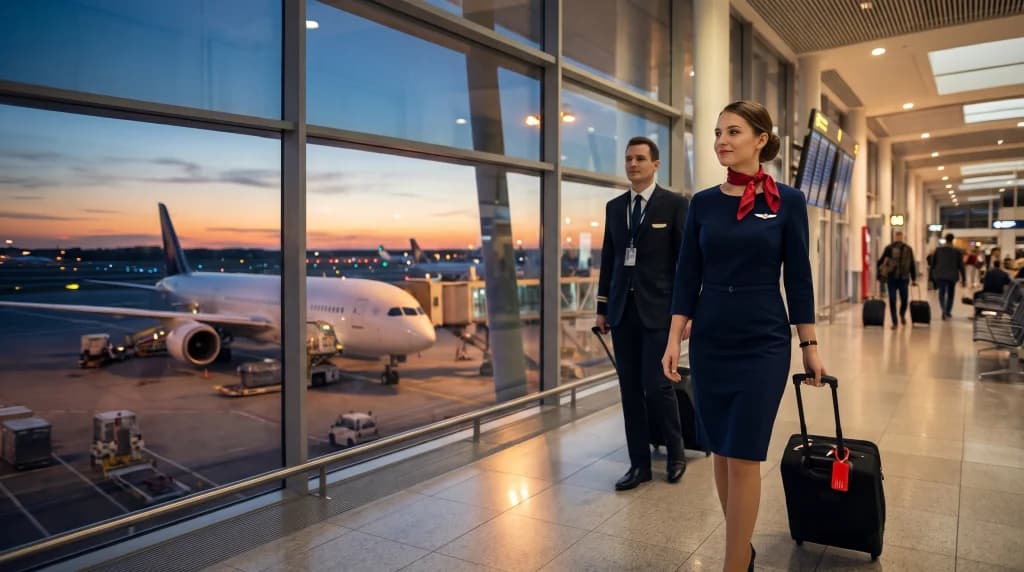
In the public imagination, working long-haul cabin crew is widely seen as the pinnacle of modern travel glamour: razor-sharp uniforms, silk scarves, a poised greeting at the boarding door of a twin-aisle widebody, followed by dinner overlooking Tokyo Bay, a morning jog along Miami Beach, or a sun-drenched afternoon by a five-star hotel pool in Dubai. Social media feeds brim with hundreds of thousands of curated moments filed under #crewlife, reinforcing the perception that flight attendants spend their careers on an endless, airline-funded holiday.
The ground truth of long-haul cabin operations begins where the lenses turn off. Behind the veneer of seamless service lies one of the most physically demanding and mentally draining occupations in civil aviation. It is a profession where luxury alternates with chronic sleep fragmentation, and where crossing the globe comes at the cost of laboring within an environment fundamentally hostile to human physiology. To understand long-haul flying as a crew member, one must look past business-class champagne and confront the relentless realities of human endurance, regulatory emergency procedures, and isolation across three different continents within a single week.
Physiology at 36,000 Feet: The Harsh Environment of a Sealed Tube
For a passenger, a fourteen-hour sector from Warsaw to Tokyo or Frankfurt to Singapore is an endurance test largely slept through while watching inflight entertainment (IFE). For cabin crew, it is a demanding physical shift performed within an environment recognized by aerospace medicine as a persistent physiological stressor.
Hypoxia, Aridity, and Cabin Altitude
Conventional widebody jets like the Boeing 777 and Airbus A330 are pressurized to maintain an equivalent cabin altitude between 6,000 and 8,000 feet (1,800 to 2,400 meters) above sea level. Consequently, the crew performs strenuous physical tasks under a reduced partial pressure of oxygen. Pushing a fully laden meal trolley weighing up to 100 kilograms demands substantially more cardiovascular effort than it would on the ground. While composite airframes such as the Boeing 787 Dreamliner and Airbus A350 lower this cabin altitude to roughly 6,000 feet while maintaining higher humidity levels, the working atmosphere remains far from optimal.
At a cruising altitude of 38,000 feet, ambient relative humidity inside the cabin plunges below 10% to 12%—drier than the Sahara Desert. In conditions this arid, the human body sheds roughly 200 milliliters of moisture per hour through respiration and transdermal evaporation alone. Flight attendants battle chronically dry mucous membranes, ruptured ocular capillaries, persistent dermatological flare-ups, and insidious dehydration that compounds muscular fatigue.
Cosmic Radiation and Circulatory Strain
Passengers rarely consider that airline flight crews rank among the most occupationally exposed groups to ionizing radiation on Earth. At high flight levels, Earth's magnetosphere provides diminished shielding against galactic cosmic rays, a vulnerability magnified across high-latitude polar routes. Each intercontinental rotation delivers an occupational radiation dose equivalent to multiple chest X-rays, requiring airline operators to maintain strictly audited individual dosimetric logs.
Compounding this is raw biomechanics: walking miles on hard floors in uniform shoes while subjected to low-frequency fuselage vibrations and clear-air turbulence. Common occupational outcomes include lower-extremity varicose veins, lumbar and cervical spine deterioration from lifting heavy Atlas catering units into overhead latches, and repetitive-stress microtrauma across weight-bearing joints.
The Broken Circadian Clock: The Toll of Jet Lag and Sleep Debt
The most unrelenting adversary facing long-haul crew is circadian dysrhythmia—commonly known as jet lag. Human biology evolved over millennia around an unyielding diurnal cycle governed by melatonin and cortisol secretion tied to the solar day. A high-subsonic commercial jet dismantles that biological clock in hours.
A typical long-haul crew roster illustrates the disruption: an early-morning westward departure from Europe to Los Angeles (a nine-hour time gain), a 48-hour local rest period, a red-eye return sector, two days of base rest, followed immediately by an eastward departure to Shanghai (a seven-hour time loss). The neuroendocrine system struggles to determine whether to digest, initiate sleep architecture, or release wakeful hormones.
The resulting condition is what occupational physicians classify as cumulative sleep debt. Crew members attempt to sleep in blackout-curtained hotel rooms under midday sun, relying on melatonin supplements, eye shades, and acoustic earplugs to secure four hours of fragmented rest before the next night departure. Chronic insomnia, cognitive fatigue, mood swings, and metabolic disturbances represent the physiological toll exacted by continuous meridian crossing.
Beneath and Above the Deck: The Crew Rest Compartment (CRC)
Passengers often wonder where their cabin crew disappears to during long oceanic sectors across the Pacific or North Atlantic. On ultra-long-haul sectors exceeding 10 to 12 hours, civil aviation regulators (such as EASA and the FAA) mandate dedicated horizontal rest in an approved Class 1 Rest Facility. To meet this legal requirement, aircraft manufacturers incorporate specialized zones hidden from public view: Crew Rest Compartments (CRCs).
Bunks in the Sky
Depending on airframe architecture, the crew rest area is situated in the overhead crown space (above the passenger stowage bins on the Boeing 777 and 787) or housed within a containerized module lowered into the forward cargo hold (on select Airbus A330/A340 configurations). Access to the CRC is discreetly concealed behind what appears to be a lavatory door or service cupboard, secured by access-code locks:
- Bunk Architecture: Inside lies a narrow aisle flanked by six to ten stacked sleeping bunks reminiscent of Japanese capsule hotels. Each berth features noise-dampening acoustic curtains, an independent restraint harness (which crew must keep fastened while sleeping in the event of severe clear-air turbulence), individual airflow louvers, an interphone station, and reading lights.
- Rest Discipline: Rest schedules are calculated to the minute. The cabin team splits into two shifts. While the active team manages inflight meal services and cabin surveillance, the off-duty team takes a mandatory three- to four-hour sleep block in silence. Inside the CRC, speaking aloud and unmuted media devices are strictly prohibited.
- The Dark Awakening: Waking up in a confined, windowless module at 37,000 feet, pulling on a tailored uniform, reapplying grooming essentials before a miniature mirror, and stepping back into a brightly lit cabin within minutes demands disciplined mental composure.
First Responders at Flight Level 390: Medics, Crisis Managers, and Firefighters
The most persistent and inaccurate stereotype is viewing cabin crew solely as hospitality staff. While passengers experience cabin staff delivering warm meals and hot beverages, every crew member undergoes rigorous, recurrent safety and emergency training designed to safeguard passenger life under extreme operating conditions. At cruise altitude over mid-ocean airspace, there are no emergency services to call. The flight attendants are the sole first responders on board.
Aviation First Aid in Restricted Spaces
Aboard a widebody carrying 300 to 450 passengers on a twelve-hour flight, in-flight medical events are a statistical certainty. Crew members undergo certification in advanced Cardiopulmonary Resuscitation (CPR), automated external defibrillator (AED) deployment, and administration of emergency pharmacology from the on-board Emergency Medical Kit (EMK). They are trained to manage everything from sudden in-flight deliveries to severe anaphylaxis and acute hemorrhages—all performed within the cramped confines of a galley or narrow aisle under the anxious gaze of fellow travelers.
Conflict De-escalation and Restraining Disruptive Passengers
The combination of cabin confinement, mild hypoxia, disrupted sleep cycles, alcohol consumption, and prescription sedatives can trigger aggressive behavioral episodes known as air rage. Crews are trained in verbal de-escalation, rapid behavioral profiling, and physical restraint protocols using certified flexi-cuffs and restraint straps. Deciding to physically restrain an unruly passenger is executed in coordination with the Captain (Pilot-in-Command) and remains one of the most stressful interventions in commercial operations.
In-Flight Fire: The Critical Threat
An uncontrolled in-flight fire remains one of the most hazardous emergencies on an aircraft. Annually, crew members undergo practical examinations inside smoke-filled cabin simulators. They drill the containment of thermal runaway in lithium-ion batteries—a growing concern from personal electronic devices—using specialized fire-containment bags, and practice locating hidden fires behind lavatory service panels wearing Protective Breathing Equipment (PBE) with self-contained chemical oxygen generators.
The Upside of Long-Haul Flying: Why Crew Stay in the Air
If long-haul flying were merely a catalog of physical wear and psychological stress, attrition would empty airline rosters within months. For hundreds of thousands of aviation professionals, however, this work is an enduring lifestyle. Long-haul rosters provide distinctive operational autonomy and opportunities found in few traditional corporate careers.
The Intercontinental Layover
Following a flight to Singapore, Buenos Aires, or Cape Town, crews receive an operational layover—a scheduled rest period typically spanning 24 to 72 hours, depending on rotation frequency. Supported by dedicated accommodation in central, full-service hotels and travel per diems, crew members have the freedom to experience international destinations. Teams often explore together, whether surfing in Australia, touring historic sites in Kyoto, or visiting local night markets in Bangkok.
Freedom from Routine and Complete Disconnection
For many, the most compelling aspect of long-haul operations is the total absence of desk-bound monotony. Crew complements change on almost every flight; automated scheduling systems introduce flight attendants to a wide range of colleagues each month. Crucially, professional responsibility ends the moment the aircraft engines spool down and the passenger doors open. There are no project spreadsheets to take home, no late-night email chains, and no ongoing administrative deadlines. Once clear of the airfield, off-duty time belongs entirely to the crew member.
Staff Travel Privileges (Standby Tickets)
A defining benefit of airline employment is access to standby leisure travel (ID90/ZED ticketing agreements). These allow employees and eligible family members to book confirmed or space-available flights across global alliance networks at a fraction of commercial fares, paying predominantly statutory taxes. Spontaneous international weekend trips remain a staple of long-term airline life.
Behind Hotel Walls: Isolation and Fragmented Relationships
The personal trade-offs of an international flight career often surface in personal relationships. Maintaining marriages, raising children, and sustaining traditional social networks require complex logistical coordination. Flight attendants frequently miss major personal milestones: school plays, anniversaries, and holidays such as Christmas and New Year's Eve, which are often spent crossing time zones or alone in overseas hotel rooms.
This dynamic gives rise to what aviation psychologists describe as layover isolation. Once the novelty of early career travel subsides, the similarity of modern chain hotels can feel repetitive. Surrounded by hundreds of passengers on duty and different colleagues on every rotation, long-haul crew members frequently report an underlying sense of personal isolation—a solitary reality behind the polished public face of the airline industry.
Conclusion: An Uncompromising Lifestyle Built on Dedication
Operating long-haul cabin services is far more than a conventional job; it is a demanding negotiation with time, physiology, and geography. It asks for physical endurance, personal flexibility, and irregular hours, and in return offers global perspective, complete off-duty freedom, and the view of a cloud-deck sunrise from 40,000 feet.
The next time a flight attendant offers a glass of water with a calm smile midway through a transoceanic night flight, consider the preparation behind that interaction. Beyond hospitality, they are highly trained safety professionals managing physiological fatigue and unfamiliar time zones, remaining vigilant over the safety of several hundred passengers resting quietly on their way across the world.