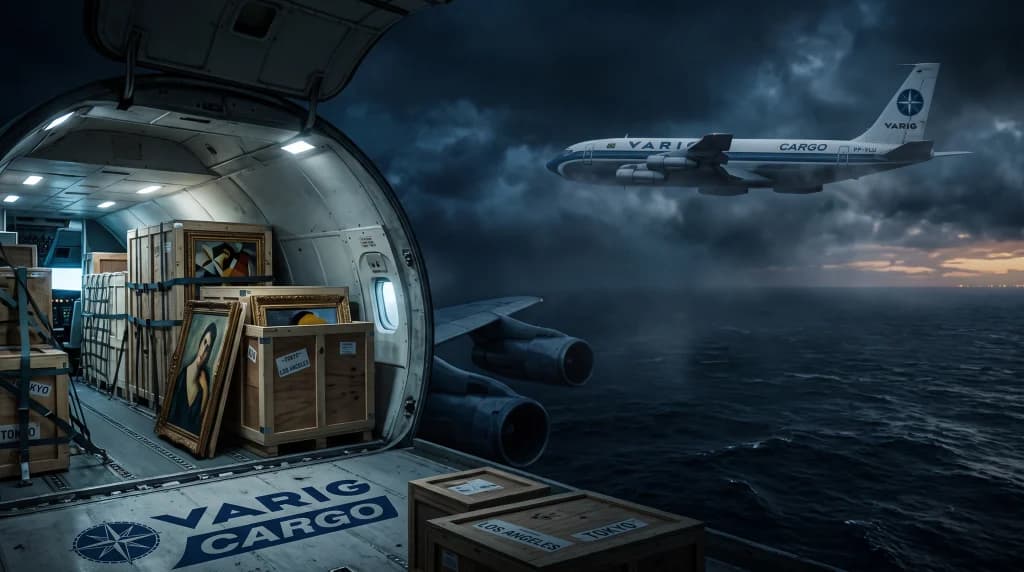
The Mystery of Varig Flight 967: The Boeing 707 Lost Over the Pacific
Introduction: The Most Enigmatic Flight in Cargo Aviation History
Within the annals of world civil aviation, some disasters redefined safety procedures, and tragedies whose root causes were uncovered only after monumental deep-sea search operations. Yet there exists a narrow, darker category of occurrences in which a massive aircraft simply vanishes into thin air, leaving behind neither an oil slick, nor a scorched life preserver, nor a single transmission from an Emergency Locator Transmitter (ELT). Long before the world held its collective breath in 2014 over the disappearance of Malaysia Airlines Flight 370 (MH370), aviation had already contended for decades with another profound, largely overlooked mystery of comparable scale.
On January 30, 1979, a heavy Boeing 707-323C freighter operated by Brazilian flag carrier Varig lifted off from Narita International Airport in Tokyo, operating scheduled flight RG967. The jet was tasked with crossing the Pacific Ocean, landing for a scheduled refueling stop in Los Angeles, and then proceeding onward to Rio de Janeiro. Aboard were six highly experienced crew members alongside a cargo manifest of extraordinary cultural and monetary value: 153 original paintings by one of Brazil's foremost modernist masters, Manabu Mabe, valued at the time at over $1.24 million (equivalent to tens of millions of dollars today).
Thirty minutes after departure, just a few hundred kilometers off the coast of Japan, the aircraft fell completely silent. No Mayday distress call was broadcast, no radar anomalies were logged by military tracking stations, and no 7700 emergency squawk was transmitted. A commercial transport jet with a maximum takeoff weight well over one hundred tons vanished above the North Pacific, becoming the only commercial jetliner in modern history to disappear without leaving a single verifiable trace. What transpired aboard Varig Flight 967?
Crew and Airframe: A Routine Flight Helmed by Veterans
The Boeing 707-323C bearing registration PP-VLU (serial number 19235) was a mature, thoroughly proven airframe. Manufactured in 1966 for American Airlines, it joined Varig Cargo's commercial fleet in 1974. Built as a factory-reinforced "Convertible" freighter variant, the airframe featured a heavy main-deck cargo door on the port side and was powered by four reliable Pratt & Whitney JT3D-3B turbofan engines. With slightly over 21,000 total airframe flight hours logged, it was in its operational prime—airworthy, fully certified, and routinely maintained.
The flight deck roster ruled out operational negligence or lack of expertise. Command of the flight rested with 55-year-old Gilberto Araújo da Silva, an aviation figure of near-mythic standing in Brazil and a celebrated national hero. Six years earlier, on July 11, 1973, Araújo da Silva had successfully performed a forced off-field landing with a fire-engulfed Boeing 707 (Varig Flight 820) in an onion field outside Paris after an uncontained lavatory fire filled the cabin with incapacitating toxic smoke and blinded the flight deck. Though 123 people perished in that disaster, his airmanship prevented the aircraft from slamming into Parisian suburbs, earning him prestigious aeronautical decorations in both France and Brazil.
Sitting in the right seat as first officer was 39-year-old Erni Peixoto Mylius, supported by flight navigators and flight engineers Antonio Brasileiro da Silva, Evan Braga Saunders, Nicola Exposito, and José Severino Gusmão de Araújo. Collectively, the six flight crew members possessed tens of thousands of logged flight hours. This was not a crew easily overwhelmed by routine clear-air turbulence or standard hydraulic malfunctions.
The Priceless Canvases of Manabu Mabe: Treasure on the Main Deck
The distinctive character of Varig Flight 967 lay within its cargo hold. Alongside spare aircraft components, industrial electronics, and textiles, the main deck cargo pallets carried reinforced crates securing 153 original paintings by Manabu Mabe. Mabe, a Japanese immigrant who had arrived in Brazil as a child to labor on rural coffee plantations, rose to become a globally celebrated pioneer of lyrical abstraction. Following major distinctions at the São Paulo and Paris Biennials, his canvases commanded high prices across auction houses in New York and Tokyo.
The retrospective in Tokyo had been a premier cultural showcase commemorating the 70th anniversary of Japanese immigration to Brazil. Once the exhibition concluded, the canvases were crated, insured for an unprecedented sum, and palletized inside the Varig freighter. Total commercial payload weighed approximately 20 tons—comfortably below the maximum structural payload limits of the 707-320C.
The Final 33 Minutes: Timeline of a Disappearance
The flight departed without incident on a cool Tuesday evening. Surface weather across the Tokyo area was moderately calm, though typical winter weather patterns were developing across the North Pacific, bringing low cloud cover and oceanic convective activity.
- 20:23 Local Time (JST): Boeing 707-323C registration PP-VLU takes off from Narita Airport. The jet climbs outbound on an easterly heading over the Pacific, establishing itself onto its transoceanic routing toward Los Angeles.
- 20:45 JST: The flight crew checks in on standard high-frequency radio with Tokyo Area Control Center (Tokyo ACC). Captain Araújo da Silva reports crossing their initial oceanic waypoint at assigned cruising altitude, confirming all systems normal. The aircraft is approximately 500 kilometers northeast of Tokyo.
- 20:45 JST: The air traffic controller acknowledges the report and instructs the crew to deliver their next compulsory position report at the subsequent oceanic reporting point, estimated for 21:23 JST.
- 21:23 JST: The frequency remains silent. Tokyo ACC attempts to raise Varig Flight 967 on primary routing frequencies, receiving no reply. Follow-up attempts across secondary channels and the international emergency frequency (121.5 MHz) yield no response. Adjacent commercial aircraft crossing the North Pacific are requested to relay communications, but no transmissions are detected.
Around this window, the Boeing 707 faded from long-range coastal radar coverage. Once the flight crossed its estimated fuel-exhaustion timeline hours later, international search and rescue authorities declared a formal emergency.
The Pacific Search Operation and an Empty Ocean
The Japan Maritime Self-Defense Force (JMSDF), the Japan Coast Guard, and United States Navy assets stationed across Japan launched a massive coordinated search-and-rescue mission. Over eight consecutive days, maritime patrol aircraft, including P-2J Neptunes and P-3 Orions, flew sweeping patterns across tens of thousands of square nautical miles alongside naval surface vessels.
When a heavy jet transport strikes the open sea at cruising velocities near 800 km/h, catastrophic structural disintegration typically occurs. Flotam inevitably surfaces: seat cushions, light interior linings, thin iridescent slicks of Jet A-1 fuel, wooden packing crate fragments, and synthetic insulation foam. In the case of Flight 967, investigators recovered absolutely nothing. Not a single fragment of aluminum skin, not a trace of fuel, and no human remains were found. The ocean surface was completely clear. On February 8, 1979, official maritime search operations were formally terminated.
Theories and Hypotheses: What Befell the Flight and Its Art?
The utter absence of physical wreckage fostered numerous working theories—ranging from sound aeronautical analyses to Cold War espionage scenarios. Investigators and safety analysts focused on four primary hypotheses.
1. Gradual Decompression and the Ghost Flight Scenario
This remains the most technically grounded and widely supported explanation among aviation safety specialists, even if unproven. Under this scenario, shortly after leveling off at cruising altitude (FL310 or FL330), the airframe suffered an insidious decompression or a sudden structural pressurization loss—potentially triggered by an aged cargo-door pressure seal failure.
Aboard a Boeing 707 at that altitude, the Time of Useful Consciousness (TUC) without supplemental oxygen is roughly 30 to 60 seconds. If the pilots did not don their quick-donning oxygen masks immediately, or if the oxygen distribution system malfunctioned, acute hypoxia would cause unconsciousness without the crew ever recognizing the mortal threat. Managed by its engaged autopilot, the aircraft would have continued on its programmed heading out over the empty Pacific for another six to eight hours until total fuel exhaustion. In that event, the final crash site would lie thousands of kilometers away—deep within the Mariana Trench or unmapped abyssal plains of the Central Pacific, well beyond the initial search zones.
2. The Heist Hypothesis: Aerial Piracy and the Black Art Market
The vast monetary value of Manabu Mabe's paintings gave rise to speculation regarding a planned aerial hijacking. Proponents hypothesized that the aircraft was intercepted (or the crew coerced) and flown to a clandestine airstrip on an isolated Pacific atoll or into Soviet territory, motivated by an illicit art syndicate commissioned by an underground collector.
Despite its cinematic appeal, the hypothesis fails under operational analysis:
- A fully laden Boeing 707-320C freighter requires a paved runway of at least 2,000 to 2,500 meters to land safely at near-maximum landing weights. No hidden airstrips matching those technical parameters existed in the Pacific that were not under constant surveillance by US or allied military forces.
- Cold War air-defense radar systems operated by NORAD, Japan, and the Soviet Union tracked regional airspace continuously. An uncoordinated penetration by a four-engine jet transport without an active flight plan would have prompted immediate fighter scrambles.
- Crucially, throughout nearly fifty years since the event, none of the 153 missing Manabu Mabe paintings has ever surfaced on the international black market, across private auctions, or through seized contraband operations anywhere in the world.
3. Soviet Interception: A Cold War Incursion
Another popular theory in South America posited that an inertial navigation failure led the aircraft off course to the northeast, penetrating Soviet airspace near the heavily militarized Kamchatka Peninsula or Kuril Islands—home to strategic submarine bases. Theorists drew parallels with Korean Air Lines Flight 902 in 1978 (intercepted and fired upon by Soviet fighters) and the subsequent KAL 007 shootdown in 1983.
However, declassified records from Soviet Air Defence Forces (PVO) opened after 1991 contain no record of an unknown air target detected, intercepted, or engaged over Soviet airspace on the night of January 30, 1979. Furthermore, Japanese civilian radars last tracked the aircraft steady on an oceanic track moving away from Soviet defense sectors.
4. Undetected Cargo Fire
Air cargo transport during the late 1970s was not governed by the strict Dangerous Goods Regulations (DGR) enforced today. While shipping manifests listed no hazardous substances, speculation surfaced regarding undeclared flammable materials or battery chemistries in the lower holds. A sudden, intense inflight cargo fire could sever critical flight control cables or compromise fuel tanks within seconds, preventing the flight crew from transmitting a distress call.
The Tragic Fate of Captain Araújo da Silva
The human dimension of this loss centers on the unusual fate of Captain Gilberto Araújo da Silva. It is exceedingly rare in commercial aviation history for an individual aviator to serve as pilot-in-command of two monumental aviation accidents.
Having survived the 1973 Paris emergency landing through composure and manual flying skill, Araújo da Silva had become an international exemplar of cockpit leadership. Yet six years later, he faced an emergency that permitted no recovery. That an aviator with his record in crisis management was unable to broadcast a single word over the radio stands as compelling evidence that whatever unfolded aboard Flight 967 was either instantaneous or rendered the flight deck completely incapacitated.
Operational Legacy and Cultural Impact
The disappearance of Varig Flight 967 spurred updates to oceanic freighter tracking procedures. International bodies mandated more frequent position reports across transpacific corridors and improved backup power redundancy for location transmitters. For the international art world, the cultural toll was permanent: Manabu Mabe, who passed away in 1997, regarded the lost canvases as an irreplaceable part of his soul, spending his later years recreating several of the lost works entirely from memory.
Conclusion: The Eternal Silence of the Pacific
Varig Flight 967 remains one of the unresolved mysteries of twentieth-century commercial aviation. Beneath kilometers of ocean water and sediment lie the wreckage of a Boeing 707, the remains of its six crew members, and priceless masterpieces of modern art. In an era of pervasive satellite tracking, ADS-B telemetry, and real-time datalinks, the events of January 30, 1979, stand as a sobering reminder of the vastness of the world's oceans and the finite limits of aviation technology against the elements.