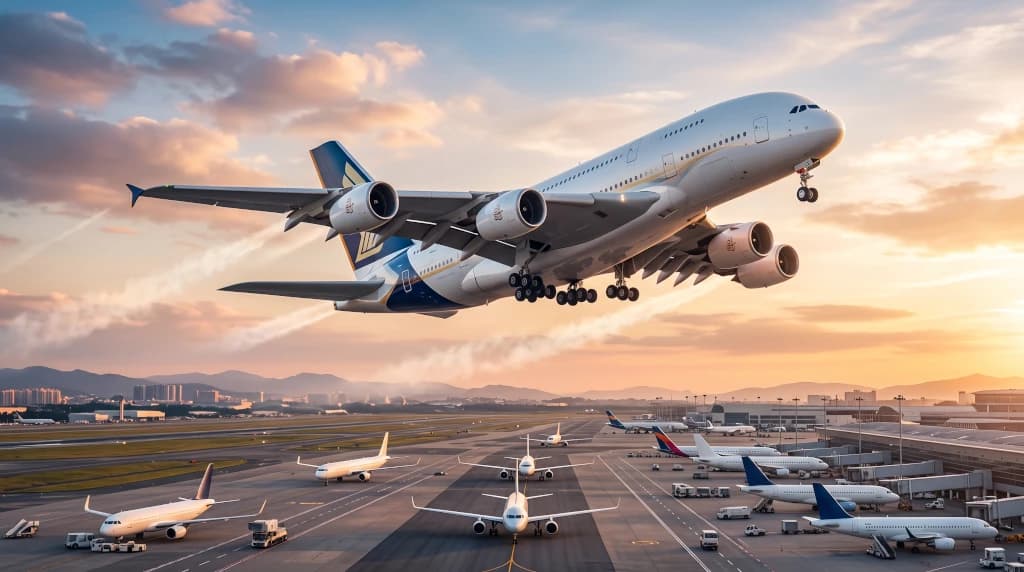
The A380 Comeback: Why Airlines Are Returning to the Airbus Superjumbo
Introduction
In 2020, industry analysts and aviation media were virtually unanimous: the era of four-engine commercial giants had reached an irreversible end. As global passenger traffic ground to a halt and airlines aggressively cut costs, the Airbus A380 became the poster child of a bygone era. Dozens of "Superjumbos" were ferried to desert aircraft boneyards in Teruel, Spain; Tarbes, France; and Alice Springs, Australia. Carriers wrote off billions of dollars in asset values, closed assembly lines in Toulouse, and proclaimed the decisive victory of efficient twin-engine wide-bodies (the so-called twins), such as the Airbus A350 and Boeing 787 Dreamliner.
Yet just a few years after prematurely drafting the A380's obituary, global skies are witnessing one of the most spectacular revivals in commercial aviation history. Airlines that had formally bid farewell to their quad-jet fleets—led by Lufthansa, British Airways, Qatar Airways, and Etihad Airways—have poured tens of millions of euros into aircraft reactivations, heavy structural overhauls, and cabin refurbishments. Why are airlines once again eager to deploy the massive Airbus A380 on flagship routes, even as the fuel burn and maintenance overhead of four powerplants remain substantial? The answer lies in a unique convergence of severe airport slot constraints, chronic delivery delays at major aircraft manufacturers, and unprecedented yield economics across premium cabin classes.
Anatomy of a Premature Obituary: Why the A380 Was Supposed to Disappear
To understand the magnitude of the current comeback, one must examine why the Airbus A380 program initially stumbled commercially. When designing the Superjumbo in the late 1990s, Toulouse engineers based market projections on a strict Hub-and-Spoke model. The premise was that intercontinental long-haul traffic would concentrate almost entirely between high-density mega-hubs (e.g., London Heathrow, Dubai, Singapore, New York JFK), with smaller regional aircraft feeding passengers from secondary cities.
However, the market rapidly pivoted toward a decentralized Point-to-Point network, powered by high-bypass turbofan engine revolutions and extended ETOPS ratings for twinjets. Airlines increasingly preferred to bypass congested transfer hubs by operating direct routes between secondary city pairs using Boeing 787s or Airbus A350s.
The A380 was an uncompromising machine, and during downturns, its design strengths turned into severe operational vulnerabilities:
- Fuel Consumption: Four engines (Rolls-Royce Trent 900 or Engine Alliance GP7200) generated significantly higher trip costs and per-seat CO2 emissions compared to modern twin-engine airliners.
- Airport Infrastructure Constraints (Code F): A massive 79.75-meter wingspan required airports to construct specialized dual-deck jet bridges, widen taxiways, and accommodate wide wake turbulence separations.
- Load Factor Risks: Filling over 500 seats during off-peak seasons was notoriously difficult, and unsold capacity on an A380 quickly eroded route profitability.
The Four Pillars of the Superjumbo Renaissance: Why the Giant Flies Again
Despite these legacy challenges, the A380 has reclaimed its frontline role due to operational bottlenecks that aircraft planners could hardly have foreseen a decade ago. Today's commercial aviation sector faces infrastructure limitations where sheer cabin volume offers the only viable solution.
1. Slot Bottlenecks at Mega-Hubs
The most precious currency in modern aviation is the airport slot—the right to take off or land within a specific timeframe at high-demand gateways. Key international hubs including London Heathrow (LHR), New York (JFK), Tokyo Haneda (HND), and Frankfurt (FRA) operate at absolute physical runway capacity. Airlines cannot simply add extra daily frequencies to meet demand.
With international travel demand reaching historic highs, the only method to increase available seat miles without securing non-existent slots is upgauging—deploying a larger aircraft. Replacing a Boeing 777-300ER (seating roughly 350 passengers) with an Airbus A380 (configured for 480 to over 600 seats) delivers a 40–50% capacity boost within the exact same slot window.
2. The New Aircraft Supply Crunch: Boeing 777X Delays and Engine Bottlenecks
The return of the A380 is directly tied to supply chain disruptions across the aerospace manufacturing sector. Major carriers had originally scheduled the retirement of their quad-jets to coincide with deliveries of next-generation wide-bodies, notably the flagship Boeing 777-9 (777X) and the Airbus A350-1000.
Years of certification delays surrounding the Boeing 777X, combined with aerospace component shortages and engine turnaround backlogs, left airlines facing a structural deficit in long-haul wide-body capacity. Bringing preserved A380s out of desert storage became the most reliable operational hedge to protect market share and network schedules.
3. Yield Economics and the Premium Cabin Boom
Airline profitability structures have undergone a profound shift. High-yield demand has surged across Premium Economy, Business, and First Class cabins. In this segment, the Airbus A380 provides an unmatched revenue-generating platform.
With its dual-deck architecture spanning the full length of the fuselage, airlines can dedicate the entire upper deck to high-yield premium passengers. This cabin configuration generates margins that comfortably absorb higher aggregate fuel costs. When premium seat factors remain above 85–90%, the A380's unit revenue dynamics (CASK/CASM against RASK) make it a formidable commercial performer.
4. Passenger Psychology: An Unrivaled Standard of Space and Quiet
From a passenger perspective, the A380 remains an unrivaled favorite. Travelers frequently seek out flights operated by the Superjumbo, directly influencing booking conversion rates:
- Acoustic Comfort: Measured ambient noise levels inside the A380 cabin during cruise are up to 50% lower than legacy wide-bodies like the Boeing 777-200 or 747-400.
- Volumetric Space: Vertical sidewalls and high ceiling vaults eliminate cabin claustrophobia, offering generous shoulder room even in standard Economy configurations.
- Turbulence Damping: Massive wings with a surface area of $845\text{ m}^2$ act as enormous aerodynamic dampers, smoothing out rough air with substantially lower G-force jolts than lighter twinjets.
The Global Reactivation Map: Who Brought the A380 Back?
The Superjumbo's revival spans nearly all major legacy operators with the fleet infrastructure to support it.
1. Emirates: The Undisputed Superjumbo Bastion
The Dubai-based carrier remains the world's primary A380 operator, maintaining an active fleet of over 115 aircraft. Emirates not only kept the aircraft at the center of its global strategy but also executed a multi-billion-dollar retrofit campaign—installing customized Premium Economy cabins and refreshing its iconic Onboard Lounges and First Class Shower Spas. Emirates management has repeatedly emphasized that the A380 generates the bulk of the airline's operating profits on high-density trunks to London, Paris, Sydney, and New York.
2. Lufthansa: The Strategic Reversal in Munich
In 2021, Lufthansa executives asserted that its A380s would never take to the skies under the crane logo again. Yet surging transatlantic demand and delivery pauses for new wide-bodies forced a decisive strategy shift. The German flag carrier reactivated its A380 fleet, basing the aircraft at its Munich (MUC) hub to serve key North American gateways (New York, Boston, Los Angeles) and Asian destinations (Bangkok, Delhi).
3. British Airways, Qatar Airways, Etihad, Qantas, and Singapore Airlines
British Airways relies heavily on its 12 A380s as the core capacity anchor for slot-restricted operations out of London Heathrow to North America, South Africa, and Asia. Qatar Airways and Etihad reactivated their fleets to capture high-yield connecting traffic—with Etihad redeploying its ultra-exclusive three-room suite, The Residence. Meanwhile, Japan's ANA continues to deploy its trio of custom-painted Flying Honu sea-turtle A380s to dominate high-volume holiday routes between Tokyo and Honolulu.
Operational and MRO Economics: The Real Cost of Return
Reactivating an A380 after multi-year storage in desert environments is an intensive engineering undertaking, requiring significant capital allocation and complex maintenance logistics.
Returning a single aircraft to flight-ready status requires extensive procedures:
- Heavy Structural Maintenance (C-Checks and D-Checks): Unsealing airframes, replacing fluids, conducting deep corrosion non-destructive testing (NDT), and inspecting wing spars cost anywhere from $2 million to $5 million per airframe.
- Landing Gear Overhauls: The A380's massive 22-wheel landing gear assemblies and complex hydraulic actuators required comprehensive workshop teardowns after extended exposure to desert heat.
- Flight Crew Recertification: Carriers had to schedule extensive full-flight simulator (FFS) cycles and recurrent training pipelines to recertify hundreds of captains, first officers, and cabin crew members.
Conclusion: How Long Will the Second Golden Age Last?
The comeback of the Airbus A380 demonstrates the unpredictable and dynamic nature of the global aviation industry. An aircraft written off prematurely has reaffirmed its irreplaceable utility in an era marked by airport congestion and fleet capacity constraints.
Aviation planners broadly agree: the Superjumbo's second operational life will extend comfortably into the early to mid-2030s. Only when large-scale, fully mature fleets of Boeing 777-9s and expanded Airbus A350-1000 variants enter steady service will the double-decker giant begin its final, definitive retirement. Until then, boarding this monumental double-deck aircraft remains one of the most distinctive, comfortable, and memorable experiences in commercial flight.