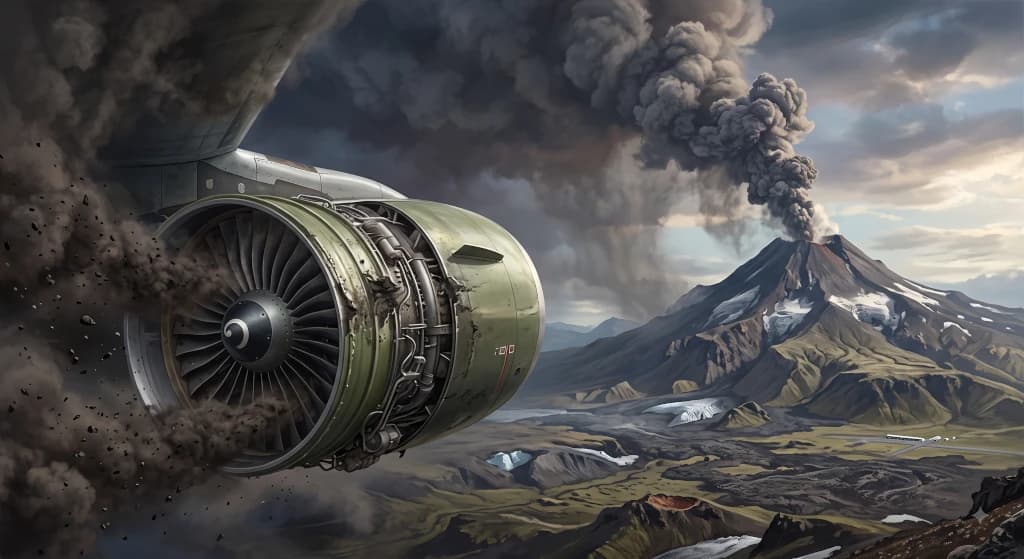
Impact of Volcanic Ash on Jet Engines: Lessons from Volcano Eruptions
Introduction
When the unassuming Icelandic volcano Eyjafjallajökull spewed a massive plume of finely ground ash into the upper reaches of the troposphere and stratosphere in mid-April 2010, global civil aviation ground to a halt. Within just a few days, over 100,000 flights were canceled, stranding nearly 10 million passengers and generating estimated industry losses exceeding $1.7 billion. Airspace over most of Europe—stretching from the British Isles to Scandinavia and Central Europe—was meticulously shut down. To many passengers and observers, the aviation authorities' decision seemed like a drastic overreaction; after all, looking up at the sky from the tarmac in Warsaw, London, or Frankfurt, there were often no threatening, dark clouds in sight.
Yet aerospace engineers, volcanologists, and flight safety experts knew all too well that entering a suspension of microscopic silica and mineral particles—invisible to the naked eye—was a silent death sentence for a modern turbofan engine. Volcanic ash particles are not ordinary sand or desert dust. They consist of microscopic glass shards and sharp rock fragments with extremely high melting points. They attack aircraft in two distinct ways: acting like a high-powered sandblaster on the airframe and sensors, and melting into a plastic, liquidized rock that chokes the interior of a jet engine. To understand why an invisible cloud paralyzed an entire continent, we must look back several decades and explore the mechanics of a phenomenon that nearly caused some of the worst disasters in modern aviation history.
Anatomy of Destruction: What Volcanic Ash Does Inside an Engine
A jet engine is one of the most sophisticated masterpieces of mechanical engineering. It requires a constant, uninterrupted flow of massive air volumes that are ingested, compressed, mixed with fuel, and burned at temperatures reaching 1,400–1,700°C. When volcanic ash enters this finely tuned machine, a series of destructive physical and chemical processes unfolds.
1. Vitrification and Combustion Chamber Blockage
The primary component of volcanic ash is silicon dioxide ($\text{SiO}_2$), along with oxides of aluminum, iron, and calcium. This type of ash melts at approximately 1,100°C. The problem is that the operating temperature inside the combustion chamber and high-pressure turbine (HPT) section of a modern jet engine far exceeds this threshold.
When ash particles are ingested, they pass seamlessly through the front fan and compressor section. Destruction begins inside the combustion chamber. In a fraction of a second, solid rock particles melt into a liquid, viscous glass sludge. This liquid glass is then blown onto the turbine nozzle guide vanes and the turbine blades themselves, which are heavily cooled from within by cooler bleed air. Upon contacting the cooler metal surfaces, the liquid glass instantly solidifies, forming a hard, smooth, and impermeable ceramic-glass coating.
The consequences of this process are immediate and catastrophic:
- Airflow Blockage: Solidifying glass clogs the passages between turbine vanes, drastically reducing the exit area for expanding exhaust gases.
- Engine Surge and Stall: The pressure buildup inside the combustion chamber caused by restricted exhaust flow forces a reversal of airflow—leading to violent compressor surges, loud backfires, and loss of thrust.
- Flameout: Disrupted airflow and oxygen starvation in the combustion chamber cause the engine flame to extinguish completely.
2. Erosion and Mechanical Damage
Before ash even reaches the hot section of the engine, it inflicts severe mechanical damage on the front components. Silica particles have a hardness of up to 7 on the Mohs scale (for comparison, steel is around 5, and diamond is 10). Striking the engine at cruising airspeeds (around 800–900 km/h), the ash acts like an abrasive blasting cabinet:
- Compressor Blade Erosion: Abrading the microscopic leading edges of compressor blades degrades their aerodynamic efficiency, preventing the engine from generating proper compression ratios.
- Clogging Cooling Channels: Modern turbine blades feature microscopic cooling holes through which air is forced to prevent the metal from melting. Volcanic ash rapidly plugs these holes, leading to thermal failure and physical melting of the turbine blades under their own operating temperatures.
3. Damage to Other Aircraft Systems
The danger of volcanic ash is not confined to the propulsion units. Glass particles impacting the airframe cause broader operational hazards:
- Windshield Sandblasting: The multi-layered glass cockpit windshields can turn completely opaque within minutes, making visual contact with the runway during landing impossible.
- Pitot Tube Blockage: Pressure sensors responsible for measuring airspeed and altitude become clogged, feeding erroneous data to flight management computers (FMC/FCS) and disengaging autopilot systems.
- Environmental Control System (ECS) Contamination: Fine ash enters the cabin ventilation system, generating a suffocating sulfur smell, haze, and respiratory irritation for passengers and crew.
Lessons from History: Incidents That Changed Aviation
Understanding the lethal hazard posed by volcanic ash did not happen overnight through theoretical laboratory calculations. It was knowledge forged through terrifying in-flight emergencies where catastrophic mass-casualty accidents were narrowly averted.
1. British Airways Flight 9 (June 24, 1982) – The "Jakarta Incident"
This is the most famous and pivotal incident in the history of volcanic ash research in aviation. A Boeing 747-200 (registration G-BDXH) named City of Edinburgh, carrying 247 people onboard, was cruising at 37,000 feet from Kuala Lumpur to Perth. At night, over the Indian Ocean near the island of Java, the flight crew under Captain Eric Moody observed a strange phenomenon: glowing electrical discharges (St. Elmo's fire) appeared across the windshield, and a thick sulfurous haze began filling the cabin.
Without the crew's knowledge, the aircraft had flown into an undetected cloud of ash spewed by Mount Galunggung. Within minutes, disaster struck:
- Surging and severe backfires caused all four Rolls-Royce RB211 engines to flame out one by one. The monumental "Jumbo Jet" was transformed into a 200-ton glider.
- The cockpit windshield was completely abraded and frosted over as rushing glass particles stripped away its protective outer layers.
- The crew declared an emergency and began gliding toward the ocean while attempting engine restarts. Captain Eric Moody delivered one of the most famous and composed passenger announcements in aviation history: "Ladies and gentlemen, this is your captain speaking. We have a small problem. All four engines have stopped. We are doing our damndest to get them going again. I trust you are not in too much distress."
The aircraft glided for 13 agonizing minutes, descending from 37,000 to 13,500 feet. Then, a phenomenon occurred that engineers only fully understood years later: as the glider descended into denser, cooler air, the dead engines cooled down. The molten glass that had hardened on the turbine blades contracted, cracked under thermal shock, and broke away! With the airflow restored, the crew successfully restarted the engines. Despite near-zero visibility through the pitted windshield, the crew executed a safe night landing in Jakarta. Remarkably, there were no injuries, though all four engines and windshields required total replacement.
2. KLM Flight 867 (December 15, 1989) – Terror Over Alaska
Just seven years later, history repeated itself under strikingly similar circumstances. A modern Boeing 747-400 operated by KLM, flying from Amsterdam to Anchorage with 245 passengers, entered an ash cloud generated by Mount Redoubt in Alaska. The sequence was identical: all four General Electric CF6 engines flamed out. The aircraft lost over 14,000 feet of altitude, drifting dangerously toward snow-covered mountain peaks before the crew managed to restart the engines at just 4,000 feet above ground level. The repair bill for the airframe and engines exceeded $80 million.
The 2010 Eyjafjallajökull Eruption: Why European Airspace Was Closed
Following the events of the 1980s, the International Civil Aviation Organization (ICAO) adopted a global "Zero Tolerance Policy" regarding volcanic ash. The mandate was absolute: if volcanic ash was detected in a given sector of airspace—regardless of its concentration—that airspace had to be closed to civil air traffic immediately.
When Eyjafjallajökull erupted in April 2010, weather patterns (a strong jet stream blowing from northwest to southeast) funneled fine ash directly over the densely populated and heavily congested airspace of Western and Central Europe. Following the "Zero Tolerance" framework, computer models at the Volcanic Ash Advisory Centre (VAAC) in London drew sweeping no-fly zones across the continent.
Grounding air traffic sparked fierce pushback from airlines. Executives at major carriers argued that computer models were overly conservative and that real ash concentrations over Germany or the Netherlands were harmless. Airlines even conducted passengerless test flights, which showed no immediate structural failures. However, subsequent teardowns and endoscopic inspections of those test engines revealed microscopic glass deposits accumulating on turbine vanes. The decision to close the skies, though financially painful, ultimately prevented catastrophic engine failures.
How the 2010 Eruption Transformed Aviation: Thresholds and Tolerances
The 2010 airspace shutdown proved that a rigid "Zero Tolerance" stance was unsustainable for modern global commerce. It triggered a massive research initiative involving engine manufacturers (Rolls-Royce, General Electric, CFM International, Pratt & Whitney), regulatory bodies (EASA, FAA), and meteorological agencies.
The fundamental shift was moving away from a binary "ash/no ash" rule to defining precise safety thresholds for ash concentration per cubic meter of air:
- Low Concentration Zone (Below $2 \times 10^{-3} \text{ g/m}^3$): Designated as a normal operational zone. Engines operating under these conditions show no critical glass accumulation, and erosion remains within normal maintenance tolerances.
- Medium Concentration Zone ($2 \times 10^{-3} \text{ g/m}^3$ to $4 \times 10^{-3} \text{ g/m}^3$): A restricted operational zone. Airlines may operate flights provided they implement enhanced maintenance procedures, such as mandatory post-flight endoscopic engine inspections.
- High Concentration Zone (Above $4 \times 10^{-3} \text{ g/m}^3$): A complete no-fly zone.
Post-2010 Technological Innovations:
- Lidar and Airborne Laser Measurements: Research aircraft and satellites equipped with Lidar optical systems can construct real-time 3D density maps of ash plumes, replacing theoretical estimates with empirical data.
- AVOID System (Airborne Volcanic Object Imaging and Detector): Wing-mounted infrared sensors tested for commercial aircraft that allow pilots to detect volcanic ash clouds up to 100 kilometers ahead and navigate safely around them.
- Advanced Ceramic Coatings: Engine manufacturers introduced Environmental Barrier Coatings (EBC) on turbine blades to prevent molten glass from adhering to metallic substrates.
Conclusion: Respecting the Forces of Nature
Eruptions from Icelandic volcanoes—from the historical events involving Galunggung to the memorable shutdown of 2010—taught global aviation a brutal yet invaluable lesson. They demonstrated that despite all its engineering marvels, jet technology remains susceptible to microscopic particles of crystalline rock.
Thanks to hard-won experience and groundbreaking research over the past decade, the aviation industry is incomparably better prepared for future volcanic activity. Regulations have become far more flexible, detection systems operate with satellite precision, and pilots are trained to identify and react to the first signs of ash entry. The next time your flight is delayed due to volcanic activity halfway across the continent, remember: that decision is not a bureaucratic whim, but the result of lessons learned to ensure you reach your destination safely.