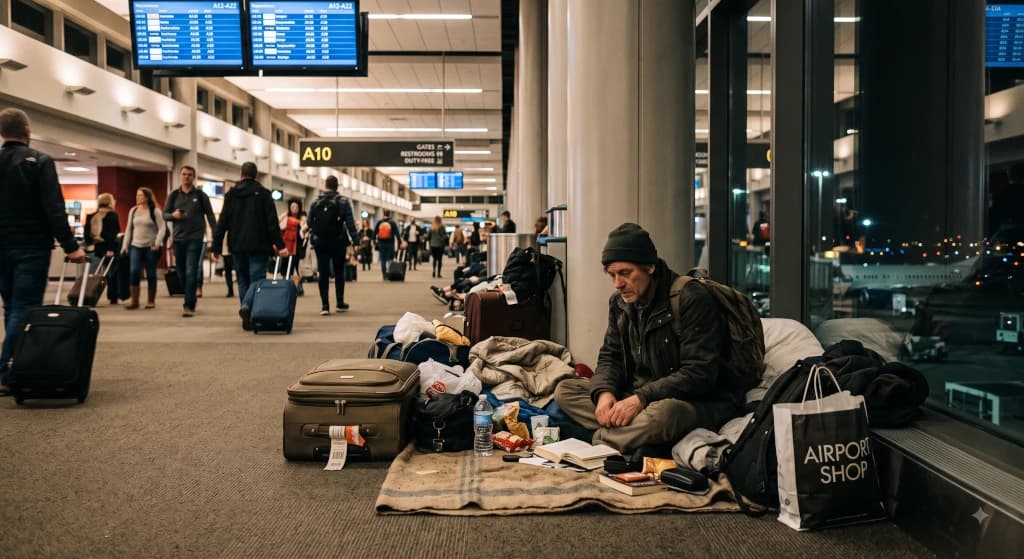
Lost Passengers: Who Are the People Who Lived in Airports?
Introduction
For most of us, an airport is merely a transit point—a sterile environment of glass facades, rattling luggage conveyor belts, and the scent of expensive duty-free perfume. It is a place where we spend two or three hours nervously checking the departure board and waiting for the boarding call. However, there is a narrow, fascinating group of people for whom this temporary architecture became their entire world. For them, a place of transit transformed into a permanent home, and the waiting area into a living room. This is the phenomenon of long-term terminal residents, known in sociological literature and media as lost passengers or "terminal dwellers."
What drives a person—whether voluntarily or through the cold gears of legal procedure—to spend weeks, months, or even decades on an airport bench, under the constant gaze of surveillance cameras and the sterile, artificial glow of fluorescent lights? The history of this phenomenon is a complex mosaic of geopolitical crises, loopholes in asylum law, personal tragedies, and profound psychological breakdowns. Let us take a closer look at the lives of famous terminal residents and the mechanisms that turn ultra-modern airports into inescapable traps.
The Legal Void: How an "Invisible Person" Is Created
To understand how a person can end up "living" at an airport, we must examine the unique legal structure of international hubs. The main transfer area—known as the transit zone (airside)—lies beyond passport control and security checkpoints. Physically, it is part of a specific country's territory, but legally, it exists as a sort of "no man's land."
A passenger in the transit zone has not formally crossed the host country's border, meaning the host state is not obligated to grant them the rights enjoyed by individuals inside its territory. On the other hand, without valid documents, a visa, or permission from a destination country, airlines cannot board the passenger onto a flight, and border control cannot allow them entry. This creates a legal stalemate: the individual cannot move forward, cannot go back, and cannot remain where they are. They are trapped in limbo.
The most common reasons people become trapped in transit zones include:
- Geopolitical Crises and Revoked Documents: Sudden regime changes, outbreak of war, or passport cancellation by a home government (rendering a citizen stateless mid-journey).
- Refusal of Asylum Status: Situations where a passenger applies for asylum at a transit airport, and the appeals process drags on for months within border zones.
- Visa Errors and Lost Documentation: Losing a passport during connecting flights while being unable to return to one's home country due to life-threatening risks.
- Mental Health Disorders and Voluntary Isolation: Individuals suffering from severe conditions (such as schizophrenia or fugue states) who view the sterile, secure environment of an airport as a sanctuary from the outside world.
The Icon of the Terminal: The Remarkable Story of Mehran Karimi Nasseri
Any discussion of airport dwellers must begin with the man whose life inspired Steven Spielberg's famous film The Terminal, starring Tom Hanks. That man was Mehran Karimi Nasseri, also known as "Sir Alfred," who spent an astounding 18 years (from 1988 to 2006) living in Terminal 1 at Paris-Charles de Gaulle Airport.
Nasseri, an Iranian refugee, lost his documentation confirming refugee status in Belgium due to complex political complications. When he landed in Paris intending to travel to the United Kingdom, British authorities denied him entry and sent him back to France. French authorities could neither allow him into the country (due to lack of a visa) nor deport him (due to the absence of a country willing to accept him). Nasseri settled onto a curved red bench on the lower level of Terminal 1.
His existence became a blueprint for airport survival:
- Daily Routine: He woke up at 5:30 AM before the first waves of passengers arrived. He shaved in public restrooms and kept his personal belongings neatly packed in plastic suitcases.
- Work and Reading: He spent his days reading newspapers, writing diaries, and studying academic books. He earned the affection of airport staff, flight attendants, and restaurant workers, who shared meals and free newspapers with him.
- Psychological Trap: When French authorities and the Red Cross finally secured his right to reside in France and a refugee passport in 1999 after years of legal battles, Nasseri... refused to sign the papers. Years of isolation had made him terrified of leaving the safe, predictable microworld of the terminal. The airport space had become his identity. He only left the airport in 2006 due to severe illness, though he returned to CDG near the end of his life, where he passed away in 2022.
Other High-Profile Cases: From Moscow to São Paulo
Nasseri was far from an isolated case. Civil aviation history features dozens of dramatic stories of individuals forced to make airports their permanent residence.
Edward Snowden at Moscow Sheremetyevo (2013)
One of the most famous modern cases involved Edward Snowden, a former CIA and NSA analyst. After leaking classified documents detailing the global surveillance program PRISM, Snowden became stranded in the transit zone of Moscow's Sheremetyevo Airport for 39 days. Following the revocation of his US passport by American authorities, Snowden was unable to purchase a ticket to South America. The transit zone became the arena for top-level international diplomacy until Russia granted him temporary asylum.
Sanjay Shah at Nairobi Airport (2004–2005)
A man holding a British Overseas Citizen passport spent 435 days at Jomo Kenyatta International Airport in Nairobi. Following changes to UK immigration law, he was denied entry to the United Kingdom, and Kenyan authorities revoked his citizenship when he attempted to leave the country. Shah lived on an airport sofa, washing in passenger restrooms and eating at fast-food outlets. His determination and hunger strike ultimately led to him being granted full British citizenship.
Feng Zhenghu at Tokyo Narita Airport (2009–2010)
Chinese human rights activist Feng Zhenghu spent 92 days in the transit zone of Terminal 1 at Narita Airport. After visiting Japan, Chinese authorities denied him entry to his own homeland eight times, turning him back on consecutive flights to Tokyo. Zhenghu refused to re-enter Japan and took up residence near the departure gate, wearing a T-shirt that read "Chinese citizen denied the right to return home." His protest, broadcast across social media, eventually forced authorities in Beijing to relent and allow him back into the country.
Anatomy of Everyday Life: How to Survive in an Airport
Living in a facility designed for short stays presents severe physical and psychological challenges. Airports are built to stimulate movement and commercial consumption, not to provide restorative sleep or personal privacy.
Terminal dwellers must develop complex survival strategies to meet basic biological needs:
- Personal Hygiene: Using public restrooms during off-peak hours (typically between 1:00 AM and 4:00 AM). Showers are rarely accessible, so residents usually rely on sink baths.
- Obtaining Food: Depending on the generosity of food court staff, collecting discarded meal vouchers, eating at free sample stations, or receiving support from airport chaplains and charitable organizations.
- Sleep Deprivation and Noise: Constant ambient noise, public address announcements, 24/7 bright LED lighting, and metal benches divided by armrests (designed to prevent lying down) make chronic sleep deprivation a daily reality.
- Psychological Isolation: Being surrounded by thousands of moving people while experiencing no meaningful social interaction leads to profound feelings of alienation and depersonalization.
New Regulations and the Biometric Era: Is the Era of "Lost Passengers" Coming to an End?
In today's highly digitized, security-driven world, are stories like Mehran Karimi Nasseri's still possible? The answer is that it is becoming increasingly difficult, though not entirely impossible.
In recent years, airport operators and international border agencies have introduced several measures aimed at eliminating long-term stays in transit zones:
- Time Limits Airside: Most modern airports have implemented strict rules prohibiting stays in the transit area longer than 24 to 48 hours without a valid onward boarding pass.
- Dedicated Holding Centers: Asylum seekers or individuals lacking documentation are now immediately directed to closed holding facilities near the airport rather than remaining in open public terminals.
- Biometric Scanning and APIS Systems: Advanced Passenger Information Systems (APIS) ensure that passengers without entry rights to their destination country are prevented from boarding at the point of origin.
Conclusion: A Mirror of the Modern World
The phenomenon of lost passengers spending months in airport terminals is far more than a collection of bizarre news trivia. It is a powerful metaphor for the modern world—a world where mobility and borders have become heavily regulated commodities. People trapped in airports show just how thin the line is between being a privileged global traveler and a stateless exile.
The next time you walk through an airport terminal, complaining about a delayed flight or a hard chair at your gate, take a closer look at the people sitting quietly in the corner with a few plastic bags. You might be looking at someone for whom that loud, gleaming terminal became the only safe place on Earth.