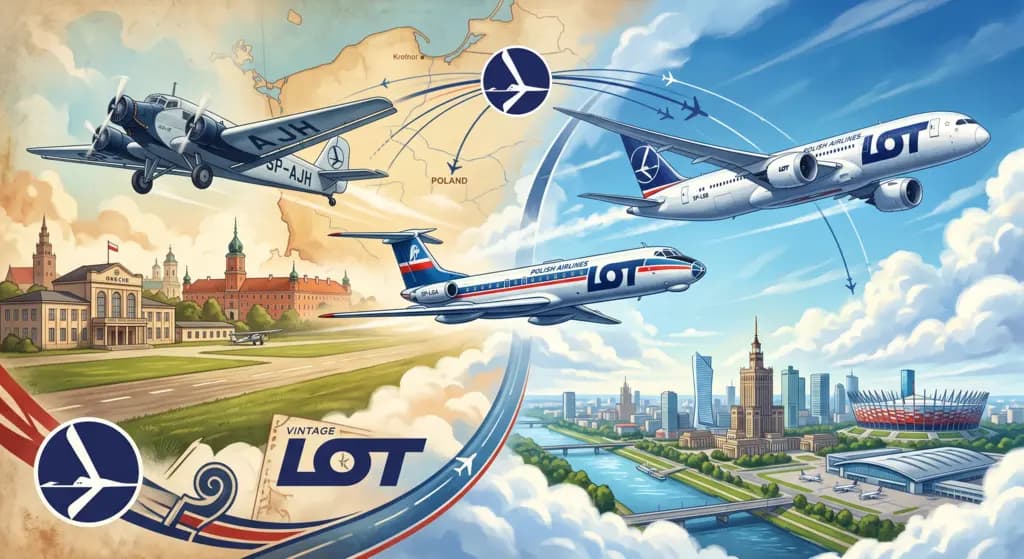
History of LOT Polish Airlines: From the Pioneer 1920s to the Dreamliner Era
Introduction
Few airlines in the world can boast an uninterrupted history spanning nearly a century, having survived the turmoil of World War II, massive political transformations, and global industry crises. LOT Polish Airlines is an absolute phenomenon on the map of world civil aviation. Founded in the late 1920s, Poland's national carrier is one of the oldest operating airlines on the globe, and its iconic crane logo—designed by the eminent artist Tadeusz Gronowski—remains one of the most recognizable Polish graphic designs in history.
The story of LOT is not just a dry chronicle of aircraft purchases and new route launches. It is a fascinating, dramatic tale of pioneer courage, the strength of Polish engineering, the political constraints of the Cold War, and a spectacular technological and market transformation after 1989. Today, connecting Warsaw with key metropolises in North America, Asia, and Europe using state-of-the-art Boeing 787 Dreamliners, the Polish carrier represents the highest industry standards. Let us take a closer look at the remarkable evolution of this national flag carrier—from wood-and-canvas biplanes to 21st-century transatlantic jets.
The Pioneer Years (1928–1939): Birth of the Crane and European Leadership
The official birth of LOT Polish Airlines dates back to December 29, 1928, when a decree by the Minister of Communications consolidated and merged the existing private aviation companies: "Aerolot" (which had been operating domestic routes since 1922) and "Aero." The newly created state-and-municipal enterprise formally commenced flight operations on January 1, 1929. Its first operational base was Mokotów Aerodrome in Warsaw.
The fleet initially relied on German Junkers F 13s and three-engine Fokker F.VIIa/3m aircraft. From the very beginning, LOT focused on dynamic international expansion. By the 1930s, the Polish carrier was setting new technical and organizational standards in Europe:
- Modern Fleet: LOT was among the first airlines in Europe to phase out wooden aircraft in favor of all-metal designs. The acquisition of American Lockheed L-10 Electra (1936) and L-14 Super Electra (1938) aircraft elevated the Polish airline to the forefront of global aviation technology.
- Operational Innovations: In 1931, the iconic crane logo was officially adopted. During the same period, radio operators were introduced into flight crews, and onboard radio receivers were installed across the fleet.
- Network Expansion: By 1939, LOT's route network had expanded impressively, connecting Warsaw with Berlin, Rome, Paris, Athens, Beirut, and even Helsinki. The total route length exceeded 10,000 kilometers.
A symbol of pre-war LOT's strength and ambition was the spectacular delivery flight of a Lockheed L-14 Super Electra commanded by Capt. Władysław Klisz. In May 1938, the aircraft took off factory-fresh from Burbank, California, crossed South America, the Atlantic Ocean, and Africa, landing in Warsaw after covering nearly 25,000 kilometers. It was an extraordinary navigational and technical feat for its era, serving as direct preparation for planned scheduled transatlantic routes to the USA.
Wartime Turmoil and Rebuilding Behind the Iron Curtain
The outbreak of World War II in September 1939 abruptly halted the golden age of Polish aviation. The commercial fleet was evacuated to Romania, and from there, several aircraft made their way to Great Britain and the Middle East, where Polish crews and equipment supported the Allied war effort. Inside Poland, all ground infrastructure was destroyed or seized.
The airline's reconstruction began in post-war Poland in 1945, when state authorities formally re-established LOT as a state-owned enterprise. However, under the new geopolitical realities of the Cold War, the airline was completely cut off from the Western market and became reliant on Soviet aviation technology.
Throughout the 1950s and 1960s, the backbone of the fleet consisted of Soviet piston and turboprop aircraft:
- Lisunov Li-2 and Ilyushin Il-12/Il-14: The primary workhorses serving domestic and short-haul international routes in the immediate post-war years.
- Ilyushin Il-18: A four-engine turboprop introduced in 1961 that allowed LOT to extend its reach back into the Middle East and North Africa.
- Tupolev Tu-134: The introduction of this twin-engine jet in 1968 launched the jet age for LOT on European routes.
Wide-Bodies and Oceanic Ambitions (1970s and 1980s)
A true breakthrough in LOT's post-war history occurred in April 1972, when the long-haul Ilyushin Il-62 jet landed at Warsaw Okęcie Airport. Possessing an aircraft capable of crossing the ocean non-stop allowed the airline to realize the dream of its pre-war pioneers: establishing regular transatlantic scheduled flights.
In May 1973, LOT inaugurated its historic service from Warsaw to New York (JFK), soon followed by routes to Chicago, Montreal, and Toronto. LOT became a crucial bridge connecting the Polish diaspora in North America with their homeland. Passengers were drawn by traditional Polish hospitality, excellent service, and national cuisine served onboard.
However, the 1970s and 1980s were also marked by tragedy. Fatal crashes of the Il-62 "Mikołaj Kopernik" in 1980 at Okęcie and the Il-62M "Tadeusz Kościuszko" in 1987 in the Kabaty Woods exposed critical design flaws in the Soloviev D-30KU engines. These disasters shocked the nation and compelled airline management to seek safer Western alternatives.
Turning to the West (1989–2000): A Technological Revolution
The fall of communism in Poland and the political transition of 1989 served as the catalyst for the most radical fleet modernization in Central and Eastern Europe. LOT became the first carrier in the former Eastern Bloc to phase out Soviet-built aircraft entirely in favor of Western equipment.
The symbolic dawn of this new era came in April 1989 with the acquisition of the modern, wide-body Boeing 767-200ER (and soon after, the larger 767-300ER). The American airliners immediately replaced the Il-62s on long-haul oceanic routes, delivering unprecedented safety, passenger comfort, and cabin noise reduction.
Over the following decade, the fleet transformation proceeded at a rapid pace:
- Boeing 737 (-300, -400, -500 series): Replaced aging Tupolev Tu-134s and Tu-154Ms on medium-haul European routes.
- ATR 42 and ATR 72: Modern turboprops took over the dense domestic and regional network.
- Embraer ERJ-145: Introduced in 1999, these Brazilian regional jets enabled LOT to open thinner routes to Western and Central European destinations.
The New Millennium: Global Alliance, Crises, and the Dreamliner Era
LOT entered the 21st century with ambitious goals, but also faced challenges brought on by deregulation, the rise of low-cost carriers (LCCs), and market turbulence following the September 11 attacks in 2001.
In 2003, LOT reached a major strategic milestone by officially joining Star Alliance, the world's largest global airline network. This gave LOT passengers access to a vast worldwide route map, reciprocal frequent flyer benefits through Miles & More, and seamless single-ticket connections.
However, a decisive forward-looking move was the order for next-generation long-haul airliners: the Boeing 787 Dreamliner. In November 2012, LOT made history as the **first airline in Europe** to take delivery of this composite-built passenger aircraft.
Why the Dreamliner Changed Everything
The B787 Dreamliner revolutionized the economics of LOT's long-haul operations. With 20% lower fuel consumption, higher cabin humidity, lower cabin altitude pressure, and advanced bleedless architecture, the carrier could offer a superior transatlantic travel experience while launching new long-haul destinations across Asia and North America.
LOT Today: Regional Leader and Future Outlook
Having undergone deep restructuring between 2012 and 2015, and subsequently navigating global industry disruptions such as the COVID-19 pandemic and the war in Ukraine, LOT Polish Airlines has solidified its position as a leading network carrier in Central and Eastern Europe.
The airline's primary hub remains Warsaw Chopin Airport (WAW), from which LOT operates a connecting strategy linking passengers from across the CEE region to North America (New York, Newark, Chicago, Los Angeles, Toronto) and Asia (Tokyo, Seoul, Beijing, Mumbai, Delhi).
The national carrier's current fleet is among the most modern and streamlined in Europe, consisting of:
- Boeing 787-8 and 787-9 Dreamliners: Dedicated exclusively to long-haul routes.
- Boeing 737 MAX 8s: Serving as the backbone for high-density European and Middle Eastern routes.
- An extensive Embraer fleet (E170, E175, E190, E195, and E195-E2): LOT is one of the world's largest operators of Brazilian regional jets, providing exceptional capacity flexibility.
Conclusion: A Heritage Flying Toward the Future
The history of LOT Polish Airlines is a compelling story of determination, innovation, and adaptability. From modest biplane flights over pre-war Poland and transoceanic Il-62 routes during the Communist era, to pioneering the Boeing 787 in Europe, LOT remains a point of national pride and an ambassador for Poland in skies around the world.
With plans for further fleet expansion, new long-haul route openings, and the prospective development of a new hub airport (CPK), LOT Polish Airlines enters its second century with a clear vision and a strong market standing. The stylized crane on the tail fin continues to represent the finest traditions of aviation: safety, heritage, hospitable service, and an unwavering drive toward new horizons.