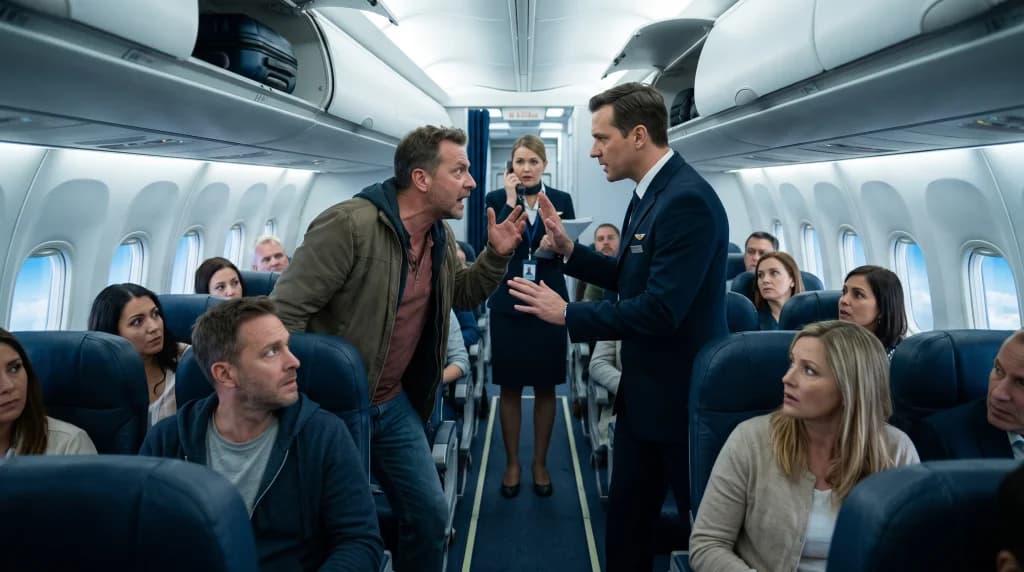
Aviation Law and Unruly Passengers: Penalties for Mid-Flight Altercations
Introduction: The Thin Line Between Rage and Catastrophe
For most travelers, commercial flight is a mix of pre-holiday excitement, the monotonous hum of jet engines, and the familiar struggle to find a tolerable posture in an economy seat. Yet at a cruising altitude of 10,000 meters, inside a sealed aluminum-composite cylinder traveling at 900 km/h, the parameters of social dynamics narrow drastically. Confined spaces, reduced barometric pressure with lower oxygen partial pressure, dehydration, travel stress, and alcohol purchased in duty-free concourses combine into a volatile cocktail. When this detonates into what the aviation industry classifies as air rage, a routine disagreement can escalate into an incident that jeopardizes the safety of hundreds aboard.
Many disruptive flyers harbor the misconception that an airliner cabin is an extraterritorial space detached from civil law—a setting where verbal abuse, defying crew instructions, or refusing to fasten a seatbelt warrants little more than a reprimand upon arrival. In reality, modern international aviation law operates as a coordinated legal and financial mechanism. A passenger who instigates an altercation mid-flight transitions immediately from a customer into a perpetrator of an international offense, pursued under international conventions, domestic penal codes, and carrier legal departments. Understanding the operational and legal procedures triggered when a traveler loses control at altitude clarifies the severe stakes involved.
Threat Classification: From Non-Compliance to Cockpit Incursion
Incidents involving disruptive or unruly passengers are not addressed arbitrarily. The International Civil Aviation Organization (ICAO) and the International Air Transport Association (IATA) established a standardized, four-tier threat hierarchy that defines the severity of the infraction and dictates the cabin crew's mandatory containment protocol:
- Level 1 (Disruptive Behavior / Verbal Non-Compliance): Characterized by verbal hostility, profanity directed at crew or passengers, and refusal to comply with safety briefings (such as declining to stow electronics, ignoring seatbelt signs, or smoking traditional or electronic cigarettes in lavatories).
- Level 2 (Physically Abusive Behavior): Direct physical interference with crew members or fellow travelers (pushing, grabbing, striking, or spitting), alongside intentional destruction of airline property or cabin equipment.
- Level 3 (Life-Threatening Behavior): Display or brandishing of improvised or concealed weapons (such as broken glassware or heavy tools), explicit death threats, choking, or severe assaults intended to incapacitate crew members.
- Level 4 (Attempted or Actual Breach of the Flight Crew Compartment): The highest state of emergency. Any effort to force the armored cockpit door, tamper with electronic access keypads, or declare intent to seize control of the airframe is treated under counter-terrorism protocols as an act of unlawful interference.
Authority at Altitude: Legal Prerogatives of the Pilot-in-Command
Airliner captains are frequently perceived merely as vehicle operators, yet international aviation conventions invest the Pilot-in-Command (PIC) with broad executive, judicial, and law enforcement authority over the aircraft in flight.
The foundational framework governing mid-air conduct is the Tokyo Convention of 1963 (Convention on Offences and Certain Other Acts Committed on Board Aircraft). Under this treaty, the aircraft commander is empowered to take all reasonable preventative measures, including the application of physical force, to protect the safety of the aircraft, persons, and property aboard without seeking prior external approval:
- The captain may direct flight attendants or request passenger assistance to physically restrain an aggressive individual using dedicated onboard equipment (such as textile restraint kits or flexicuffs).
- The captain holds final operational authority to abort the scheduled route and execute an unscheduled emergency diversion to the nearest suitable aerodrome to remove the disruptive passenger (offloading).
- The captain can formally surrender the perpetrator to local law enforcement authorities at the diversion airfield, accompanied by a binding complaint of unlawful disruption.
Crucially, the Tokyo Convention extends blanket legal immunity to the aircraft commander, crew members, and passengers who assist in restraining a disruptive individual. An offender subdued mid-flight cannot successfully pursue civil damages against the crew or airline for bruises, joint sprains, or emotional distress sustained during a lawful, safety-critical restraint operation.
Closing the Jurisdictional Loophole: From Tokyo 1963 to Montreal 2014
For decades, international air law was hampered by a significant jurisdictional gap. Under the original terms of the Tokyo Convention, primary legal jurisdiction over offenses committed mid-flight belonged solely to the State of Registration of the aircraft. This created recurring enforcement hurdles: if a passenger on an Irish-registered aircraft operated between two European hubs initiated a violent assault over another country's airspace, local police at the destination often lacked direct statutory authority to detain or prosecute, as the crime occurred neither on domestic soil nor aboard a domestic flag carrier.
This barrier was systematically resolved through the Montreal Protocol of 2014 (MP14), which amended the Tokyo framework by expanding jurisdictional authority to include:
- The State of Destination: Authorities in the country where the aircraft ultimately touches down following an incident hold full legal jurisdiction to arrest, charge, and try the perpetrator under domestic penal statutes, regardless of aircraft registry.
- The State of the Operator: The nation where the operating airline maintains its principal place of business retains concurrent prosecutorial jurisdiction.
With MP14 widely ratified across international aviation markets, the notion that international airspace offers a jurisdictional vacuum is invalid. A passenger inciting an altercation is directly accountable to the judiciary of the jurisdiction where the wheels touch the tarmac.
Criminal Liabilities: From Misdemeanor Charges to Federal Sentences
Airborne altercations are legally distinct from public disturbances on city streets. In flight, physical confrontations are evaluated under statutes governing the reckless endangerment of an aircraft in flight and interference with flight crew duties.
European and International Jurisdictions
Across European Union member states and coordinated civil aviation authorities, national criminal codes interface with civil aviation statutes to enforce strict deterrents:
- Non-compliance with safety directives issued by the Pilot-in-Command carries immediate administrative fines, detention, or penal citations for disrupting public transport safety.
- Physical assaults against flight attendants carrying out safety-critical duties are categorized under aggravated assault statutes, often carrying statutory custodial sentences ranging from six months to eight years of imprisonment.
- In extreme instances where an individual attempts to access the flight deck or compromises flight stability, charges may elevate to air piracy or unlawful seizure of aircraft, carrying mandatory multi-year prison terms.
Federal Enforcement in the United States
Incidents occurring within United States airspace or aboard U.S. air carriers fall under federal jurisdiction, investigated by the Federal Bureau of Investigation (FBI) and prosecuted through the Department of Justice alongside the Federal Aviation Administration (FAA):
- The FAA enforces a rigorous Zero Tolerance Policy. Administrative civil penalties issued directly by the regulator against disruptive passengers routinely reach between $10,000 and $40,000 per violation.
- Under Title 49 of the United States Code (49 U.S.C. § 46504), assaulting or intimidating a flight crew member or flight attendant in a manner that interferes with the performance of their duties is a federal felony carrying penalties of up to 20 years of imprisonment in a federal penitentiary.
Financial Repercussions: The Cost of Fuel Dumps and Emergency Diversions
Criminal indictments represent only a portion of the total liability. For many disruptive passengers, the most devastating long-term consequence takes the form of civil restitution claims pursued by airline legal teams seeking reimbursement for unscheduled diversions.
When an intercontinental widebody transport is forced to divert due to an unmanageable passenger, the financial chain reaction is extensive:
- Fuel Jettison (Fuel Dumping): Widebody aircraft (such as the Boeing 777 or Airbus A350) have a Maximum Takeoff Weight (MTOW) far exceeding their Maximum Landing Weight (MLW). To land immediately without risking landing gear failure or structural wing cracking, the crew must dump tens of metric tons of Jet A-1 into the atmosphere. The unrecoverable cost of the jettisoned kerosene alone typically tallies between $30,000 and $60,000.
- Unscheduled Aerodrome and Ground Handling Fees: Additional landing slots, emergency approach clearances, handling charges, apron parking, and jetway hookup fees at an unplanned diversion airport generate an immediate $10,000 to $25,000 in billing.
- Emergency Service Interventions: Tarmac deployment of armed airport police tactical units, immigration processing officers, border guards, and emergency medical response teams is routinely invoiced back to the carrier, which passes the liability directly to the offender.
- Crew Duty Time Exceedance (FTL Limits): An unscheduled landing often causes the flight and cabin crew to exceed their statutory Flight Time Limitations. The aircraft is grounded, requiring the airline to provide hotel accommodations, meals, and surface transfers for hundreds of displaced passengers, or to position a replacement crew via private charter. Expenses regularly mount to between $50,000 and $150,000.
- Downstream Passenger Compensation Claims: If the diversion causes downstream delays or missed connections under passenger protection frameworks (such as EU261 regulations), the carrier may file subrogation claims to recoup statutory payout liabilities from the individual responsible.
Courts worldwide consistently uphold civil restitution actions brought by airlines. Judgments ordering disruptive passengers to pay $100,000 to $200,000 in operational restitution are well established, and these debts are rarely dischargeable through personal bankruptcy proceedings.
The No-Fly List: Long-Term Travel Exclusion
Beyond custodial sentences and civil judgments, an unruly passenger's ability to fly commercially can be terminated permanently. Major carriers maintain proprietary internal passenger exclusion registries, colloquially known as blacklists.
Inclusion on an exclusion list by a network airline (such as Lufthansa, Air France-KLM, or British Airways) often triggers coordinated exclusions across an entire global airline alliance (Star Alliance, SkyTeam, or oneworld). Carriers actively share security data concerning passengers who compromise flight safety. An individual placed on an international ban list faces the cancellation of existing bookings, widespread purchase refusal across partner airlines, and frequent denial of electronic travel authorizations (such as the U.S. ESTA or European ETIAS) due to documented criminal incidents in commercial aviation.
Conclusion: The Practical Reality of Airborne Conduct
Excessive alcohol consumption, disputes over reclined seatbacks, refusing cabin crew instructions, or using unauthorized electronic cigarettes in lavatories can escalate into severe legal liabilities. The aircraft cabin is a tightly regulated operational environment where safety protocols are established entirely around risk mitigation. It provides no leeway for negotiation, procedural laxity, or uncontrolled hostility.
Prior to initiating a confrontation at cruising altitude, disruptive passengers must recognize the reality of their actions: momentary anger often results in criminal convictions, severe financial restitution, and lasting travel bans. At 10,000 meters, the authority of the captain and international aviation safety regulations remain absolute.