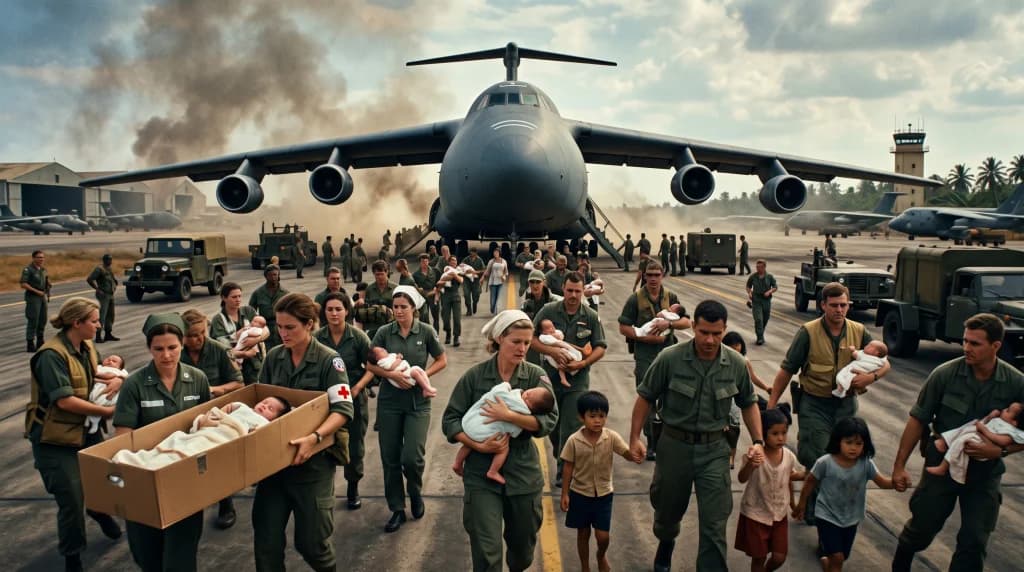
Operation Babylift: The 1975 Orphan Airlift and C-5 Galaxy Disaster
Introduction: Saigon's Final Hours and the Presidential Directive
In the spring of 1975, South Vietnam was consumed by an atmosphere of imminent collapse. Defensive perimeters dissolved daily as North Vietnamese Army (NVA) divisions and Viet Cong units advanced south along Highway 1. In the capital, Saigon, civic panic mounted beyond the reassurance of government broadcasts. Amid hundreds of thousands crowding the city streets stood the most vulnerable demographic: tens of thousands of orphaned children, including thousands born to Vietnamese mothers and American servicemen—known colloquially as bụi đời ("children of the dust"). Facing persistent rumors of reprisal campaigns following a communist victory, the international community mobilized for an urgent humanitarian effort.
On April 3, 1975, United States President Gerald Ford announced the authorization of a complex military air mission: Operation Babylift. Supported by a two-million-dollar emergency allocation, the Military Airlift Command (MAC) of the U.S. Air Force (USAF) mobilized long-range transport assets alongside civilian charter aircraft. The mission objective centered on an air bridge out of Tan Son Nhut Air Base to evacuate over 3,000 children across the Pacific to adoptive families in the United States, Australia, Canada, and Western Europe. However, the first official military mission of this humanitarian campaign would result in one of the most significant hull losses in the operational history of the Lockheed C-5A Galaxy.
Strategic Airlifters at Tan Son Nhut: MAC's Operational Challenge
By early April 1975, Tan Son Nhut Air Base on the perimeter of Saigon was among the most congested and hazardous operational airfields in the world. Runways faced the constant threat of rocket and mortar attacks, while parking aprons were choked with retreating South Vietnamese Air Force (VNAF) aircraft and civilian charters staging diplomatic personnel. Executing an evacuation of infants under these conditions required heavy airframe capacity.
The mission relied on the primary long-range strategic transports in the American inventory:
- Lockheed C-5A Galaxy: The largest military airlifter in the western inventory, powered by four General Electric TF39 high-bypass turbofans. Its double-deck design could accommodate personnel on the upper troop deck above an expansive pressurized cargo hold exceeding 30,000 cubic feet of volume.
- Lockheed C-141A Starlifter: The core strategic workhorse of Military Airlift Command, configured rapidly for aeromedical evacuation (MEDEVAC) litters and passenger seating.
- Boeing 747 and Douglas DC-8: Commercial wide-body and narrow-body aircraft chartered from commercial carriers (including Pan Am, World Airways, and Flying Tiger Line) operating into the combat periphery.
The interior architecture of the C-5A was designed for mechanized military logistics rather than neonatal transport. Dedicated infant restraints, localized pediatric oxygen drops, and standard airline seating were largely absent on the cargo deck. Technicians and crew chiefs improvised rapidly: cargo pallets were locked into deck rails to support field mattresses, infant cribs were fashioned from cardboard supply boxes, and milk bottles were secured under tie-down cargo netting. Civilian volunteers, flight nurses, and evacuating embassy personnel filled every station to care for the children during the overwater transit across the South China Sea to Clark Air Base in the Philippines.
April 4, 1975: The Loss of C-5A Galaxy 68-0218
The initial official military flight of Operation Babylift was scheduled for the afternoon of April 4, 1975. On the ramp at Tan Son Nhut stood Lockheed C-5A Galaxy, tail number 68-0218, commanded by an experienced aircraft commander, Captain Dennis "Bud" Traynor. Over 300 occupants boarded the transport: 145 Vietnamese orphans, medical teams, civilian escorts, and embassy staff on the upper passenger deck, alongside more than 150 infants and caretakers accommodated across the lower cargo deck.
Explosive Decompression over the South China Sea
The transport departed Runway 25L, climbed eastbound, and crossed the Vietnamese coastline out over the South China Sea. Roughly twelve minutes after takeoff, as the airframe climbed through 23,000 feet approximately 40 miles off the coast, catastrophic structural failure struck. A violent metallic disruption tore through the aft fuselage: the airframe experienced an explosive decompression.
Under internal cabin pressure, the rear pressure cargo door and loading ramp tore away from their structural mountings and fell into the ocean. The decompression blast evacuated unrestrained items, filling the cabin with a dense, freezing condensation fog. Critically, as the ramp assembly tore loose, it severed primary mechanical control cables and ruptured multiple hydraulic lines routed through the aft airframe.
Flight Control Degradation: Total Loss of Pitch and Yaw Authority
Captain Traynor and his copilot, Captain Tilford Harp, faced immediate, catastrophic flight control degradation: the aircraft suffered a total loss of all four independent hydraulic systems. The primary elevators and the rudder were completely unpowered, rendering flight deck yoke pitch inputs and rudder pedal deflections entirely ineffective. The crew retained only partial mechanical aileron authority on the wings and dynamic control of the four General Electric TF39 turbofan throttles.
Lacking aerodynamic pitch trim, the C-5A entered a pronounced phugoid oscillation—a cycling exchange between airspeed and altitude where the nose pitched up, bled energy, stalled into a descent, gathered speed, and pitched up again. By managing differential throttle inputs—advancing thrust to introduce a nose-up pitching moment and reducing power to drop the nose—Traynor and Harp manually arrested the descent, reversed heading 180 degrees, and navigated the damaged transport back toward Tan Son Nhut.
Emergency Approach and Impact
The approach to the airfield required continuous energy management. Because the total hydraulic failure prevented the extension of flaps or slats, the crew had to maintain an approach speed significantly higher than the standard $V_{\text{APP}}$ threshold to prevent a low-altitude aerodynamic stall. Gliding down an unstable emergency descent profile, the pilots realized the rate of sink would prevent the airframe from clearing the perimeter to reach the paved runway.
The Galaxy impacted a marshy rice paddy in the Phường Long Bỉnh district, roughly two miles short of the threshold, at an indicated speed near 240 knots. The airframe skipped back into the air, cleared the Saigon River, and disintegrated upon secondary impact into four major sections. The lower cargo compartment was crushed on deceleration. The upper troop deck sheared free from the primary wreckage and tumbled across the mud, maintaining its structural cocoon.
The crash resulted in 138 fatalities, including 78 children and nearly 50 adult personnel and crew members. Through the pilots' throttle management and the crashworthiness of the upper compartment, 175 occupants survived, including the majority of the children seated on the upper deck. Captain Dennis Traynor and Captain Tilford Harp were subsequently awarded the Air Force Cross for airmanship in controlling a hydraulically crippled airframe.
Accident Investigation: The Aft Pressure Door Latching Mechanism
The loss of the opening Babylift mission shocked the public and threatened the immediate cancellation of the air bridge. Investigators from the Air Force Office of Special Investigations (AFOSI) and safety boards were tasked with determining whether the event was caused by hostile fire, an onboard explosive device, or mechanical failure.
Key forensic evidence was recovered from the seabed of the South China Sea. U.S. Navy assets, including salvage vessels and submersibles, located and retrieved the separated cargo ramp components. Analysis of the hardware identified the sequence of failure:
- Latching Mechanism Maintenance: The C-5A aft cargo door relied on a system of mechanical locking hooks and tension ties. Prior maintenance records indicated components had been serviced using parts transferred from other airframes that were not rigged to precise engineering tolerances.
- Improper Rigging and Lock Engagement: Investigators discovered that several cargo door locks had failed to fully seat into their structural pins. While the cockpit annunciator panel registered a closed and locked status, the structural hooks rested only partially engaged.
- Cabin Differential Pressure ($\Delta P$): As the airframe reached 23,000 feet, the differential pressure between the pressurized hold and the ambient atmosphere generated tons of outward force against the rear door assembly. The improperly engaged latches failed sequentially, leading to the explosive loss of the door and ramp structure.
Sustaining the Evacuation: The Role of C-141s and Commercial Airlifters
Despite the disaster of flight 68-0218, the tactical situation in South Vietnam deteriorated rapidly. Communist forces were interdicting supply corridors into Saigon, and suspending the air evacuation would have stranded thousands of dependants. Operational command temporarily grounded C-5A airframes from the mission while Operation Babylift continued.
The operational load shifted to the Lockheed C-141A Starlifter fleet and commercial carriers:
- Starlifter crews conducted "hot-pad" turnarounds at Tan Son Nhut, keeping engines running on the apron during loading to mitigate the risk of artillery destruction on the ground.
- Seating configurations were adapted; toddlers were belted two or three per seat, while smaller infants were secured in cargo pallets outfitted with harness webbing.
- Commercial charter flights operated in parallel; notably, a World Airways flight operated by company president Ed Daly departed under direct fire, evacuating personnel outside standard military processing channels.
By April 26, 1975—four days before the fall of Saigon—the coordinated air bridge had completed more than 30 operational transport sorties, evacuating over 3,300 children to staging points in the Pacific and onward to receiving nations.
Ethical and Political Reassessments
Alongside the tactical execution of the mission, Operation Babylift has been the subject of ongoing historical and ethical analysis. Commentators noted that the speed and chaos of the final days of the war created significant administrative complications:
- Documentation Deficits: A number of evacuated children were not documented orphans. In the chaos of the final advance, some parents surrendered children to care facilities under the belief that evacuation offered physical safety, expecting eventual reunification.
- Political Perspectives: Critics and anti-war organizations questioned the motivation of the Gerald Ford administration, arguing the high-profile humanitarian initiative served as an effort to generate domestic sympathy for supplemental military appropriations for South Vietnam.
- Identity and Heritage: The displacement of thousands of children into foreign families led to subsequent identity challenges. In later decades, adult adoptees formed international networks to research their heritage and trace family connections in Vietnam, an effort often complicated by the destruction of municipal archives in 1975.
Conclusion: Operational Legacy in Aviation History
Operation Babylift remains a complex and poignant chapter in military aviation history. The mission saw heavy strategic transport aircraft—designed to haul armor, artillery, and combat infantry across intercontinental distances—repurposed as high-capacity aeromedical transports to evacuate non-combatants from a collapsing theater.
At military air bases and aviation museums worldwide, the airmanship demonstrated by the crew of flight 68-0218 and the logistics executed across the Tan Son Nhut air bridge remain documented case studies. In the final weeks of a protracted conflict, the operation highlighted the operational flexibility of strategic airlift and the human efforts dedicated to non-combatant evacuation under fire.