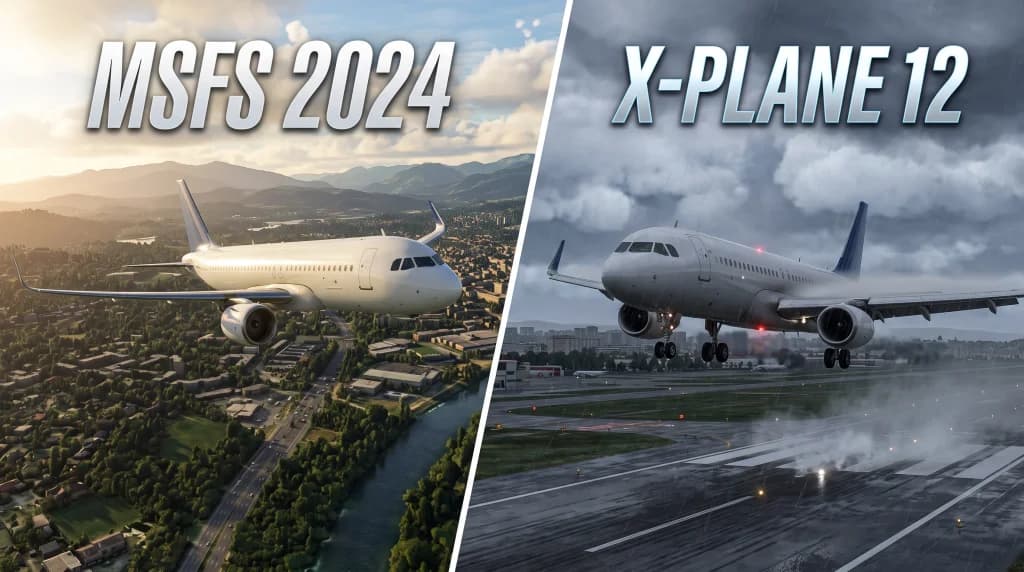
MSFS 2024 vs X-Plane 12: Flight Physics, Visuals, and Systems
Introduction: The Clash of Two Virtual Aviation Philosophies
In the world of civil flight simulation, a quiet yet uncompromising battle has raged for years over the title of the definitive platform for virtual flying. On one side stands Microsoft Flight Simulator 2024 (MSFS 2024), developed by French studio Asobo under the auspices of Microsoft. It is a technological leviathan powered by Azure cloud infrastructure, petabytes of streamed photogrammetry, machine learning, and an unprecedented 1:1 scale digital twin of Earth. On the other side stands an enduring bastion of pure aeronautical engineering: X-Plane 12, the creation of Austin Meyer and the Laminar Research team. This platform has been refined for over a quarter of a century for pilots, engineers, and simmers who prioritize flight dynamics and certifiable aerodynamic fidelity over purely visual spectacle.
For virtual aviators, selecting a primary platform is no longer merely an aesthetic choice. It determines how an airframe responds in critical flight regimes, how the controls feel during wind shear on short final, how deeply systems and hydraulic failures are modeled, and how many gigabytes of memory and bandwidth you must dedicate to the hobby. This head-to-head comparison evaluates both platforms across the three foundational pillars of modern flight simulation: flight modeling and atmospheric physics, visual fidelity and rendering architecture, and avionics systems depth and the third-party add-on ecosystem.
Flight Dynamics and Aerodynamics: Blade Element Theory vs. Advanced CFD
The debate over flight model realism remains the central axis of division between Laminar Research purists and Microsoft Flight Simulator adopters. Both engines address the governing equations of fluid mechanics through distinctly different mathematical paradigms.
X-Plane 12: The Reign of Blade Element Theory (BET)
The foundation of X-Plane has always been Blade Element Theory (BET). Rather than relying on pre-baked performance look-up tables stored in aircraft configuration files, Laminar Research's physics engine dissects the 3D geometry of the airframe—wings, stabilizers, fuselage cross-sections, and individual propeller blades—into dozens of discrete geometric elements. In real time, across compute cycles running at hundreds of Hertz, the engine calculates lift, drag, and moment vectors for every individual segment based on local airflow velocities and angles of attack.
In X-Plane 12, this foundational model received targeted architectural refinements:
- Dynamic Propeller Wash Interaction: Propwash interaction across control surfaces and the fuselage remains a benchmark in XP12. During the takeoff roll in a single-engine aircraft (such as a Cessna 172), spiraling slipstream and asymmetric blade thrust (P-factor) demand immediate, intuitive rudder input.
- Inertia and Mass Distribution: X-Plane 12 conveys the physical mass of an aircraft effectively. Transitioning from a light General Aviation trainer to a heavy widebody transport delivers an immediate sensation of real airframe inertia, particularly during ground-effect flare maneuvers.
- First-Principles Engine Thermodynamics: Fuel consumption curves, cylinder head temperature spikes, carburetor icing, and high-density altitude turbine performance degradation derive directly from thermodynamic equations rather than simplified lookup scripts.
MSFS 2024: Computational Fluid Dynamics (CFD) and Surface Discretization
Earlier iterations of the modern Microsoft platform drew criticism for an "on rails" handling feel that lacked aerodynamic mass and micro-instabilities. In MSFS 2024, Asobo deployed a comprehensive Computational Fluid Dynamics (CFD) framework:
- Extensive Surface Discretization: Aircraft models in MSFS 2024 are mapped across thousands of surface sampling points that interact dynamically with a real-time, simulated 3D airflow vector field enveloping the airframe.
- Soft-Body Aerodynamics and Rotorcraft Dynamics: The updated core engine computes structural aeroelastic wing flex, parachute and aerostat cloth physics, and complex rotorcraft wake behaviors (including Vortex Ring State and true translational lift / Ground Effect).
- Orographic and Structural Terrain Interaction: Atmospheric airflows interact directly with high-resolution digital elevation models, 3D canopy forests, and urban structures. Landing in an alpine valley near a ridge generates realistic downdrafts, mechanical turbulence, and localized wind shear that actively disturb light airframes.
While X-Plane 12 retains an edge in control feedback fidelity at the stall boundary and during uncoordinated spin recovery, MSFS 2024 has closed the gap significantly. For transport-category airliners, handling quality now depends far more on the engineering quality of individual third-party flight models than on engine limitations.
Graphics, Lighting, and World Modeling: Cloud Photogrammetry vs. Photometric Rendering
This category presents two divergent development philosophies: a cloud-streamed planetary digital twin versus a localized simulation engine.
MSFS 2024: The Global Digital Twin and Thin-Client Architecture
MSFS 2024 represents a major milestone in cloud-delivered geospatial visualization. Transitioning away from massive hundreds-of-gigabyte base installations on local SSD storage, the platform utilizes a thin-client architecture. High-resolution Bing Maps aerial orthoimagery, procedural elevation meshes (TIN), photogrammetric city captures, and dynamic 3D biomes are streamed on demand from Microsoft Azure data centers.
The visual outcomes set a high bar for environmental realism:
- Ground Micro-Topography and Biome Detail: Ground surfaces feature procedurally generated volumetric rocks, soil ruts, 3D grass foliage, diverse tree canopies with seasonal variations, and dynamic wheel rutting on unpaved strips.
- Atmospheric Light Scattering: Spectral simulations of Rayleigh and Mie scattering produce sunrises, sunsets, and atmospheric haze that closely mirror views from a flight deck at FL390.
- VFR Navigation Fidelity: Visual Flight Rules (VFR) navigation against real-world sectional charts is seamless in MSFS 2024. Power plants, highway interchanges, landmarks, and river bends are situated in exact real-world positions globally.
X-Plane 12: Photometric Lighting and Physically Based Rendering
Laminar Research views X-Plane primarily as an aeronautical tool rather than an environmental renderer. Nevertheless, X-Plane 12 introduced a substantially re-engineered photometric lighting engine built on physical units (Physically Based Lighting):
- Cockpit Ambient Lighting: Flight deck environments in XP12 exhibit convincing realism. Glass gauge reflections, overhead floodlight diffusion, integral backlighting on instruments, and soft shadows cast by windshield pillars convey genuine cockpit ergonomics without artificial contrast exaggeration.
- Volumetric Water and Wave Dynamics: Water bodies in XP12 are dynamic 3D surfaces with wave height, wavelength, and chop rendered in direct mathematical correlation with surface wind speed and direction—a critical factor for seaplane and flying boat operations.
- Default Scenery Limitations: Ground representation outside airport boundaries remains a noticeable compromise in X-Plane 12. Default scenery relies on regionalized autogen buildings and OpenStreetMap vector footprints. Without add-on orthophoto tiles (via tools like Ortho4XP or commercial scenery packs), rural areas away from bespoke airports appear relatively repetitive when compared to MSFS 2024's global streaming model.
Weather and Atmospheric Modeling: Volumetric Clouds and Convective Fronts
Adverse weather operations provide the ultimate benchmark for simulation accuracy. The two platforms handle atmospheric hazards through distinct methods.
Cloud Systems and Convection
Both simulators utilize volumetric cloud rendering via ray marching, yet their data pipeline and physical modeling diverge:
- MSFS 2024 (Meteoblue Multi-Layer Integration): Utilizing multi-tier predictive weather models from Switzerland's Meteoblue alongside real-time METAR observations, MSFS 2024 generates expansive multi-layered cold fronts, cirrostratus decks at high cruise altitudes, and towering cumulonimbus structures with localized cloud-to-ground lightning and microbursts.
- X-Plane 12 (Dynamic Thermodynamic Simulation): While cloud visuals in XP12 can occasionally appear granular compared to MSFS, its atmospheric model is deeply dynamic. Penetrating a mature thunderstorm cell in X-Plane 12 presents severe operational danger: violent vertical shear vectors can induce structural overstress and wing spar failure, whereas MSFS typically caps destructive structural G-load damage.
Airframe Icing and Anti-Ice Systems
In X-Plane 12, structural airframe icing operates as a continuous physics calculation. Rime and clear ice accumulate on leading edges, Pitot masts, and propeller blades as a function of dew point depression, relative humidity, and supercooled large droplets (SLD). As ice mass accretes, total weight climbs, profile drag escalates, and the airfoil boundary layer separates early—raising approach speeds $V_{\text{APP}}$ and dramatically increasing stall speed. Activating pneumatic de-ice boots or electrical anti-ice surfaces produces a direct, measurable restoration of lift coefficients.
MSFS 2024 has improved visual frost and ice accumulation across window panes and airframes, alongside corresponding aerodynamic drag penalties. However, the cascading systems logic connecting isolated Pitot-static tube blockages to specific instrument anomalies remains deeply integrated within X-Plane 12's core code.
Cockpit Systems and the Add-on Ecosystem: The State of Study-Level Aircraft
The long-term viability of any flight simulation platform is measured by its software development kit (SDK) and the caliber of third-party developers building within its environment.
The X-Plane 12 Ecosystem: A Tradition of Study-Level Engineering
Historically, X-Plane has served as a primary platform for technically complex transport-category projects:
- ToLiss (A319, A320neo, A321, A330, A340): Renowned for Airbus systems fidelity, custom Fly-by-Wire control law integration (Normal, Alternate, and Direct Law), accurate FADEC architecture, and layered electrical and hydraulic failure logic. ToLiss aircraft are widely utilized for supplemental training by type-rated pilots.
- Hotstart (Challenger 650, TBM 900): Among the most intricately modeled general aviation aircraft in simulation history. The Hotstart CL650 models individual electrical bus components, relays, hydraulic valves, thermal dissipation loops, and fluid flow dynamics based on original manufacturer schematics.
- Flight Factor and Felis: Highly detailed classic airliners—such as the Felis Boeing 747-200 Classic—featuring comprehensive flight engineer panel workflows and analog systems logic.
The MSFS 2024 Ecosystem: Broadening Complex Aircraft Coverage
The perception that Microsoft Flight Simulator is limited to simplified avionics has been thoroughly dismantled by modern third-party releases:
- Fenix Simulations (Airbus A320 Family): A landmark add-on utilizing complete external real-world flight computer software running alongside the simulation engine. It delivers advanced systems logic, dynamic hydraulic fluid simulation, and authentic EFIS/MCDU responses comparable to Level-D training suites.
- PMDG (Boeing 737, Boeing 777): An established developer that transitioned its flagship Boeing aircraft families to the platform, providing comprehensive FMC logic, autoflight roll modes, and detailed fuel system management.
- FlyByWire and iniBuilds: Developers delivering high-fidelity modern widebody platforms—exemplified by the complex open-source FlyByWire Airbus A380X—offering advanced systems architecture to the flight simulation community.
MSFS 2024 also includes a fully integrated Aviation Career Mode featuring structured operational missions such as Helicopter Emergency Medical Services (HEMS), aerial firefighting, external sling-load cargo logistics, and agricultural spraying. For pilots seeking mission-driven flight assignments without third-party network coordination via VATSIM or IVAO, MSFS 2024 provides a comprehensive native operational framework that X-Plane 12 does not offer out of the box.
Hardware Performance, Optimization, and Platform Stability
Running high-fidelity flight simulators requires substantial compute performance. Both platforms manage system resources through distinct approaches:
- Network Bandwidth Requirements: MSFS 2024's thin-client architecture conserves local drive capacity by streaming scenery assets, but it demands a fast, stable broadband or fiber-optic connection (50–100 Mbps minimum). Bandwidth drops or server latency can temporarily degrade ground photogrammetry into low-poly meshes. Conversely, X-Plane 12 runs entirely from local storage, making long-haul transoceanic flights immune to network disruptions or cloud server downtime.
- Graphics APIs and Engine Architecture: X-Plane 12 utilizes modern Vulkan (and Apple Metal on macOS) APIs, providing efficient VRAM allocation and consistent frame pacing across both Windows rigs and Apple Silicon hardware (M1/M2/M3/M4). MSFS 2024 utilizes a DirectX 12 foundation with native support for advanced upscaling and frame interpolation pipelines (DLSS 3 Frame Generation, FSR). While it achieves high frame rates on modern hardware, it benefits significantly from high system memory capacities (32 GB to 64 GB recommended for dense add-on airports).
Conclusion: Selecting the Right Platform for Your Flight Deck
Comparing MSFS 2024 and X-Plane 12 is no longer a simple contrast between "scenery" and "physics." Both platforms have evolved into capable, modern flight simulation environments.
Choose Microsoft Flight Simulator 2024 if your flying centers on worldwide VFR cross-country navigation, exploring diverse planetary landscapes, participating in structured aviation careers, enjoying leading-edge airliner add-ons like Fenix or PMDG, and operating with reliable high-speed internet connectivity.
Choose X-Plane 12 if you prioritize core aerodynamic fidelity in critical handling regimes, value deep mechanical failure simulation from developers like ToLiss and Hotstart, prefer a platform that operates completely offline, or fly primarily on Apple macOS systems.
For dedicated simulation enthusiasts, the most rewarding approach is often running both platforms side by side. Each serves distinct operational strengths, and the ongoing competition between them continues to elevate the realism and technical depth of desktop flight simulation for virtual aviators everywhere.