Pan American Flying Boats: The Luxury of 1930s Oceanic Clippers
Introduction: The Golden Age of Transoceanic Aristocracy in the Skies
Today, boarding a long-haul airliner rarely feels like an exalted ceremony. Passengers remove their shoes at airport security, shuffle through crowded jet bridges, and spend a dozen hours sealed inside a pressurized aluminum tube eleven kilometers above the earth, staring at seatback screens and sipping drinks from plastic cups. In the 1930s, however, crossing an ocean by air was an entirely different affair. It was an era before reinforced concrete runways capable of handling multi-engine giants existed, when crossing the North Atlantic or the boundless expanse of the Pacific represented the most elite, adventurous, and opulent travel experience modern civilization could offer.
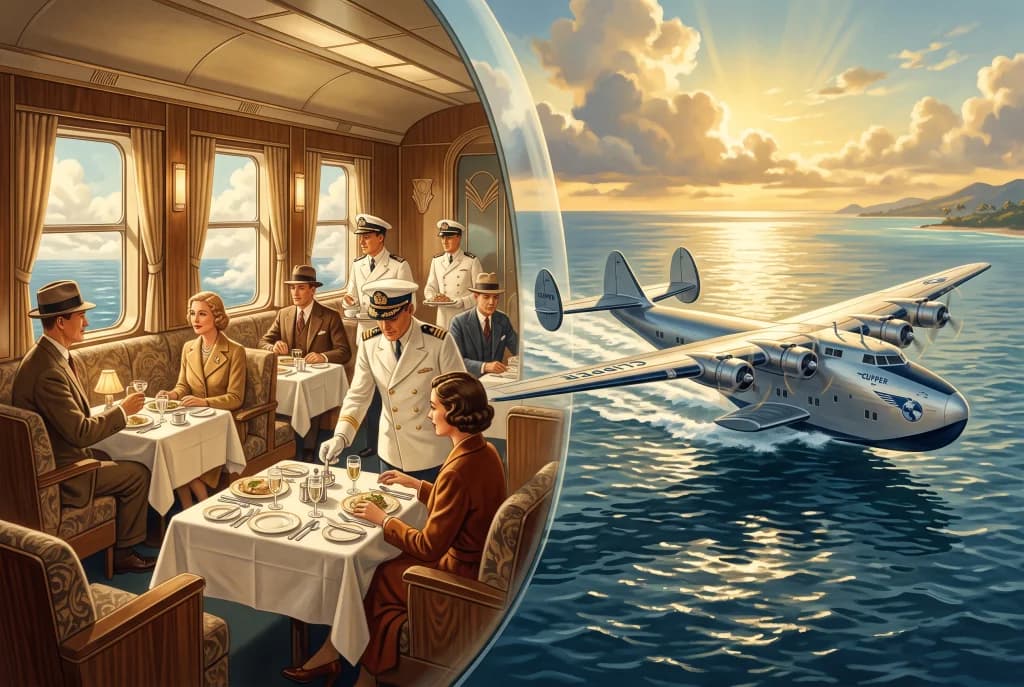
During that pioneering decade, the undisputed icons of global reach and refined luxury were the flying boats of Pan American Airways, proudly christened the Clippers. Pan Am's visionary founder, Juan Trippe, was not merely building an airline; he was creating a dynamic aerial equivalent of ocean liners such as the Queen Mary and the Normandie. Passengers did not simply board an airplane—they walked up mahogany gangways onto flying maritime vessels, greeted by saluting officers in tailored naval whites. Inside lay walnut-paneled passenger salons, multicourse meals served on fine Rosenthal china with heavy silverware, seats that converted into curtained sleeping berths with damask linens, and operating crews trained in strict naval discipline.
A round-trip ticket aboard a Clipper cost as much as a new automobile or an engineer's full annual salary. For a select group of diplomats, industrial magnates, royalty, and Hollywood figures, it provided entry into a vanished chapter of travel. Step back into the world of Pan American's flying boats—the Sikorsky S-42, the Martin M-130, and the legendary Boeing 314—where celestial navigation with a hand-held sextant converged with lobster thermidor and vintage champagne at eight thousand feet.
The Clipper Fleet: From Sikorsky Pioneers to the Sovereign Boeing 314
Before Juan Trippe could offer dining salons above transoceanic waves, aviation engineers had to circumvent the aerodynamic and structural limits of the period. In the early 1930s, constructing two-kilometer concrete runways on remote coral atolls across the Pacific or the Caribbean was financially and logistically impossible. Water, by contrast, offered an endless, natural landing surface accessible in nearly every port of call. This practical reality gave birth to commercial aviation's marine giants.
1. Sikorsky S-42: Opening the Caribbean and South America
Pan American's first truly modern long-range flying boat was the Sikorsky S-42, which entered service in 1934. Conceived by Russian-American aviation pioneer Igor Sikorsky, the four-engine, all-metal parasol monoplane accommodated up to 32 passengers on day flights or 14 in a sleeper layout. While modest in size compared to its successors, the S-42 introduced key operational standards: mineral-wool acoustic insulation, upholstered reclining armchairs, and dedicated dressing rooms with running water.
2. Martin M-130: Conquering the Pacific and the Legend of the "China Clipper"
In 1935, Pan American introduced the Martin M-130. The first airframe delivered, named the China Clipper, quickly captured international public imagination. With a maximum takeoff weight exceeding 23 tons and a range of over 5,100 kilometers, the M-130 pioneered the use of aerodynamically profiled hull sponsons (known as sea wings) instead of conventional wingtip floats. These sponsons stabilized the hull on water, housed auxiliary fuel tanks, and provided a boarding platform for passengers. The Martin M-130 inaugurated the historic six-day island-hopping air route across the Pacific from San Francisco to Manila.
3. Boeing 314 Clipper: The Peak of Maritime Passenger Aviation
The definitive benchmark of flying-boat luxury arrived with the Boeing 314, of which Pan Am ordered twelve units, entering scheduled service in 1939. Featuring a wingspan of 46.3 meters—wider than a contemporary Boeing 737—and a maximum takeoff weight of 38 tons, it was the largest commercial passenger aircraft of its era. Powered by four 14-cylinder Wright R-2600 Twin Cyclone radial engines producing 1,600 horsepower each, its double-deck hull resembled an ocean yacht:
- Upper Deck (Flight Deck and Crew Accommodations): A dedicated flight crew compartment with separate stations for two pilots, a navigator, a radio officer, and two flight engineers, complete with a private crew rest area and sleeping bunks.
- Lower Passenger Deck: Configured into five distinct passenger compartments, a central fourteen-passenger dining salon and lounge, a fully equipped commercial galley, separate men's and women's dressing rooms, and an aft private compartment known as the De Luxe Bridal Suite with an en-suite lavatory.
The Pacific Crossing: Six Days of Island-Hopping Adventure
To grasp the scale of early transoceanic flight, consider Pan American's signature transpacific route from San Francisco to Manila. Modern airliners complete this journey nonstop in roughly fourteen hours. In 1936, aboard a Martin M-130 or later a Boeing 314, the crossing was an epic six-day expedition covering more than 13,000 kilometers.
Developing Remote Island Infrastructure
Because flying boats did not operate across open oceans at night for safety reasons and the limits of nighttime celestial navigation in overcast weather, Juan Trippe developed the route from the ground up. Pan Am chartered the supply freighter North Haven, sailed across the Pacific, and constructed dedicated landing bases and marine facilities on remote coral atolls: Honolulu (Hawaii), Midway Island, Wake Island, and Guam.
On Wake and Midway, the airline erected prefabricated luxury hotels known as Pan Am Outposts. These stations featured air conditioning, freshwater distillation plants, power generators, refrigerated pantries, and even short golf layouts built over rolled coral sand. Each late afternoon, the Clipper landed on the calm waters of the lagoon and secured to a floating dock. Motor launches ferried passengers ashore to the hotel for a hot bath, multicourse dinner, and an overnight stay in a conventional bed. At dawn, following a breakfast of eggs and bacon, passengers returned to the slipway for the next flight leg.
The Price of Aerial Exclusivity
A round-trip ticket between San Francisco and Manila in 1936 was priced at $1,438. During the Great Depression, when the average American annual wage hovered around $1,300 and a new Ford V8 cost roughly $600, this represented a major financial expenditure—equivalent to roughly $32,000 to $35,000 today. The passenger manifest typically featured ambassadors, corporate executives, publishing tycoons, film celebrities, and high-society travelers.
Etiquette and Haute Cuisine: A Fine Hotel at 8,000 Feet
Onboard service aboard Pan American's ocean Clippers established hospitality benchmarks that remain unique in commercial aviation history. Long before freeze-dried ingredients and convection ovens became standard, food service mirrored high-end European dining.
1. Dining Under the Auspices of Paris Chefs
The galley of the Boeing 314 was staffed by two professional flight stewards recruited from prominent European and American hotels. Menus were developed in partnership with the celebrated Hôtel Ritz Paris. Meals were prepared fresh in an onboard galley equipped with steam tables, insulated iceboxes, and warming ovens.
Dining was a formal communal affair rather than meal service at one's seat. Passengers moved into the central dining salon, which seated fourteen guests per sitting. Tables were set with crisp white linen cloths, custom silver plate bearing the Pan Am insignia, and patterned Rosenthal porcelain. A typical dinner service might include:
- Terrine de foie gras and Beluga caviar on toasted canapés,
- Clear turtle soup or cream of asparagus with truffles,
- Lobster Thermidor glazed with Gruyère and Dijon mustard,
- Roast tenderloin of beef with red wine reduction and fresh garden vegetables steamed onboard,
- Crêpes Suzette flambéed with Grand Marnier table-side from a rolling cart,
- Vintage Bordeaux wines, Dom Pérignon champagne, after-dinner liqueurs, and fine cigars.
2. The Evening Transformation: Armchairs to Sleeping Berths
On transatlantic crossings between New York and Southampton or Marseille, which operated around the clock, the Clipper took on a different character in the evening. Around 21:00, stewards converted the main passenger cabin. The wide, plushly upholstered seats unfolded into flat berths, while upper bunks counterbalanced down from the curved overhead ceiling—mirroring Pullman railroad sleeping cars.
Each berth measured more than two meters in length and nearly a meter in width, fitted with inner-spring mattresses, Egyptian cotton sheets, wool blankets, and goose-down pillows. Heavy velvet curtains provided acoustic and visual privacy. Passengers changed into sleepwear in the dressing rooms—the ladies' lounge included vanity tables, mirrors, and Guerlain cosmetics—while a steward collected, polished, and returned their dress shoes before morning call.
Life in the Air: Salons, Bridge Tournaments, and Window Views
Commercial flying boats in the 1930s operated without pressurized cabins. Operating altitudes rarely exceeded 8,000 to 10,000 feet (2,400 to 3,000 meters). Inside, passengers breathed air at normal sea-level pressure, avoiding the low humidity and mild hypoxia common in modern high-altitude operations. Flying at lower altitudes provided sweeping views of ocean swells, passing cargo vessels, and coastal coral reefs.
Thanks to the wide cross-section of the Boeing 314's hull, passengers moved freely about the aircraft. Social life centered on the main salon, where travelers held bridge matches, played chess, and wrote correspondence on Pan Am stationery—subsequently marked with official Clipper Mail cachets. Acoustic insulation materials developed by the Soundproofing Corporation kept cabin noise levels low enough to carry on normal conversation without raising one's voice.
Naval Tradition on the Flight Deck: Maritime Command and Celestial Navigation
A distinctive aspect of Clipper operations was its operational philosophy. Deeply influenced by the United States Navy, Juan Trippe structured Pan American around maritime command principles and terminology rather than traditional terrestrial aviation models:
- The Pilot-in-Command held the title of Captain, with authority patterned after merchant marine ship masters, wearing double-breasted navy blue tunics with gold braid and peaked white officer caps.
- Airspeed was logged in knots, and flight distances were recorded strictly in nautical miles.
- The aircraft's layout was documented as port, starboard, galley, bulkheads, and bilge.
- During water taxiing, the captain directed maneuvers using engine bells and marine docking terminology, while bowmen handled mooring lines and drogue sea anchors from the forward hatch.
The Navigator and the Astrodome
A standard Boeing 314 flight crew comprised ten to eleven personnel. On long oceanic sectors, the navigator held primary operational responsibility for pathfinding. In an era without GPS, radar, or transoceanic radio beacons, locating an aircraft's position over open water relied on dead reckoning and celestial mechanics.
A clear observation dome—the astrodome—was set into the upper hull of the flight deck. The navigator climbed up, unlatched the viewing station, and used a bubble sextant to measure the elevation of celestial bodies above the horizon. Back down at the chart table, accounting for calculated airspeed and estimated wind drift, they drafted lines of position across maritime plotting sheets. A deviation of two degrees over a long ocean leg could mean missing a refueling point like Wake Island by a hundred miles, with serious consequences as fuel reserves dwindled.
In-Flight Engine Access Corridors
Equally notable was the role of the flight engineers. The wings of the Boeing 314 were so thick—standing roughly 1.8 meters tall at the root—that engineers could access internal wing crawlways during flight. A flight engineer could crawl inside the wing structure, open an inspection door behind an operating Wright Cyclone engine, and examine fuel lines, oil lines, and magneto linkages while airborne over the ocean. Minor in-flight mechanical adjustments were part of normal operating procedures.
The Sunset of the Flying Boats: How World War II Ended the Clipper Era
The golden era of the luxury commercial flying boat was brief. The outbreak of World War II fundamentally altered long-range civil aviation, bringing about rapid technological shifts that superseded these prewar marine giants.
1. Military Requisition and Wartime Operations
Following the attack on Pearl Harbor in December 1941, the federal government requisitioned Pan American's Clipper fleet for the military. The famous Pacific Clipper (a Boeing 314), cut off by advancing forces in the Pacific, completed an improvised 50,000-kilometer circumnavigation via Asia, Africa, and South America to return to New York safely. Plush upholstery, china, and linen gave way to utilitarian transport configurations carrying military leadership, couriers, and high-priority cargo—including President Franklin D. Roosevelt's trip to the 1943 Casablanca Conference.
2. The Global Proliferation of Concrete Runways
The strategic factor that rendered flying boats obsolete was the rapid global expansion of paved runways. Between 1939 and 1945, allied forces built thousands of heavy-duty concrete runways on remote islands across the Pacific, through the Azores, and across Greenland, Europe, and North Africa. The foundational advantage of flying boats—operating without prepared airfields—was no longer required.
3. The Rise of Landplanes: Douglas DC-4 and Lockheed Constellation
From an aerodynamic standpoint, flying boats involved notable structural compromises. The deep-V hull, step, sponsons, and upswept empennage generated substantial parasitic drag. As manufacturers introduced modern landplanes like the Douglas DC-4 and the pressurized Lockheed Constellation, land-based aircraft proved far more efficient. They flew 100 to 150 km/h faster, burned less fuel per passenger-mile, cruised above weather at 20,000 feet, and cost significantly less to maintain.
Operating flying boats in salt water presented ongoing maintenance challenges: duralumin airframe corrosion, wave-impact stresses during water takeoffs, and the logistical burden of marine bases. By 1946, scheduled transoceanic passenger flying boat services had drawn to a close. Pan American retired its marine fleet and transitioned to land-based Constellations and DC-6s.
Conclusion: An Unmatched Chapter in Passenger Aviation
Pan American's flying boats remain a distinctive chapter in the history of transport—a period when the journey was an event in itself rather than simple transit between destinations. They served as a bridge between the ocean-liner era and modern long-haul air travel.
None of the twelve Boeing 314s built survive today; the airframes were scrapped, scuttled after structural retirement, or lost during testing in the late 1940s and early 1950s. What remains are archival photographs, gilded menus, pilot logs, and the enduring heritage of the Clippers. These aircraft set early standards for international air travel, showing that even over thousands of miles of open ocean, aviation could deliver remarkable comfort, hospitality, and classic style.