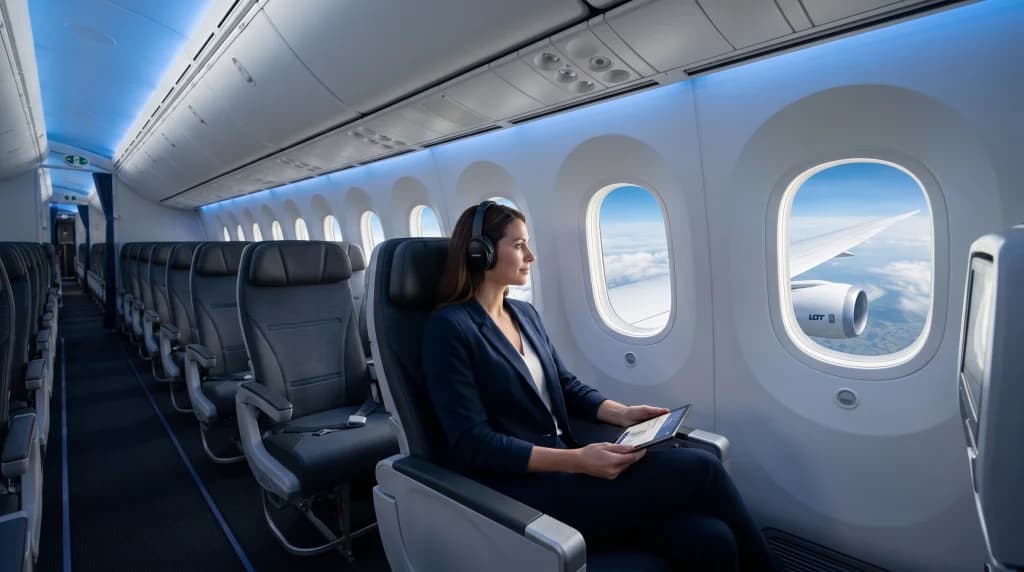
The Art of Seating on the Dreamliner: The Quietest, Smoothest Rows
Introduction: The Physics and Anatomy of Comfort Aboard the Boeing 787
For many travelers, seat selection comes down to a basic dilemma: window or aisle. Those seeking panoramic vistas and a bulkhead surface to rest against while sleeping opt for the window without hesitation. Conversely, passengers who value freedom of movement, extra leg space into the gangway, or unimpeded lavatory access instinctively choose the aisle. When boarding an intercontinental long-haul service spanning ten, twelve, or fourteen hours aboard the wide-body Boeing 787 Dreamliner, however, that binary mindset proves to be a costly mistake. The precise row and seat you select dictate whether you disembark refreshed or with an aching lower back and sensory fatigue.
The Dreamliner remains an engineering breakthrough that redefined ultra-long-haul flight. Built with an airframe comprising 50% carbon-fiber composite materials, it allowed Boeing's design teams to pressurize the cabin to an equivalent altitude of 6,000 feet (1,800 meters)—compared to the 8,000-foot industry baseline typical of legacy aluminum airframes—while doubling cabin relative humidity and incorporating oversized, electrochromic dimming windows. Yet even inside this high-tech composite envelope, the fundamental laws of aerodynamics, structural mechanics, and acoustics hold absolute sway. The passenger deck is far from uniform: sound pressure levels can vary by well over 10 decibels between forward and aft stations, while vertical acceleration during atmospheric turbulence increases noticeably the further one sits from the center of gravity. Decoding the acoustic and aerodynamic map of the 787 transforms a standard economy ticket into an experience rivaling higher cabin tiers.
The Dreamliner Acoustic Profile: Finding Restful Silence
The General Electric GEnx-1B and Rolls-Royce Trent 1000 high-bypass turbofans powering Dreamliners sport distinctive serrated trailing edges on their nacelle exhaust nozzles—known throughout the industry as chevrons. Their express purpose is to smooth the shearing boundary layer where hot core exhaust gases meet bypass fan air, slashing perceived engine exterior noise by up to 60% compared to legacy airframes like the Boeing 767. Even so, two massive powerplants generating over 300 kN of thrust apiece represent substantial acoustic power sources.
Understanding how sound propagates through the cabin reveals clear acoustic zones:
- Forward of the Engines (Rows 1–15): An acoustic sweet spot. Because the aircraft cruises at high subsonic velocities (approximately Mach 0.85), combustion noise and jet exhaust wake are effectively left behind the airframe. The forward section receives primarily the muted hum of the forward fan case and aerodynamic boundary-layer air rushing over the radome. Ambient noise here hovers around a restful 68–72 dB. Passengers in business class or the forward rows of Premium Economy can converse comfortably without raising their voices.
- Directly Over the Wing Box (Rows 16–25, depending on carrier configuration): The soundscape shifts perceptibly. You sit directly abreast of a high-bypass fan spanning nearly 3 meters in diameter. Mid-frequency fan wash and low-frequency vibrations transmitted through the structural wing spar dominate the local environment. Furthermore, during intermediate descent and landing configurations, mechanical actuator sounds from flap tracks and airflow rushing over deployed flight spoilers add transient acoustic spikes.
- Aft of the Trailing Edge to the Tail Cone (Row 26 to the rear pressure bulkhead): The loudest sector of the aircraft. Seats here sit directly within the acoustic cone of the engine jet exhaust wash. Noise manifests as a deep, low-frequency rumble that gradually accelerates sensory fatigue over a long sector. In the final rows, noise levels during high-speed cruise often climb to 80–85 dB, making high-performance Active Noise Cancelling (ANC) headphones essential.
The Physics of Turbulence: Why the Empennage Swings
In structural terms, a commercial transport airframe in flight behaves as an elastic beam supported at a dynamic balance point: the Center of Gravity (CG), closely aligned with the aerodynamic center of lift located across the central wing box where the wings mate with the fuselage keel.
When a Dreamliner navigates Clear Air Turbulence (CAT) or crosses jet stream shear boundaries, the physical displacement experienced varies dramatically across cabin sections:
1. The Fulcrum of Stability: Rows Over the Wing
The seating block spanning the wing chord (generally rows 14–24 on standard B787-8 and B787-9 cabin arrangements) offers the most stable ride for travelers sensitive to motion sickness or turbulence anxiety. The airframe rotates around its center of gravity much like a playground seesaw pivoting on its central axis. Over the center wing box, vertical displacement amplitudes are minimized. Rather than sharp upward or downward drops, occupants feel muted, dampened undulations.
2. The Forward Fuselage: Direct and Crisp Damping
Seats situated in the forward fuselage ahead of the wings encounter turbulence directly, but the ride remains relatively benign. Vertical gusts displace the nose up or down in linear motions that are quickly countered by the aircraft's advanced digital fly-by-wire flight control surfaces.
3. The Aft Fuselage: The Moment-Arm Multiplier
The farther aft your seat is located, the longer the moment arm becomes relative to the center of gravity. In the last ten rows of a Dreamliner, localized atmospheric eddies produce pronounced vertical displacements. Worse, the empennage is subjected to combined lateral oscillations and yawing motions—a classic dynamic known as Dutch roll. While the automated yaw damper system applies rapid rudder corrections to counter this motion, passengers in the rear cabin still perceive subtle lateral tail-wagging. For a passenger prone to vestibular disorientation, the aft rows represent a challenging environment.
The 787's Secret Weapon: Smooth Ride Technology
No analysis of Dreamliner ride dynamics is complete without examining its integrated active load alleviation system: Smooth Ride Technology.
The system utilizes dedicated micro-pressure sensors flush-mounted in the nose radome. These pitot-static sensors register subtle shifts in vertical wind gusts milliseconds before the turbulence impacts the lifting surfaces. Onboard flight computers interpret these pressure transients instantaneously, commanding micro-deflections of the flaperons, ailerons, and flight spoilers along the flexible carbon-composite wings. This dynamic surface deflection offsets aerodynamic lift spikes and dampens vertical accelerations by up to 30%. While this active software dampening operates effectively throughout the hull, the immutable laws of structural mechanics mean it yields its greatest stabilization benefits nearest the aircraft's center of gravity.
Row-by-Row Analysis: A Functional Guide to 787 Seating
Most commercial operators field two primary Dreamliner variants: the B787-8 (baseline variant, 56.7 m in length) and the popular stretched B787-9 (62.8 m in length). While interior finishes vary across airlines (such as LOT Polish Airlines, Qatar Airways, British Airways, or United), functional cabin layouts share consistent characteristics.
1. Exit Rows: Generous Legroom at the Cost of Acoustic Isolation
Seats positioned at emergency exit doors (typically at Door 2 or Door 3 stations) are prized for their expansive legroom, providing unrestricted extension without a seat back directly ahead. However, travelers should weigh several trade-offs:
- Cold Drafts: Emergency exit hatches incorporate thinner acoustic and thermal insulation packages than standard fuselage walls. At FL410, where outside air temperatures drop to -55°C, cool drafts are noticeable along the perimeter floorboards.
- High-Frequency Wind Noise: Aerodynamic flow across the structural seals of the exterior door perimeter generates a characteristic high-frequency hiss that persists throughout the cruise phase.
- Zero Under-Seat Storage: All personal items and carry-on bags must be stowed in overhead bins for takeoff and landing.
- Narrower Usable Cushion Width: Tray tables and in-flight entertainment (IFE) monitors are stowed directly within the armrests, making them rigid and reducing seat width by roughly 2 to 3 centimeters.
2. Bulkhead Rows: Unhindered Recline versus Bassinet Proximity
Seats positioned immediately behind structural cabin dividers or galley bulkheads prevent any passenger ahead from reclining into your personal space. However, these specific partition walls incorporate structural hardpoints for infant bassinets. The statistical probability of spending a transatlantic flight within arm's reach of a restless infant is highest in these specific rows.
3. The Red Zone: The Final Rows of the Aft Cabin
The final three to four rows of a Dreamliner (e.g., rows 30–33 on the B787-8, or rows 40–43 on the B787-9) combine virtually every cabin drawback:
- Maximum ambient sound levels from engine exhaust flow and boundary layer turbulence.
- Amplified vertical and lateral accelerations during convective turbulence encounters.
- Foot traffic from passengers queueing for aft lavatories, repeated galley cart collisions against outer seat corners, and latch noise from lavatory doors.
- Restricted recline angles caused by proximity to the aft pressure bulkhead or galley partitions.
- Extended wait times during disembarkation via forward jetways.
The Impact of Seating Geometry: The 3-3-3 Standard
During the initial development of the 787, Boeing originally envisioned an eight-abreast 2-4-2 layout in economy class, yielding a spacious seat width exceeding 18.5 inches (47 cm). Commercial airline yields ultimately dictated otherwise, and virtually all global carriers (with rare initial exceptions, such as Japan Airlines) adopted a denser 3-3-3 cross-section.
This shoehorns nine passenger seats across a cabin cross-section measuring 5.49 meters wide. As a result, standard Dreamliner economy seat widths typically measure between 17.1 and 17.3 inches (43.5 cm), paired with narrower aisle clearances. Understanding seat placement within this geometry helps mitigate space constraints:
- Seats B and J (Middle Seats in Window Triples): The least flexible positions. Occupants are boxed in between a window passenger and an aisle occupant on either side.
- Seat E (Middle Seat in the Center D-E-F Bank): Counterintuitively, Seat E provides better functional odds than B or J. If you need to exit during cruise, you have two potential egress paths—meaning you can slip past whichever aisle neighbor happens to be awake, cutting your chances of disturbing a sleeping seatmate in half.
The Ideal Seat: Practical Recommendations
Synthesizing acoustics, aerodynamic stability, and cabin ergonomics highlights clear sweet spots across the Dreamliner deck.
Optimal seating strategies for the Boeing 787:
- Top Economy Compromise (Quiet and Balanced): The forward economy rows positioned directly behind Premium Economy but ahead of the wing root leading edge (typically rows 7–12, varying by airline cabin map). These rows offer quiet flight, modest motion displacement, and prompt cabin meal service.
- Maximum Stability (Turbulence-Sensitive Flyers): Seats positioned directly over the main wing spar in the central triple block (seats D, E, F across rows 18–22). The aircraft exhibits its lowest angular displacement here, providing the steadiest ride during rough air.
- Rows to Avoid: The final two rows in the tail cone and the row immediately forward of mid-cabin lavatory complexes (where recline is often locked out, foot traffic is high, and cabin lighting frequently interrupts rest).
Conclusion: Informed Seat Selection Maximizes the Dreamliner Experience
The Boeing 787 Dreamliner delivers an advanced passenger environment where long-haul flying is notably less exhausting—provided you do not leave your seat assignment to the chance algorithms of automated online check-in. Moving forward or backward by a dozen rows fundamentally changes how you perceive the flight, turning a loud, jarring journey into a quiet, smooth ride.
Before confirming your next intercontinental booking, pull up the specific carrier's seat layout, cross-reference the wing planform, note galley and lavatory placements, and factor in the underlying physics of flight. Harnessing an understanding of how this composite airframe behaves at cruising speed will help you select the ideal seat, sleep soundly across oceans, and touch down ready for the day ahead.