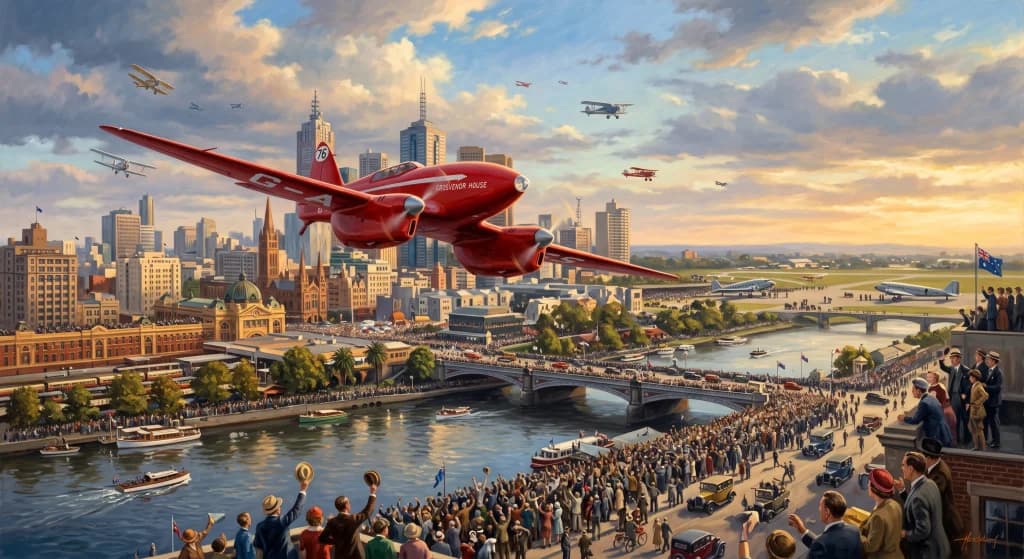
The 1934 London-Melbourne Air Race: The Birth of Modern Aviation
Introduction
Today, traveling between London and Melbourne aboard an ultra-modern Boeing 787 or Airbus A350 takes less than twenty-four hours in a pressurized, climate-controlled cabin complete with high-speed Wi-Fi and chilled champagne. In the early autumn of 1934, however, air travel linking the heart of the British Empire to the Australian continent over 18,000 kilometers away was an epic, multi-week expedition fraught with peril. Passengers flying Imperial Airways endured slow, fabric-covered biplanes such as the Handley Page H.P.42 and Armstrong Whitworth Atalanta, staging through dozens of unpaved airstrips across Europe, the Middle East, and British India. A one-way journey routinely lasted twelve to fourteen days, with passengers overnighting at colonial rest houses along the route.
That status quo shattered because of one visionary philanthropist and the catalyst of sporting rivalry. Sir Macpherson Robertson—an Australian confectionery magnate who amassed a fortune manufacturing MacRobertson's chocolates—pledged an astronomical prize purse of £15,000 in gold (equivalent to millions of pounds today) along with a solid gold trophy to commemorate the centenary of the State of Victoria. Thus was born the MacRobertson Air Race of 1934: the Great London-to-Melbourne Air Race. Conceived to celebrate British aeronautical supremacy, it became a dramatic clash of competing design philosophies and the technical turning point that laid the foundation for modern air transport.
The Rules of Engagement: A Grueling Corridor Across Three Continents
The regulations established by the Royal Aero Club were demanding and unforgiving. The course covered exactly 18,240 kilometers (11,330 miles), traversing Central Europe, the deserts of the Levant and the Persian Gulf, the Indian subcontinent, the dense monsoonal jungles of Burma and Siam, the Dutch East Indies, the treacherous Timor Sea, and finally the arid wastes of Australia's Northern Territory.
Organizers established five mandatory Control Points where every entrant was required to land, register their logbook, and undergo technical verification:
- Baghdad (Iraq) – Gateway to desert expanses and blinding dust storms.
- Allahabad (India) – Heart of the subcontinent, testing engines against tropical heat and oppressive humidity.
- Singapore (Malaya) – Staging base prior to crossing the equatorial island archipelagos.
- Darwin (Australia) – First landfall on Australian soil following the hazardous overwater transit of the Timor Sea.
- Charleville (Queensland) – Final refueling depot before the sprint south across the outback.
The official finish line was set at Flemington Racecourse in Melbourne. The contest featured two distinct divisions: the outright Speed Race and the Handicap Race, engineered to balance aircraft size, payload, and power to favor commercial utility. Twenty-two optional intermediate refueling airfields were authorized, but every minute lost idling on the apron eroded a competitor's standing.
A Clash of Doctrines: Handcrafted Wood Versus Stressed-Skin Metal
While sixty-four entrants initially registered from across the globe, twenty machines lined up on the grass at RAF Mildenhall in Suffolk at dawn on October 20, 1934. The technological diversity was startling: vintage British fabric biplanes and light sporting tourers sat alongside monoplanes that seemed to belong to an entirely different era.
1. The De Havilland D.H.88 Comet: Britain's Thoroughbred Racer
Confronted by the fact that Britain possessed no production aircraft capable of winning the high-speed division, the de Havilland Aircraft Company undertook an extraordinary engineering gamble. In nine months, the company designed and fabricated three bespoke prototypes: the D.H.88 Comet. It was an aerodynamic marvel: a low-wing, cantilever monoplane constructed of spruce and balsa wood clad in stressed birch plywood skin. Powered by two specially tuned De Havilland Gipsy Six R racing engines producing 230 hp each, it featured retractable undercarriage and two-position Ratier variable-pitch propellers. The aircraft accommodated two pilots squeezed into a tandem cockpit set behind massive fuselage fuel tanks. It was built for one express purpose: to sustain cruise speeds exceeding 350 km/h and win the speed division at all costs.
2. The Douglas DC-2 "Uiver": The Modern Airliner Takes Flight
Occupying the opposite philosophical pole was the aircraft that drew skepticism from British traditionalists: a factory-standard, twin-engine Douglas DC-2 operated by Royal Dutch Airlines (KLM), christened Uiver (Stork). The machine represented American production engineering at its peak: an all-metal, stressed-skin duralumin structure with flush riveting, split trailing-edge flaps, and two 710 hp Wright Cyclone radial engines. Remarkably, the Dutch team, commanded by veteran KLM captain Iwan Smirnoff, entered the race in full commercial airline trim: flying with a crew of three, an in-flight steward serving hot meals, roughly thirty thousand pieces of international mail, and three fare-paying passengers in the cabin.
3. The Boeing 247D: A Transatlantic Contender
American aeronautical design was further represented by a modified Boeing 247D entered by aviators Roscoe Turner and Clyde Pangborn. While slightly more compact than the Douglas, the 247D featured sleek all-metal construction, streamlined cowlings, and proven Pratt & Whitney Wasp engines, positioning it as the DC-2's direct rival for commercial honors.
The Race Unfolds: Grit, Fatigue, and Equatorial Monsoons
At dawn on October 20, 1934, sixty thousand spectators looked on as the scarlet D.H.88 Comet named Grosvenor House, piloted by Charles W.A. Scott and Tom Campbell Black, departed Mildenhall as the race favorite.
The opening legs triggered widespread attrition. Heavy weather over Europe, severe icing, and low stratus clouds crippled several crews, pushing airmen to the limits of endurance:
- Crisis in the Comet: Scott and Black flew without sleep, sustained by amphetamines. Their D.H.88 set blistering records, touching down in Baghdad after twelve hours of continuous flight. Across the Bay of Bengal toward Darwin, disaster loomed: oil lines ruptured, and one Gipsy Six began shedding oil pressure and smoking heavily. The pilots throttled the failing engine back to idle, nurse-flying on a single power unit for hundreds of miles across open ocean while hoping the wooden airframe would withstand the severe vibration.
- Airline Routine on the "Uiver": Concurrently, KLM's DC-2 progressed with operational regularity. While sports-plane pilots shivered in drafty wooden cockpits wearing flight goggles and sheepskin leathers, passengers aboard the Uiver enjoyed multi-course dining served on fine porcelain, drank coffee, and rested on reclining upholstered armchairs within a soundproofed cabin. Captain Smirnoff adhered to established navigation schedules, maintaining a predictable flight regime.
The Miracle at Albury: A Town Lights the Way
The race's most dramatic episode took place mere hundreds of kilometers short of Melbourne. While Scott and Black had already limped their crippled Comet across the finish line—winning the speed division in an astonishing 71 hours and 18 seconds—the Dutch DC-2 was intercepted by a violent thunderstorm over the mountain ranges of New South Wales.
On the night of October 23–24, severe electrical discharges and torrential rain blinded the crew. Atmospheric static disabled the aircraft's radio direction finder, and downdrafts pushed the transport toward ridgelines in zero visibility. Fuel was running out. Smirnoff circled through the darkness, aware that fuel exhaustion and an off-field impact were minutes away.
What followed became aviation legend. Residents in the rural town of Albury heard an unseen twin-engine transport circling within the low overcast. An engineer at the municipal power substation devised an ingenious solution: by manually cycling the town's primary power grid circuit breakers, he flashed the streetlights in Morse code to spell out A-L-B-U-R-Y. Simultaneously, regional radio station 2CO interrupted its programming, urging motorists to rush to the local racecourse. Over a hundred townspeople drove onto the sodden turf, aligning their vehicles in two parallel rows to illuminate a makeshift runway with their headlights.
Smirnoff spotted the beams slicing through the deluge and brought the multi-ton Douglas down onto the muddy turf. The landing gear sank to its axles in wet clay, but everyone on board was unhurt. The following morning, townspeople used ropes and muscle to pull the heavy DC-2 out of the mud. After offloading the passengers and part of the cargo to lighten the airframe, Smirnoff executed a short-field takeoff from the grass and touched down in Melbourne less than two hours later, securing second place in the Speed Race and first place in the Handicap Division with an elapsed time of 90 hours and 17 minutes.
Analysis of Results: A Sporting Feat, an Industrial Watershed
While Great Britain claimed the gold trophy through the endurance of the de Havilland crew, industry observers recognized the true victor. Turner and Pangborn crossed the line third in their Boeing 247D (92 hours and 55 minutes).
The final standings underscored an immense technological shift:
- 1st Place (Speed): De Havilland D.H.88 Comet – 70 hrs 54 min (air time) / 71 hrs 00 min (elapsed time) – a purpose-built racing prototype with zero commercial utility.
- 2nd Place (Speed) / 1st Place (Handicap): Douglas DC-2 "Uiver" – 81 hrs 10 min (air time) / 90 hrs 17 min (elapsed time) – a standard production airliner carrying passengers, freight, and mail.
- 3rd Place (Speed): Boeing 247D – 85 hrs 53 min (air time) / 92 hrs 55 min (elapsed time) – an off-the-shelf, all-metal American airliner.
The Legacy: How the Race Forged Modern Commercial Flight
The repercussions of the MacRobertson Air Race were immediate and global. The operational metrics achieved in October 1934 served as a wake-up call to European airline executives and the British Air Ministry alike.
1. The Twilight of the Biplane
Imperial Airways' pride—its majestic multi-bay biplanes—were revealed overnight as obsolescent relics. A standard Douglas airliner had flown to Australia in one-quarter of the scheduled transit time of the Imperial route network. The British doctrine prioritizing heavy, drag-inducing "flying drawing rooms" collapsed. Speed, altitude capability, and aerodynamic efficiency had become the primary metrics of commercial aviation.
2. Douglas Hegemony and the Genesis of the DC-3
The race was an unmatched practical demonstration of airliner reliability. The performance of the Uiver convinced European operators such as KLM, Swissair, and Lufthansa that future operations belonged to American stressed-skin, all-metal monoplanes. Orders for the DC-2 surged. Incorporating lessons learned during the race, Donald Douglas widened the fuselage, upgraded the wing structure, and introduced the Douglas DC-3 (Dakota) in 1935—the first transport aircraft capable of turning a pure operating profit carrying passengers without reliance on government airmail subsidies.
3. Redefining Global Geography
For Australia and New Zealand, the race erased a historic sense of geographic isolation. It demonstrated that the Antipodes were not isolated by a month of ocean steaming, but reachable via a matter of days in the air. The corridor refined by the competitors formed the technical baseline for the post-war Kangaroo Route, operated jointly by Qantas and BOAC.
Conclusion: The Race That Opened the Skies
The 1934 MacRobertson Air Race marked the transition from romantic record-setting to modern industrial air transport. It captured the brief intersection between handcrafted sporting aviation and scalable, series-production aeronautical engineering.
While crowds cheered the crimson Comet as it roared across the line in Melbourne, it was the arrival of the KLM DC-2—its passengers finishing morning tea as postal sacks were unloaded—that heralded the aviation era we know today. On that stormy October night in the mud of the Albury racecourse, modern long-haul commercial passenger transport truly took wing.