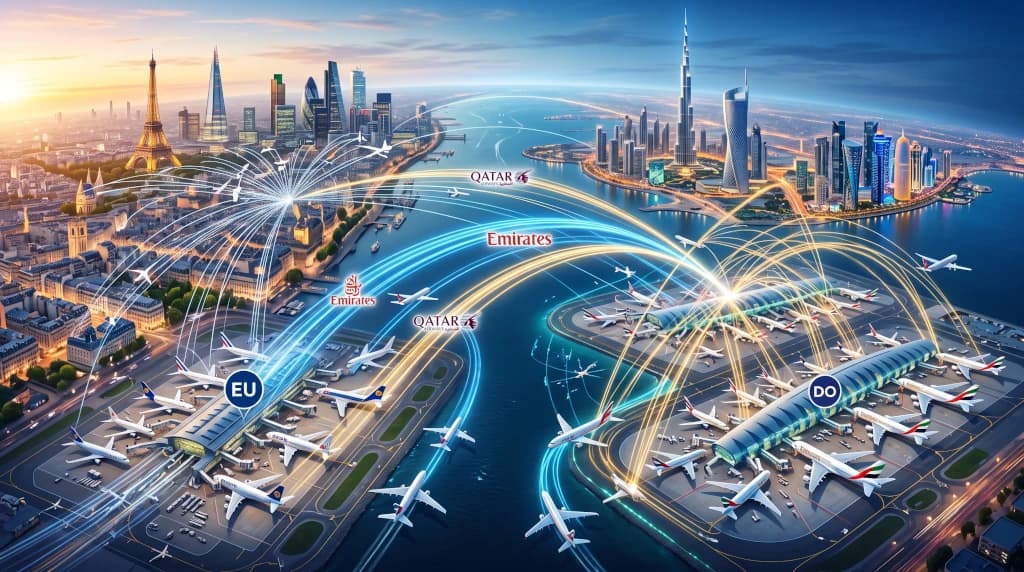
Gulf Mega-Hubs vs. Traditional Capitals: How Dubai and Doha Captured Global Transit
Introduction
Just four decades ago, the global commercial aviation map closely resembled mid-20th-century colonial trade routes. A passenger traveling from London to Sydney, Paris to Mauritius, or Frankfurt to Bangkok was resigned to multi-stop journeys operated by traditional European or American legacy flag carriers. Aircraft made scheduled refueling stops in Athens, Cairo, Karachi, or Colombo, while the undisputed capitals of intercontinental transit remained historic gateways such as London Heathrow (LHR), Frankfurt (FRA), Paris Charles de Gaulle (CDG), and New York JFK. Between Europe and Asia stretched vast desert expanses over which jets flew through the night without landing, regarding the Arabian Peninsula merely as an empty geographic flyover zone.
Today, that traditional aviation order lies in ruins. Dubai International (DXB) has cemented its status as the world's busiest airport for international passenger traffic, handling nearly 90 million passengers annually, while Doha's Hamad International (DOH) routinely sweeps global accolades as the world's finest airport. The Arabian Gulf carriers—spearheaded by Emirates and Qatar Airways—have pushed Western European network airlines into a defensive posture, capturing high-yield long-haul connecting traffic. How did two cities raised from desert sands dethrone century-old Western metropolises? The answer lies in the unyielding geometry of the terrestrial globe, fleet scale, an unconstrained 24/7 operating model, and a state-level symbiosis connecting government, airport, and airline.
Geography as Destiny: The Power of the 8-Hour Radius
To grasp the dominance of the Gulf mega-hubs, one must examine the globe through geodesy rather than conventional political boundaries. Dubai and Doha sit at an almost mathematically ideal intersection connecting the world's primary population and economic centers.
Within a 4-hour flight radius from Dubai or Doha reside approximately two billion people—encompassing the Middle East, the Indian subcontinent, Central Asia, East Africa, and Eastern Europe. Expanding this perimeter to an 8-hour flight radius (the operational sweet spot for both modern long-range narrow-body aircraft and standard wide-body twinjets) brings roughly two-thirds of the human population within non-stop range. This perimeter encompasses all of Europe, virtually the entirety of Asia (including China, Japan, and South Korea), and the majority of the African continent.
Traditional European gateways like London or Paris are geographically blind to the west, bounded by the Atlantic Ocean. While they serve as viable transatlantic transfer points for travelers moving from Eastern Europe or the Middle East to North America, they are poorly positioned to capture the fastest-growing trade and migration flows of the 21st century: Africa to Asia, Europe to Australasia, or India to North America. Dubai and Doha effectively linked any two points on Earth with a single transfer via the One-Stop-to-the-World commercial model.
Fleet Architecture: The Scale of Pure Wide-Body Operations
Prime geographic positioning is worthless without appropriate operational assets. While European legacy carriers hesitated over fleet rationalization—maintaining fragmented, multi-type inventories—the Gulf carriers committed to a bold fleet doctrine: maximum capacity, modern composite airframes, and structural fleet commonality.
1. Emirates: The Airbus A380 and Boeing 777 Empire
Emirates built a mainline business model entirely on wide-body aircraft, operating zero narrow-body airframes. The backbone of this operation centers on two aircraft types: the double-decker Airbus A380 (over 115 airframes in service) and the long-range twin-engine workhorse, the Boeing 777-300ER. This narrow fleet focus yields decisive economies of scale:
- Unit Cost Reduction (CASK): An Airbus A380 flying with an 85% passenger load factor into Dubai generates a Cost per Available Seat Kilometer (CASK) substantially lower than smaller competitor wide-bodies.
- Route Densification: Emirates operates up to six daily flights between London Heathrow and Dubai utilizing solely A380 aircraft, moving thousands of transit passengers into its desert connecting bank within a single 24-hour cycle.
2. Qatar Airways: Fleet Agility and the Benchmark Qsuite
Doha's strategy evolved with distinct technical nuances. Qatar Airways assembled a versatile long-haul fleet centered on high-efficiency composite twinjets: the Airbus A350-900/1000 family and the Boeing 787-8/9 Dreamliner. This composition grants the carrier operational agility to open routes into secondary and tertiary markets—such as Lyon, Adelaide, Da Nang, or Kraków—feeding regional feed directly into Doha's intercontinental waves.
Simultaneously, the launch of Qatar's signature business class product, the Qsuite—featuring closing privacy doors, double beds, and convertible four-person quad suites—established a premium benchmark that European and American legacy carriers struggled to match for nearly a decade.
State-Aviation Symbiosis: Why the West Struggles to Compete
The ascendancy of Dubai and Doha is more than an aeronautical feat; it stems from fundamentally contrasting macroeconomic and regulatory environments. In North America and Europe, airports, airlines, and air traffic control providers operate as fractured, frequently conflicting commercial entities constrained by stringent antitrust laws, night curfews, and environmental mandates. In the Arabian Gulf, aviation functions as a unified national strategic triad: government leadership, airport authorities, and the national flag carrier advance a single economic agenda.
1. Absence of Night Curfews: The 24/7 Transit Machine
A primary structural advantage enjoyed by DXB and DOH is the total absence of night flight restrictions. Major European hubs including Frankfurt, Munich, London Heathrow, and Zurich enforce strict night curfews for noise abatement—effectively shutting down commercial flight operations between 23:00 and 05:00 or 06:00. Aircraft sit idle on terminal aprons, accumulating capital lease costs without generating seat revenue.
In Dubai and Doha, the primary operational transfer peak (the core rush bank) unfolds precisely during the night: between 00:00 and 04:00. Heavy inbound waves arrive from Southeast Asia and Australia, passengers connect across air-conditioned terminal concourses, and outbound departures launch toward Europe to arrive at prime morning slots. As a result, Gulf carrier daily aircraft utilization rates regularly exceed 14 to 15 flight hours per day, compared to 10 to 11 hours typical of Western legacy airlines.
2. Decisive Capital Investment and Rapid Infrastructure Delivery
While London Heathrow's third runway expansion stalled across decades of legal challenges and environmental reviews, and the construction of Berlin Brandenburg Airport turned into a protracted operational delay, infrastructure delivery in the United Arab Emirates and Qatar moves forward deliberately. The multi-phase development of Dubai World Central / Al Maktoum International (DWC)—engineered for an ultimate capacity exceeding 260 million annual passengers—alongside Doha Hamad's expansion featuring "The Orchard" indoor botanical concourse, reflects long-term planning backed by swift capital deployment.
The Passenger Experience: The Airport as a Destination City
Traditional European airports developed in the 1960s and 1970s functioned primarily as utilitarian processing halls: border control desks, basic gate seating, cramped restrooms, and standard newsstands. The Gulf hubs recognized passenger psychology: if a traveler must complete a 2- to 4-hour middle-of-the-night layover between 10-hour flight sectors, the airport cannot be a mere waiting area—it must function as a seamless, self-contained destination.
Operational design signatures that transformed industry standards at DXB and DOH include:
- Optimized Minimum Connection Times (MCT): Despite massive terminal footprints, concourse layouts prioritize swift transit flows. Specialized transfer screening checkpoints process thousands of passengers per hour with minimal queue friction.
- Flagship Business Class Lounges: Facilities like Qatar Airways' Al Mourjan Business Lounge in Doha or the multi-level Emirates Lounges in Dubai span entire concourse levels, offering à la carte dining, private rest pods, and hotel-standard shower suites.
- High-Turnover Retail Ecosystems: Duty-free zones in DXB and DOH generate billions in commercial revenue, combining conventional retail with luxury boutiques, gold bullion counters, and high-value lottery sweepstakes.
Legacy Hubs at the Crossroads: Western Strategic Responses
For years, European and American airline leadership accused Gulf competitors of receiving state market distortion, subsidized fuel, and uncommercial infrastructure support. While regulatory bodies and politicians debated open-skies frameworks, travelers consistently selected Gulf carriers based on younger aircraft fleets, elevated in-flight service, and competitive pricing.
In response, Western legacy airlines adjusted their international network blueprints:
- Consolidation into Megacarrier Groups: Holding companies including IAG (British Airways, Iberia), Air France-KLM, and the Lufthansa Group trimmed marginal routes to secondary Asian cities, refocusing wide-body operations on their protected transatlantic joint ventures over the North Atlantic.
- Strategic Commercial Partnerships: Rather than engaging in direct head-to-head route wars, several Western airlines opted for deep commercial tie-ups. Notable examples include Qantas shifting its historic "Kangaroo Route" European stopover hub from Singapore to Dubai under an extensive partnership with Emirates, and British Airways forging close codeshare integrations with Qatar Airways inside the oneworld alliance.
- Ultra-Long-Haul Point-to-Point Flights: To bypass Gulf transfer hubs altogether, carriers are investing in extended-range variants. Qantas's "Project Sunrise" deploys custom-configured Airbus A350-1000ULH aircraft to link Sydney and Melbourne non-stop with London and New York on 20-plus-hour flight sectors.
Structural Headwinds: Emerging Challenges for Gulf Megahubs
Despite their established dominance, the commercial model underpinning Dubai and Doha faces evolving structural, competitive, and geopolitical pressures.
1. Geopolitical Volatility and Airspace Closures
The Persian Gulf sits directly adjacent to volatile flight corridors. Escalating Middle Eastern security tensions and subsequent airspace restrictions over territories like Iran, Iraq, and the southern Levant funnel air traffic into increasingly narrow arrival and departure tracks. Tactical flight routing detours consume extra fuel tonnage, elevate operating costs, and disrupt connecting banks.
2. Regional Rivalry: The Emergence of Riyadh Air and Saudi Vision 2030
The immediate competitive challenge to DXB and DOH originates not from legacy Europe, but from neighboring Saudi Arabia. Under its "Vision 2030" economic blueprint, Riyadh is deploying hundreds of billions of dollars to build a global mega-hub alongside Riyadh Air, backed by substantial wide-body order books. Saudi Arabia aims to establish its own intercontinental transit corridor, supported by sovereign wealth capital and a sizable domestic origin-and-destination passenger base.
3. The Rise of Point-to-Point Long-Range Aircraft
The continuous refinement of ultra-long-range narrow-body aircraft (such as the Airbus A321XLR) and long-range mid-size wide-bodies (Boeing 787) enables point-to-point operations that bypass mega-hubs entirely. High-value business travelers increasingly prefer direct flights connecting secondary cities—such as Manchester to Delhi or Milan to Hanoi—over a 02:00 AM transit connection in the Gulf.
Conclusion: A Permanent Shift in the Center of Global Aviation
The migration of global transit traffic to the Persian Gulf represents one of the most consequential structural realignments in modern transportation history. Dubai and Doha transformed from regional desert trading posts into central engines of global connectivity, dismantling the long-held Western monopoly on intercontinental flight routing.
While legacy European gateways remain vital origin-and-destination metropolitan centers, the Gulf hubs set the modern benchmark for high-volume, international passenger transfers. Even as regional competition from Saudi Arabia rises and new point-to-point aircraft technologies emerge, the Gulf mega-hubs have permanently redrawn the world's airways. For the contemporary intercontinental traveler flying between East and West, global aviation's commercial core now pulses through the round-the-clock terminals of Dubai and Doha.