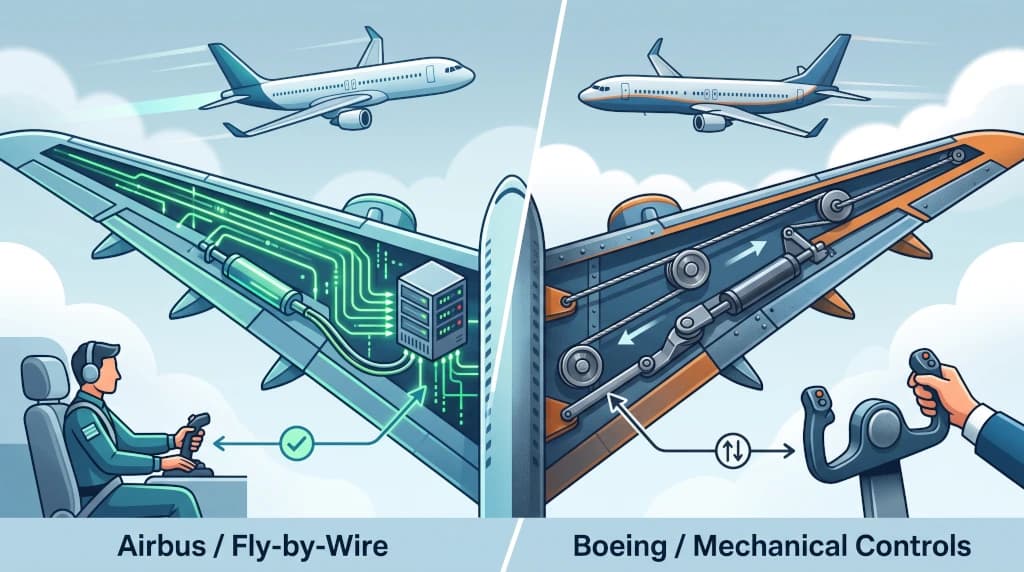
Fly-by-Wire vs. Control Columns: Airbus and Boeing Philosophies
Introduction
In the realm of commercial aviation, few subjects generate as much passionate, enduring debate as the contrasting design philosophies that govern flight decks and aircraft control systems. Since the dawn of the jet age, airline pilots relied on a direct, physical connection to their control surfaces. Steel cables, pushrods, pulleys, and hydraulic booster valves meant that the aerodynamic forces acting on elevators, rudders, and ailerons were directly transmitted to the control column in the captain's hands. The aircraft functioned as a mechanical extension of human muscle and instinct, with the pilot serving as the absolute, undisputed master of the machine.
Everything changed in 1987 with the maiden flight of the narrow-body Airbus A320. The European planemaker broke decisively with tradition by introducing commercial digital Fly-by-Wire (FBW) on a mass scale, replacing the central control column with a sidestick and embedding "hard envelope protections" where onboard computers retain final authority over critical flight parameters. In response, Boeing adopted a distinct design philosophy for the 777 and 787 Dreamliner: integrating advanced Fly-by-Wire technology while retaining the traditional central control yoke and granting the pilot ultimate authority to override computer flight envelope limits in extreme emergencies. Here is an in-depth examination of this fundamental clash of aeronautical philosophies through the eyes of airline pilots.
From Steel Cables to Digital Buses: The Evolution of Flight Controls
To fully appreciate the divergence between Toulouse and Seattle, one must first examine how mechanical linkages gave way to digital data networks. In classic airliners (such as the Boeing 707, 727, and early 737 generations), manipulating the yoke actuated steel control cables running through pulleys to position mechanical valves in hydraulic actuators (hydro-mechanical flight control systems).
As airliner mass and operating speeds increased, purely mechanical architectures reached clear physical limitations:
- Weight and Mechanical Wear: Kilometers of steel cables, hundreds of guide pulleys, and complex thermal expansion tensioners added significant weight and required labor-intensive maintenance.
- Lack of Dynamic Flight Envelope Protection: Purely mechanical systems could not automatically prevent aerodynamic stalls, structural overstress ($+2.5g$ / $-1.0g$), or high-speed overshoots resulting from pilot spatial disorientation or severe turbulence.
Fly-by-Wire (FBW) replaced mechanical links with digital data buses and electrical signaling (such as ARINC 429 and ARINC 629). Pilot control inputs are measured by linear or rotary variable differential transformers (LVDT/RVDT), routed to redundant flight control primary computers, processed through flight control laws, and sent as command signals to electro-hydraulic actuators (EHA) driving the control surfaces.
The Airbus Philosophy: Hard Envelope Protection and Digital Optimization
The Airbus flight control philosophy, pioneered under the engineering leadership of Bernard Ziegler, is rooted in a clear human-factors premise: under extreme physiological stress, spatial disorientation, or sudden collision avoidance maneuvers (such as CFIT or TCAS resolution advisories), human pilots can make catastrophic control inputs—inadvertently stalling the aircraft, entering an unrecoverable spin, or structurally compromising the airframe through excessive load factors.
1. Flight Control Laws: Normal Law and Hard Limits
Under standard operational status (Normal Law), an Airbus will not permit the pilot to exceed defined aerodynamic and structural parameters, regardless of how aggressively the sidestick is deflected:
- High Angle of Attack Protection (High AoA / $\alpha$-Protection): As the angle of attack reaches $\alpha_{\text{prot}}$, the flight control computers take over pitch trim and prevent the aircraft from exceeding $\alpha_{\text{max}}$, even if the pilot holds the sidestick fully aft.
- Bank Angle Protection: Sidestick deflection commands roll up to a maximum bank angle of 67°. Releasing the stick causes the aircraft to auto-recover and hold a standard 33° bank angle.
- Load Factor (G-Load) Protection: Flight control computers actively limit structural acceleration between $+2.5g$ and $-1.0g$ in clean configuration ($+2.0g$ to $0g$ with flaps extended).
- High-Speed Protection: If the aircraft exceeds maximum design operating limits ($V_{\text{MO}}/M_{\text{MO}}$), the system introduces a nose-up pitch command to prevent flutter and structural damage.
2. The Passive Sidestick Architecture
Across the modern Airbus family (from the A320 to the A350 and A380), the traditional control column is replaced by a sidestick mounted on the outboard console of each pilot seat. This layout opens the forward cockpit space, allowing for a retractable work table used for meal services and electronic flight bag (EFB) documentation.
A distinctive feature of classic Airbus sidesticks is their passive, uncoupled design. The first officer's sidestick does not mechanically mirror inputs made on the captain's stick. If both pilots input commands simultaneously, the flight control computers sum the deflections algebraically (a Dual Input condition), triggering visual and audio warnings until one pilot presses and holds the sidestick Takeover Priority Button.
The Boeing Philosophy: Pilot Authority and Soft Envelope Protection
While Boeing embraced advanced digital Fly-by-Wire systems on the 777 and 787, the American airframer maintained its traditional operational doctrine: the licensed flight crew holds ultimate responsibility for the safety of the flight and must retain the physical means to override all automated systems.
1. Soft Protections on the Boeing 777 and 787
On Boeing Fly-by-Wire aircraft, the Primary Flight Computers (PFC) provide robust envelope protection, but act as an advisory barrier rather than an absolute block:
- As the aircraft approaches high angles of attack or bank angles exceeding 35°, the system progressively increases control column backdrive resistance (tactile force feedback).
- However, if a tactical scenario demands an extreme maneuver (such as severe terrain avoidance or collision avoidance), the pilot can overpower the artificial breakout force and fly beyond standard limits, trading airspeed for instantaneous lift or pulling maximum available $g$ to recover the aircraft.
2. The Active, Cross-Coupled Control Column
Boeing deliberately retained a substantial central control column between the pilot's knees. Crucially, the captain's and first officer's control columns and rudder pedals remain mechanically or electronically linked (Cross-Cockpit Coupling). When the captain pulls aft on the yoke, the first officer's yoke moves in precise synchronization in real time.
This provides immediate, non-verbal situational awareness—each pilot instantly feels and sees the inputs applied by the other, as well as the active control adjustments commanded by the autopilot system.
Thrust Management: Moving Throttles vs. Detent Autothrust
The philosophical divergence extends beyond primary flight controls to the engine thrust management systems (Autothrottle vs. Autothrust).
Boeing Autothrottle: Backdriven, Moving Levers
Boeing flight decks feature servo-driven thrust levers that physically travel forward and backward in response to automated power commands. When the autothrottle increases thrust on climb or pulls power during descent, the levers move accordingly. A pilot resting a hand on the throttle quadrant retains immediate, tactile awareness of engine energy state without diverting their scan from the primary flight display.
Airbus Autothrust: Fixed Detent System
On an Airbus, following takeoff and initial climb thrust reduction, the thrust levers are placed in a fixed mechanical gate—the CL (Climb) detent—and remain stationary throughout cruise and descent. The Full Authority Digital Engine Control (FADEC) continuously modulates fuel flow and engine power electronically without moving the flight deck levers. Engine power changes are monitored purely through digital readouts on the Engine/Warning Display (E/WD).
In the Cockpit: Operational Perspectives from Line Pilots
Pilots with operational type ratings across both manufacturers note distinct advantages and trade-offs inherent to each design philosophy.
Airbus System Strengths:
- Cockpit Ergonomics: The absence of a large central yoke provides significant workspace flexibility, easy deployment of the fold-out table, and unobstructed access to instrument displays.
- Automatic Trim: In Normal Law, Airbus aircraft automatically maintain pitch trim in coordinated turns and speed changes, eliminating the need for manual trim wheel adjustments.
- Deterministic Protection under Stress: In sudden low-altitude emergency recovery (such as microburst windshear escapes), flight crews can apply full aft sidestick with total confidence that the aircraft will extract maximum lift ($\alpha_{\text{max}}$) without entering a stall.
Airbus System Considerations:
- Absence of Tactile Cross-Cockpit Feedback: The lack of mechanical coupling between sidesticks requires strict verbal cross-monitoring, as subtle control inputs made by one pilot are not felt on the opposite control stick.
- Flight Control Law Degradation: Multiple sensor disagree events (such as uncommanded pitot-static icing) trigger automatic reconfiguration into Alternate Law or Direct Law, removing hard protections and requiring immediate reversion to conventional manual flying techniques and trim handling.
Boeing System Strengths:
- Instant Kinesthetic Awareness: Interlinked yokes and motorized thrust levers supply continuous tactile and peripheral visual cues regarding aircraft control status and autopilot activity.
- Unrestricted Flight Authority: Pilots retain complete mechanical authority to exceed design limits if deemed necessary to avoid an imminent surface collision or mid-air impact.
Boeing System Considerations:
- Cockpit Footprint: The central control column occupies significant cabin volume in front of the pilot seats, precluding built-in tray tables and requiring side-mounted tablet cradles for flight documentation.
- Manual Trim Demands: Boeing FBW logic deliberately simulates classic aircraft stability, requiring pilots to actively manage speed trim switches on the yoke during manual flight.
Modern Convergence: Active Sidesticks in Next-Generation Aircraft
In modern aerospace design, the sharp dichotomy between Airbus and Boeing architectures is gradually converging toward hybrid configurations. This is visible in regional and business aviation platforms such as the Airbus A220 (originally the Bombardier CSeries) and the Gulfstream G500/G600.
These aircraft employ Active Sidesticks, blending the ergonomic benefits of an open flight deck with electronically linked servo motors. When one pilot inputs a command, the opposite stick moves in direct harmony. Furthermore, active sidesticks generate synthetic tactile resistance, artificial force cues, and stick-shaker stall warnings. This architectural choice demonstrates the industry's growing interest in combining the ergonomic footprint of sidesticks with tactile feedback.
Conclusion: Parallel Paths to Flight Safety
The debate between Airbus and Boeing control philosophies features no single winner; both represent highly evolved, rigorously certified engineering pathways. Airbus built its modern fleet architecture on the conviction that digital flight control laws should safeguard the aircraft against human performance limitations. Boeing grounded its philosophy in classic aviation tradition, ensuring flight crew judgment and authority remain the ultimate barrier in unusual operating regimes.
Both manufacturers demonstrate exceptional, nearly identical safety records that define the most reliable era in commercial aviation history. Whether managed by deterministic Normal Law logic through an outboard sidestick or commanded through a backdriven control column, flight safety ultimately rests on rigorous training, clear standard operating procedures, and effective crew resource management.