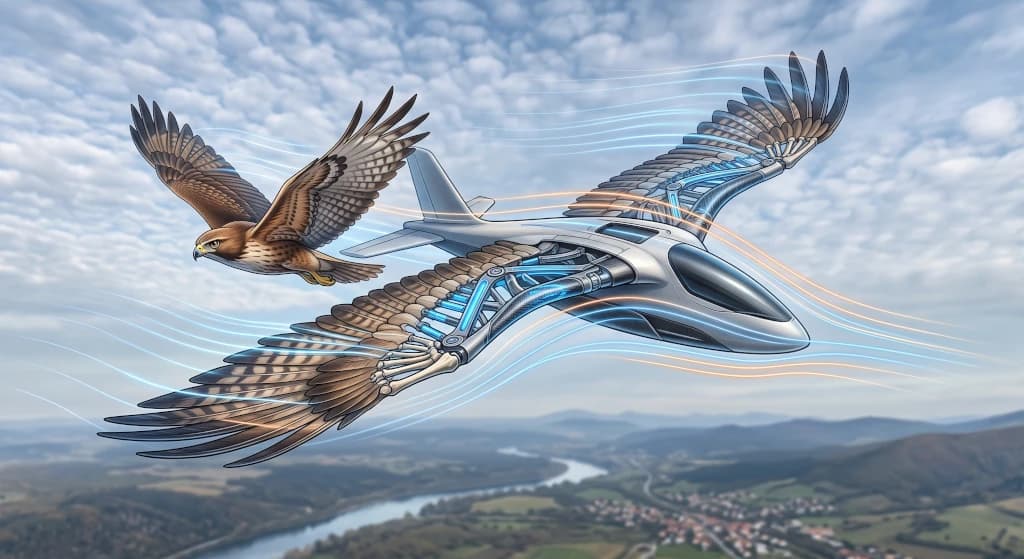
Shape Memory Wings and Biomimetics: How Nature Inspires Aircraft Aerodynamics
Introduction
When the Wright brothers took to the skies above the dunes of Kitty Hawk in 1903 aboard their Flyer I, their craft featured no rigid metallic ailerons. Orville and Wilbur controlled lateral roll by mechanically twisting the flexible, wood-and-canvas wingtips—a technique known as wing warping, inspired by observing soaring buzzards. Over the following decades, however, as aircraft speeds and operational weights surged, aeronautical engineering pivoted toward uncompromising structural rigidity. Wings evolved into massive duralumin and titanium torsion boxes, packed with heavy hydraulic actuators, complex hinge tracks, slotted flaps, and leading-edge slats that extend with mechanical grind to carve aerodynamic gaps into the lifting surface.
Today, after more than a century dominated by rigid aerostructures, aerospace design is coming full circle—empowered by advancements in nanotechnology, Shape Memory Alloys (SMAs), and high-fidelity Computational Fluid Dynamics (CFD). In an era driven by aggressive carbon reduction targets and the pursuit of single-digit fuel burn savings, traditional wing mechanization has collided with physical boundaries. The decisive answer is biomimetics: the discipline of emulating aerodynamic mechanisms honed by evolution over hundreds of millions of years. From the primary feathers of the peregrine falcon to the serrated plumage of owls and the pectoral fins of humpback whales, nature is redefining the aerodynamic frontiers of commercial jet aviation.
The Limits of Classical Aerodynamics: Why the Fixed-Geometry Wing Is a Compromise
To appreciate why aeronautical engineers are scrutinizing avian flight, one must confront a fundamental reality of commercial airliner design: a fixed-geometry wing is an inevitable compromise.
During takeoff and landing, an aircraft requires a thick, deeply cambered airfoil profile with high surface area to generate substantial lift at low speeds (typically 250–280 km/h). Conversely, during high-altitude cruise (at 36,000 feet and Mach 0.85), optimal aerodynamic efficiency demands a slender, ultra-smooth, low-camber profile presenting the absolute minimum frontal parasitic drag.
Contemporary airliners reconcile these conflicting regimes using discrete mechanical high-lift devices, which introduce severe aerodynamic penalties:
- Parasitic Drag and Flow Disruption: As slats and flaps deploy on mechanical tracks, gaps open within the lifting body. High-pressure air bleeds across these discontinuities, generating boundary layer separation, turbulent vortices, and a steep rise in parasitic drag.
- Weight Penalties: Hydraulic actuators, ballscrews, drive shafts, and high-pressure fluid circuits driving leading- and trailing-edge surfaces add multiple metric tons of dead weight to a wide-body airframe.
- Aeroacoustic Airframe Noise: Wing mechanization accounts for nearly 70% of total aircraft airframe noise during final approach; the acoustic roar of turbulent airflow shearing across flap edge cavities and slat coves often eclipses the acoustic footprint of modern high-bypass turbofans at idle power.
Birds employ no hinges, tracks, or hydraulic pumps. Instead, they modulate camber, sweep, surface area, and spanwise twist in a seamless, continuous motion (seamless morphing), adapting to gusts and flight regimes within fractions of a second.
Morphing Wings: Smart Material Architectures
Transforming the concept of a seamless morphing wing into airworthy reality relies heavily on Shape Memory Alloys (SMAs), foremost among them Nitinol (a nickel-titanium intermetallic compound). These materials exhibit a unique crystalline property: when exposed to thermal or electrical stimuli, they undergo a reversible solid-state phase transformation between low-temperature martensite and high-temperature austenite, producing substantial mechanical recovery force while reverting precisely to a memorized parent geometry.
1. The NASA and Boeing ACTE Project: Adaptive Compliant Trailing Edge
A major milestone in variable-camber aero-structures was the joint NASA-Boeing Adaptive Compliant Trailing Edge (ACTE) flight validation program, flown on a modified Gulfstream III testbed. Engineers replaced conventional multi-segmented trailing-edge flaps with a monolithic, spanwise flexible composite structure actuated by distributed SMA mechanisms.
The control surface transitioned smoothly across deflection angles ranging from -9° to +40° over its entire span without forming spanwise gaps or surface breaks. Flight test telemetry confirmed significant performance gains:
- A 3–5% reduction in total aerodynamic drag across climb and cruise profiles, which translates into multi-million-gallon fuel savings when deployed across commercial airline networks.
- A dramatic 40% drop in aerodynamic approach noise (up to 6 dB) achieved by extinguishing the discrete vortex shedding typical of conventional slotted flap ends.
2. Electroactive Polymers and Piezoelectric Transducers
The next frontier in morphing structures integrates distributed piezoelectric ceramics directly into composite skin laminates. Under alternating electrical voltage, embedded microscopic piezoelectric patches generate high-frequency surface wave deformations. This mechanism drives Active Flow Control (AFC)—delaying the laminar-to-turbulent boundary-layer transition point and damping out turbulent skin friction along the chord.
Biomimetic Blueprints: The Flight Masters of the Natural World
Modern aerodynamic research systematically translates biological adaptations from diverse organisms into full-scale commercial aviation designs.
1. Raptor Wingtips: Winglets and Raked Tip Caps
The most ubiquitous commercial application of biomimetics is the induced-drag reducing wingtip device—known industry-wide as the winglet or, in Airbus parlance, the sharklet. When soaring raptors (such as eagles, storks, and condors) ride rising thermal columns, they splay their outermost primary feathers vertically into a slotted, stepped cascade.
The fluid mechanics are absolute: the pressure gradient between the high-pressure underside and low-pressure suction surface forces air to roll around the wingtip, shedding a concentrated vortex core that induces severe downwash and drag. Splayed biological feathers—and their carbon-composite aeronautical counterparts—diffuse this single concentrated tip vortex into multiple smaller, lower-energy vortices, driving a 4–7% reduction in induced drag.
2. The Silent Flight of Owls: Serrations and Chevron Nozzles
Owls hunt in near-total acoustic silence. Their primary feathers feature a comb-like array of micro-serrations along the leading edge, accompanied by an open, porous fringe structure along the trailing edge. This layout breaks coherent turbulent vortices into microscopic air filaments, attenuating acoustic pressure waves before they propagate.
Turbofan manufacturers including General Electric and Rolls-Royce applied these exact principles to exhaust duct geometries, introducing serrated cowl lips known as chevrons on the Boeing 787 Dreamliner and 747-8. These scalloped edges induce controlled micro-mixing between hot, high-velocity core exhaust gases and cooler bypass air, trimming community noise footprints by several decibels without thrust penalties.
3. Humpback Whale Tubercles: Resisting Aerodynamic Stall
One of the most consequential fluid-dynamic lessons originated not in the sky, but in the ocean. The 30-ton humpback whale exhibits extraordinary hydrodynamic agility while hunting schooling krill. The source of this maneuvering authority lies along the leading edge of its pectoral flippers: an array of prominent, rounded protuberances termed tubercles.
Wind tunnel investigations demonstrate that these tubercles generate counter-rotating chordwise vortices. These vortices inject momentum into the boundary layer, keeping the fluid attached across the upper surface even at severe angles of attack. Integrating biomimetic leading-edge tubercles onto wind turbine blades and experimental aerofoils yields:
- An increase in maximum stall angle of over 40%.
- Substantially improved post-stall roll and pitch controllability at low approach airspeeds.
4. Sharkskin Denticles and Micro-Grooved Riblets
Fast-swimming pelagic sharks achieve high speeds not through an ultra-smooth epidermis, but via placoid scales adorned with microscopic longitudinal channels known as riblets. These microscopic grooves pin streamwise turbulent vortices away from the skin, preventing transverse momentum exchange and lowering turbulent shear stress.
Through a joint venture between Lufthansa Technik and chemical developer BASF, this mechanism reached airline fleets as AeroSHARK—a bionic surface film featuring micro-riblets measuring roughly 50 micrometers in height. Applied across large fuselage and engine nacelle sections on Boeing 777 fleets (including Swiss and Lufthansa Cargo), this riblet skin cuts surface friction drag by more than 1%, saving hundreds of metric tons of aviation fuel per hull annually.
Formation Aerodynamics: The Airbus fello'fly Initiative
Biomimetics in commercial aviation has expanded from single airframe aerodynamics into cooperative fleet operations. Drawing direct parallels to migratory geese flying thousands of miles in disciplined V-formations, Airbus established the fello'fly research initiative.
A lead aircraft sheds strong tip vortices that induce an energetic upwash field outboard of its flight path. By stationing a trailing aircraft within this rising air current, the follower harvests wake energy to generate free aerodynamic lift, reducing required engine thrust. During long-range transatlantic flight testing with two Airbus A350 aircraft maintaining a separation of 3 kilometers, automated wake-retrieval avionics delivered a fuel burn reduction exceeding 5% on the follower aircraft, while preserving normal cabin ride comfort.
Certification and Structural Integrity Challenges
While the aerodynamic and environmental advantages of morphing biomimetic wings are compelling, clearing them for mass airline service presents rigorous engineering and regulatory hurdles:
- Aeroelastic Fatigue and Cyclic Durability: Flexible matrix skins and internal SMA actuators must endure hundreds of thousands of strain cycles across operational temperature extremes (-60°C to +50°C) without micro-cracking, matrix degradation, or composite delamination.
- Ice Protection Architecture (Anti-Ice Integration): Conventional wing leading edges rely on high-temperature engine bleed air ducts or resistive heating mats. Providing thermal anti-ice protection through a shape-memory composite structure without corrupting SMA phase-transition temperatures requires specialized electro-thermal or acoustic de-icing systems.
- Fail-Safe Airworthiness Standards: Aviation certification authorities (EASA, FAA) mandate definitive proof that, in the event of complete electrical or thermal bus failure, an active morphing wing structure will reliably revert to a predictable, structurally stable, low-drag baseline configuration (Fail-Safe Neutral State).
Conclusion: The Convergence of Aviation and Nature
More than a century after aeronautical engineering abandoned the Wright brothers' flexible surfaces in favor of unyielding metallic structures, material science and computational tools are bringing flight mechanics back to biological origins. Shape memory wings, micro-textured bionic skins, and adaptive variable airfoils are blurring the line between rigid machines and dynamic natural flight.
Over the coming decades, passengers gazing out from the cabin will no longer see slotted metal plates extending from mechanical jackscrews. Instead, they will observe a continuous, organic lifting structure that flexes and tailors its curvature to atmospheric gusts with the efficiency, calm, and grace of a raptor riding the wind. Biomimetics is no transient engineering trend—it is the foundational pathway toward a quieter, lower-emission, and aerodynamically optimized future in the skies.