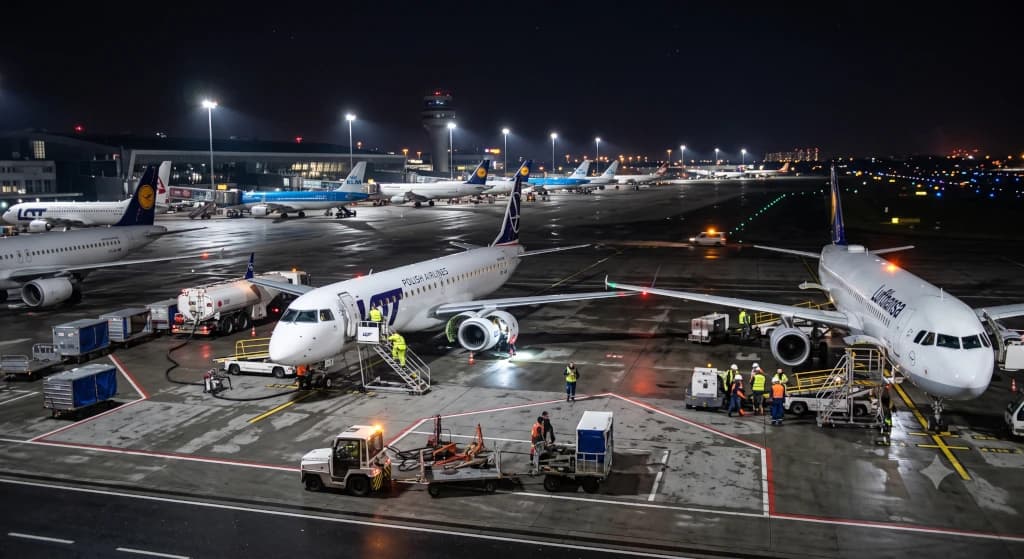
Behind the Scenes of Overnight Aircraft Parking: What Happens on the Apron While Passengers Sleep?
Introduction
When the last passenger leaves the arrivals hall and the lights in the main terminal slowly dim, most people imagine that the airport falls into a deep, hours-long slumber. Nothing could be further from the truth. As the clock strikes midnight, a fascinating, second-by-second choreographed spectacle unfolds across the apron. For engineers, mechanics, cleaning crews, and logistics teams, the night is not a time for rest, but the most intense operational window of the entire twenty-four hours. It is under the cover of darkness that the foundation for a safe and punctual morning departure peak is laid.
Overnighting an aircraft—referred to in industry parlance as a Night Stop or RON (Remain Over Night)—is a complex logistical operation. Every airline pays substantial fees for each hour an airframe sits parked on the apron, which is why this time must be utilized with absolute precision. While passengers sleep soundly in their beds or await early morning flights, activity buzzes around these multi-ton giants. Let us take a closer look at the nocturnal life of an airport and what happens to commercial aircraft before they take to the skies at dawn.
Arrival Procedures and Initial Post-Landing Handling
The night shift begins as the final scheduled evening flights touch down on the runway. After clearing the taxiway, the aircraft is guided by a marshaller or an automated Visual Docking Guidance System (VDGS) to its designated stand. Before technicians touch the airframe, the de-boarding process must take place, with passengers exiting swiftly and their checked luggage being unloaded from the cargo holds.
As the turbofan engines spin down, external ground power sources are connected. The landing gear wheels are secured with heavy-duty rubber or metal chocks, and bright protective covers are fitted around engines and sensitive sensors. At this point, custody of the aircraft shifts from the flight crew (pilots and flight attendants) to line maintenance engineers and ground handling personnel.
The first critical step involves connecting a Ground Power Unit (GPU) or plugging into a fixed electrical connection at the gate stand. This allows the aircraft's onboard Auxiliary Power Unit (APU) to be shut down, significantly reducing fuel burn and noise pollution across the apron during nighttime hours. On sweltering summer nights or during freezing winter freezes, flexible Pre-Conditioned Air (PCA) ducts are also attached to the fuselage to maintain optimal cabin temperatures throughout the overnight stay.
Overnight Technical Inspection: A Mechanic's Trained Eye
At the heart of overnight aircraft servicing lies a comprehensive technical inspection. Commercial airliners are governed by rigorous maintenance schedules, and overnight parking offers the ideal opportunity to carry out a Daily Check or a Weekly Check, depending on manufacturer specifications and airline maintenance protocols.
Armed with high-powered flashlights, specialized endoscopes, and mobile diagnostic laptops, avionics and mechanical technicians begin the Walk-Around—a meticulous visual inspection of the airframe. Every square inch of the aircraft surface undergoes scrutiny:
- Engine Condition: Mechanics inspect the fan and compressor blades for foreign object debris (FOD) damage or signs of bird strikes. Engine oil levels are checked and replenished, and fuel and hydraulic lines are inspected for leaks.
- Landing Gear and Brake Assemblies: Nighttime provides the necessary window to precisely measure brake disc wear and tire tread depth. Given the tremendous kinetic forces exerted during landing, tires must adhere strictly to pressure and groove-depth thresholds. If a brake pack or tire requires replacement, overnight technicians execute the swap within minutes using heavy-duty hydraulic jacks.
- Airframe and Control Surfaces: Flaps, slats, ailerons, and rudders are inspected for structural integrity. Technicians look for hairline cracks, loose rivets, or lightning strike entry and exit points that might go unnoticed during rapid daytime turnarounds.
- Emergency Equipment: Inside the cabin, technicians verify expiration dates and operational readiness of life vests, oxygen bottles, fire extinguishers, and emergency path lighting.
Refueling, Sanitation, and Resource Replenishment
While mechanics conduct technical checks, a fleet of specialized airport service vehicles maneuvers around the airframe. Sanitation and servicing teams perform essential tasks without which the morning flight could not depart.
1. Potable Water and Lavatory Service
One of the initial servicing tasks involves waste tank evacuation. A dedicated lavatory service truck approaches the rear fuselage. Waste tanks are drained, flushed with disinfecting solution, and charged with odor-neutralizing chemicals. Simultaneously, a separate, strictly monitored water truck replenishes the aircraft's onboard potable water tanks. To prevent any cross-contamination risk, airport operating procedures strictly forbid the same technician from servicing both water and lavatories.
2. Overnight Refueling
Refueling an aircraft overnight requires strict safety protocols. The required fuel upload is calculated based on the flight plan for the upcoming morning sector, accounting for payload estimates, weather conditions, and alternate route requirements. Jet A-1 fuel is pumped either from mobile bowsers or directly from underground hydrant systems embedded in the apron concrete. Throughout the refueling process, the aircraft remains electrically grounded to prevent electrostatic discharge.
Overnight Detailing: Deep Cleaning the Passenger Cabin
While technical teams work outside, a cleaning crew transforms the interior. Overnight cabin cleaning (a Deep Clean) differs dramatically from the quick transit clean performed during a 30-minute daytime turnaround.
Over the course of several hours, the cabin undergoes thorough reconditioning:
- All carpets and passenger seats are thoroughly vacuumed.
- Trained personnel sanitize tray tables, armrests, overhead PSU controls, and seatbelt buckles using approved, non-corrosive aviation disinfectants.
- Lavatories and galleys undergo deep cleaning and sanitization.
- Headrest covers are refreshed, and seatbelts are neatly folded and aligned across seat cushions to present a polished appearance for early morning boarding.
- Cabin windows are cleaned of smudges and residue, ensuring clear views for departing passengers at sunrise.
Catering Logistics and Cabin Supply
In the early morning hours, typically between 3:00 AM and 5:00 AM, high-lift catering trucks approach the aircraft doors. Used service trolleys from the previous day are offloaded, and fresh carts stocked with meals, beverages, duty-free merchandise, and galley supplies are loaded onboard.
Catering personnel position the trolleys precisely within the forward and aft galleys, verifying security seals. Simultaneously, fresh blankets, pillows for premium cabins, and updated inflight magazines or reading materials are delivered and placed in seat pockets.
Morning Pre-Flight Briefing: Handover to the Flight Crew
Approximately one hour before the Scheduled Time of Departure (STD), the morning flight crew—the captain, first officer, and cabin crew—arrives at the aircraft. The overnight shift leads hand over the airframe along with completed technical logs and maintenance sign-offs.
Pilots conduct their own pre-flight walk-around inspection, reviewing the Technical Logbook to ensure all maintenance actions performed overnight have been properly cleared and signed off by certified engineers. In the cockpit, flight plans are loaded into the Flight Management Computer (FMC/FMGS), navigation alignment is verified, and the cabin crew conducts safety equipment checks throughout the interior.
Conclusion: The Silent Engine Driving Global Aviation
Overnight aircraft handling on the airport apron is an intricate, essential operation without which modern commercial aviation would grind to a halt. Beneath the nighttime sky, hundreds of skilled professionals—mechanics, engineers, truck drivers, cleaners, and logistics coordinators—work seamlessly to ensure that every airframe is fully airworthy, spotless, and ready for departure.
The next time you board a 6:00 AM departure, taking your seat amidst the smell of fresh coffee and looking out at a gleaming fuselage in the early morning sun, remember that this flawless state is the result of dedicated, precise teamwork carried out while the rest of the world was fast asleep.