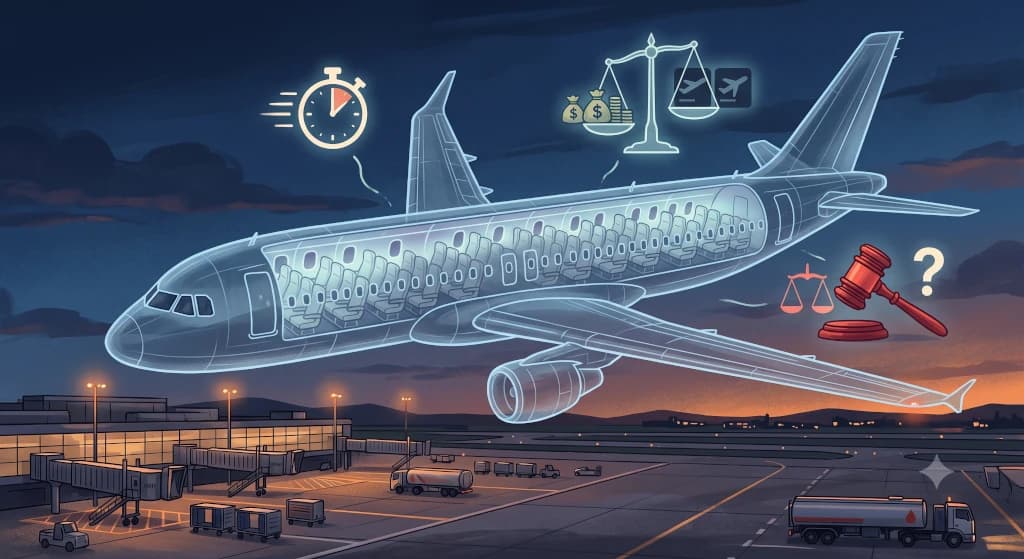
Ghost Flights: Why Did Airlines Fly Empty Planes and Is It Still Legal?
Introduction
Imagine a massive wide-body jet capable of seating nearly three hundred passengers, majestically taxiing down the runway of one of Europe's largest hub airports. The aircraft consumes tons of expensive jet fuel, generates roaring engine noise, and engages cabin crew, ground handlers, air traffic controllers, and navigation systems. Yet, when the airliner ascends into the sky, its passenger cabin is eerily empty. Onboard, there are only a handful of passengers, or quite often... nobody at all besides the crew. This is not the plot of a disaster movie or a logistical glitch. It is a phenomenon known in the industry as ghost flights.
For years, this dark secret of the aviation industry remained hidden behind the facade of published flight schedules. The situation changed dramatically during recent global crises, when media and environmentalists turned a spotlight on this absurd mechanism. Why did airlines choose to send virtually empty aircraft into the sky? In an era of climate crisis, rising fuel costs, and growing public scrutiny, is this practice still legal and ongoing? Let us examine the mechanisms governing the global skies and the regulations that force carriers to fly against all economic and environmental logic.
Anatomy of a Ghost Flight: What Is It Really?
In common parlance, a ghost flight is a commercial flight operated according to an official timetable in which the seat occupancy (load factor) drops to extremely low levels—often below 10%, and in extreme cases, a rounded zero passengers. It is important to distinguish this from ferry flights, where an empty aircraft is repositioned from one base to another for operational reasons, or from private charter and evacuation flights. We are talking about scheduled commercial flights listed in reservation systems that sell tickets, yet for various reasons carry virtually no passengers.
This phenomenon has become a symbol of the rigidity of regulatory frameworks in commercial aviation. To a passenger, seeing a plane fly empty seems completely illogical—after all, every hour flown without ticket revenue represents a pure financial loss for the carrier. However, as we will demonstrate, in the twisted world of aviation law, maintaining a route and burning tons of fuel could prove cheaper for an airline than canceling the flight.
Aviation's Holy Grail: What Are Slots and the "Use-It-or-Lose-It" Rule?
The key to understanding ghost flights lies in the concept of an airport slot. In commercial aviation, a slot is a precisely allocated time window for an aircraft to land or take off at a specific, highly congested airport (known as coordinated airports), such as London Heathrow, Frankfurt Airport, New York JFK, or Tokyo Haneda.
The capacity of airspace and ground infrastructure at major global hubs has strict physical limits. Demand for morning and late afternoon landing times vastly exceeds airport capacity. Securing a peak-hour slot at Heathrow is a make-or-break matter for an airline—it forms the backbone of profitable business connections and international route networks. A single slot pair can be worth tens, or even hundreds, of millions of dollars.
To prevent a dominant carrier from hoarding or blocking attractive slot times to stifle competition, international bodies (including IATA) and national regulators instituted a strict rule known as "use-it-or-lose-it". Under traditional global standards (the Worldwide Airport Slot Guidelines), an airline must utilize at least 80% of its allocated slot series in a given season (summer or winter) to retain its historical priority (grandfather rights) for the following year.
If a carrier fails to meet this threshold and forfeits or cancels too many flights, it loses its valuable slot to a competitor. This brings us to the core dilemma: what happens when passenger demand plummets due to a global crisis, pandemic, war, or economic collapse, yet the airline is still legally required to operate 80% of its scheduled flights?
Pandemic Apocalypse: When Empty Skies Collided with Rigid Law
While isolated ghost flights occurred occasionally throughout aviation history (such as during sudden regional crises or labor strikes), the world first witnessed the phenomenon on a massive scale in the spring of 2020. International borders closed, passenger demand plunged by 90–95% almost overnight, and airlines grounded vast portions of their fleets.
Under normal conditions, European and global regulations strictly mandated the 80% slot usage rule. When the crisis hit, regulatory bodies initially clung to existing rules. Airlines faced a stark choice:
- Option A: Cancel thousands of unprofitable flights and consequently lose invaluable slot pairs at primary airports to competitors, destroying the carrier's long-term business model well beyond the crisis.
- Option B: Dispatch aircraft carrying just two or three passengers (or completely empty) into the air, burning tens of thousands of liters of fuel simply to satisfy the formal 80% slot usage requirement.
Major European and American airlines repeatedly opted for Option B. News reports and videos surfaced showing lone passengers sitting in giant long-haul airliners. The scandal sparked widespread public outrage. Environmental organizations rightly highlighted the absurdity of an industry declaring ambitious carbon-neutrality goals while generating a massive, pointless carbon footprint purely to satisfy rigid legal clauses.
Environmental and Financial Costs: Who Pays the Price?
The absurdity of ghost flights carries a tangible, painful financial and environmental toll. Commercial aviation accounts for roughly 2.5% of global anthropogenic carbon dioxide emissions. Every ton of Jet A-1 fuel burned releases approximately 3.15 tons of CO2 directly into the atmosphere.
When an aircraft the size of a Boeing 777 or Airbus A350 flies empty, fuel costs and emissions charges (such as those under the European Union Emissions Trading System, EU ETS) still hit the airline's balance sheet. Carriers repeatedly emphasized that operating ghost flights generated multi-million-dollar financial losses, costs that ultimately had to be absorbed by paying passengers through higher fares once normal operations resumed.
Beyond carbon emissions, the problem involved several broader impacts:
- Depletion of natural resources: The wasteful burning of non-renewable fossil fuels.
- Airspace congestion: Generating unnecessary operational and radio workload for air traffic controllers (ATC).
- Reputational damage: Undermining the credibility of the aviation sector's sustainability commitments.
Are Ghost Flights Still Legal? Current Regulations and Legal Reforms
In response to intense public, environmental, and industry pressure, regulators worldwide were forced to amend rigid slot allocation rules. Temporary waivers were introduced, and usage thresholds were lowered during the height of recent crises.
Where does the law stand today? The "use-it-or-lose-it" rule has returned in full force.
Under current guidelines from IATA (Worldwide Airport Slot Guidelines – WASG) as well as updated EU and UK slot regulations, the standard usage threshold has returned to 80%. As air travel has rebounded to record passenger volumes, regulatory frameworks have reverted to baseline operational norms.
Does this mean ghost flights have returned entirely? Not quite. Lessons learned during regulatory crises forced greater flexibility into the system. Modern rules incorporate justified non-utilization provisions (JNU), allowing airlines to be excused from the 80% threshold under exceptional circumstances, such as:
- Sudden airspace closures (e.g., armed conflicts, sanitary or geopolitical border bans).
- Severe natural disasters disrupting airport operations in a specific region.
- Critical infrastructure failures at a coordinated airport.
Nevertheless, market pressure means that during off-peak periods (such as winter seasons on less popular routes), airlines still operate on thin margins. If demand on a route drops unexpectedly, a carrier must carefully calculate: is it more cost-effective to fly at a loss with empty seats to safeguard a slot, or surrender the time window and risk losing market positioning?
Alternatives and the Future of Airport Slot Management
The issue of ghost flights exposed a fundamental architectural flaw in how global air traffic rights are allocated. A framework designed in the 1970s is ill-suited to the dynamic, volatile realities of 21st-century aviation. Consequently, experts have proposed systemic reforms:
Secondary Slot Trading and Market Flexibility
One proposed solution is expanding secondary slot trading between airlines. A carrier lacking sufficient demand for a route should be able to sell or lease its slot pair to another airline easily and transparently, rather than flying empty. While secondary slot trading exists in certain jurisdictions, bureaucracy and restrictive national regulations still hinder seamless transactions.
Environmental Criteria in Slot Allocation
Calls are growing to integrate environmental metrics into traditional "first-come, first-served" or 80% usage frameworks. Airlines operating newer, more fuel-efficient fleets could be granted greater slot management flexibility, while carriers generating excessive emissions through empty flights could face penalties or slot revocation.
Conclusion: A Shadow Over the Horizon
The phenomenon of ghost flights serves as a striking example of how outdated bureaucratic rules can collide with environmental and physical realities. While restoring the 80% threshold under "use-it-or-lose-it" rules maintains fair competition at congested airports, the specter of empty planes flying to preserve legal rights remains a controversial issue.
For passengers and industry observers alike, it is a reminder that commercial airspace is not just a means of travel, but a high-stakes arena for valuable global resources. Until slot allocation frameworks are fully modernized for 21st-century realities, ghost flights will remain a grim reminder of how far aviation still has to travel on its path toward true sustainability.